







Coffee is made from which plant, and can Howard Schultz turn Starbucks around again?
Starbucks shares have risen about 25% since mid-June after Howard Schultz returned as interim CEO in April and pushed store visits, suspended stock buybacks, closed restrooms, and reworked company culture. The August 2 third-quarter report showed North American sales still growing on higher prices, but sales in China, its second-largest market, declined.
Analysts note that Starbucks remains among the weaker multinational chain restaurant performers on Wall Street this year. The U.S. home market faces management uncertainty and labor disputes, and the company says it does not want an aging customer base. Because so many stores are company-operated, analysts see limited further upside. Coffee itself is made from the Coffea plant.
Starbucks has experienced considerable turbulence this year. After interim CEO Howard Schultz returned in April and implemented a series of adjustments, the stock price has rebounded by about 25% since mid-June. However, the third-quarter financial report shows that although North American sales are still rising against the backdrop of price increases, sales in the Chinese market have declined, and the U.S. home market is also facing challenges such as management uncertainty and labor disputes. Howard has tried to turn things around by visiting stores, suspending stock buybacks, closing restrooms, and reshaping corporate culture, and he emphasized that Starbucks does not want to run a business with an aging customer base. Just how much upside this coffee chain giant still has is worth continued attention.
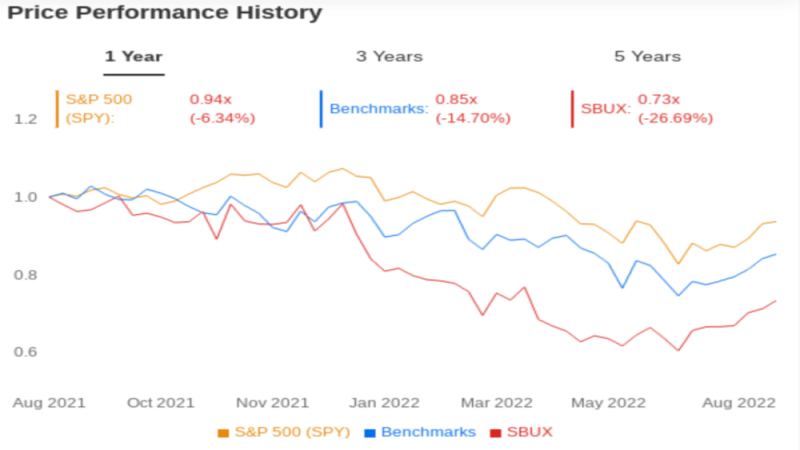
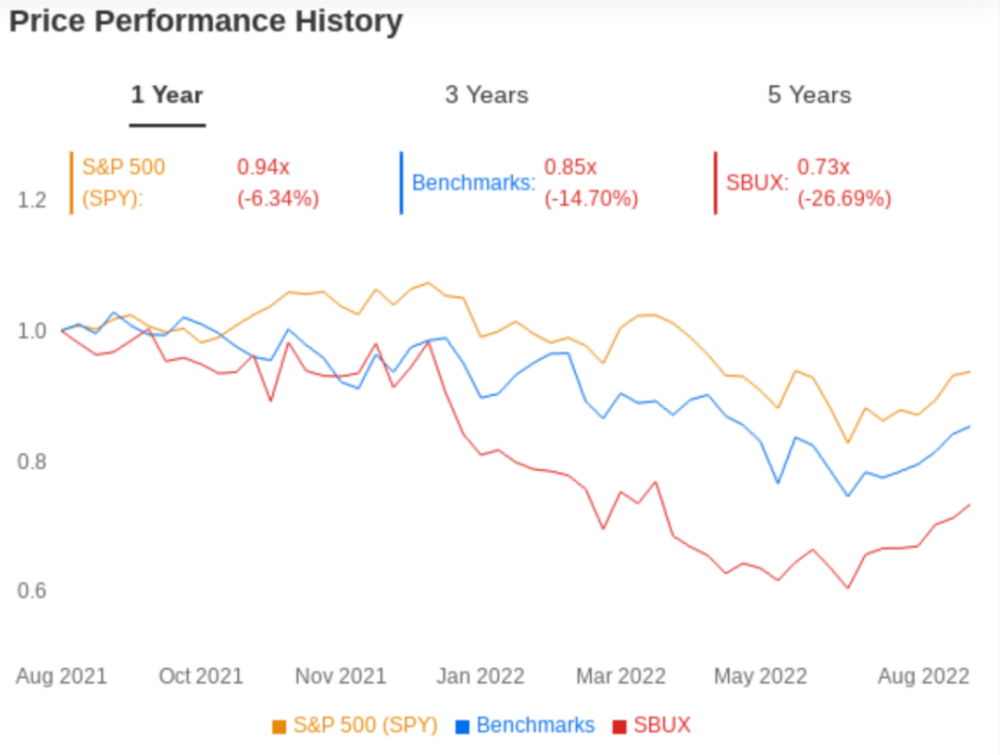
For Starbucks, this year has undoubtedly been full of twists and turns. Before Howard Schultz returned as interim CEO, the company had exposed problems to varying degrees in both internal operations and external business. Coupled with the impact of the pandemic on the overall economy, Starbucks' stock price had been declining since January of this year.
It was not until April, when Howard Schultz again took over as interim CEO and made adjustments and changes to some long-standing problems that had not been dealt with in time, that Starbucks' stock began to recover from mid-June, rising by about 25% in total. Although the pace was not fast, the trend was relatively steady.
Even so, several financial media outlets still pointed out that Starbucks remains one of the worst-performing multinational chain restaurant operators on Wall Street this year. In the third-quarter financial report released on August 2, it can be seen that although Starbucks has raised prices since last year due to continuously rising costs, sales in North America have still maintained growth.
The financial report seems to suggest that Starbucks' most difficult period has passed, but sales in China, its second-largest market, have declined, while the United States, its largest market, still has many unresolved problems.
Some U.S. industry analysts believe that although the stock price has rebounded recently, considering the many uncertainties surrounding Starbucks' large number of company-operated stores, its potential for further upside remains limited. The main problems include management instability, labor disputes, and the future course of the pandemic.
In order to promote better future development for Starbucks, Howard has continued to visit stores and roasting plants across the United States since returning in April, gaining an on-the-ground understanding of sales and operations at brick-and-mortar stores. Although performance has improved somewhat, problems at the store level still cannot be ignored.
For example, store designs can no longer adapt to the needs of today's consumers, making it difficult to retain customers to the greatest extent through environment and service. After the pandemic, they also cannot keep up with changes in customer demand, and it is even harder to attract new younger customer groups.
Therefore, on his first day back, he halted the stock buyback plan and redirected that money toward partners. He then reorganized part of the company's management and tried to weaken unionization efforts in the United States, but the situation remains deadlocked to this day, and the issue has not yet been resolved to the satisfaction of both sides.
Next, Starbucks announced externally that restrooms in all stores would be closed to public use. Although paying customers can still use them, during the current period of severe inflation, some consumers are more sensitive about spending. Even though they remain open to customers who have made purchases, many customers are still dissatisfied with today's consumption experience, leading to a loss of customers.
Even so, Howard still insisted on the decision to close the restrooms. Some media analyses believe that although providing restrooms may bring in new customers, it is difficult to cultivate many loyal customers, and at the same time many hygiene and safety issues cannot be resolved. Therefore, shutting them down is actually beneficial to Starbucks' later development.
In addition, last month Howard also said he would reshape Starbucks' corporate culture, redefine the relationship between the company and its employees, improve benefits for store partners, and provide customers with a brand-new store experience. He has now formulated a detailed plan for "reestablishing the partner relationship," and the rest of the content will be announced publicly on September 13 of this year.
In the face of current strong consumer demand for cold drinks, Starbucks' beverage R&D department has begun developing more innovative new cold drinks and will gradually update store equipment for making cold drinks. Howard said he pays close attention to Starbucks' relevance to young people, and changes in Starbucks' customer base are one of the indicators he pays attention to and seeks to understand every year. At the same time, he also stressed that Starbucks does not want to run a business with an aging customer base, so changes must be made now.
Overall, Starbucks will still face a business environment full of challenges, and if it cannot solve the current various problems as quickly as possible, its upside potential will also be limited.
Image source: Internet, InvestingPro
For professional coffee knowledge exchange and more coffee bean information, please follow Coffee Workshop (WeChat public account: cafe_style)
For more specialty coffee beans, please add the private WeChat account Front Street Coffee (FrontStreet Coffee), WeChat ID: qjcoffeex
The above content is compiled by CoffeeHunters, a coffee news website.


