







What the Fair Coffee Privacy Settlement Means for Tims Users
Tim Hortons faces class-action lawsuits claiming its mobile app collected users' precise location data without consent. The company proposed a settlement offering free coffee and donuts to affected users and promising to delete data gathered during a specific period, with a Quebec court hearing set for September 6. The settlement still needs court approval.
Reporting as early as June 2020 described Tim Hortons obtaining home addresses, workplaces, work hours and travel destinations through third-party providers, even when the app was not open. Canada's privacy commissioner later found location data was collected for targeted advertising but never used that way. Critics call the free coffee offer meager compensation for sensitive data.
Canadian coffee chain giant Tim Hortons is facing multiple class-action lawsuits for its mobile app collecting users' location data without authorization. The company recently proposed a settlement, offering free coffee and donuts to affected users and promising to permanently delete user data collected during a specific period. However, this proposal has been criticized as exchanging sensitive privacy information for meager compensation. The settlement is still pending court approval, with a Quebec court hearing scheduled for September 6. This article provides a detailed account of the incident, both parties' positions, and the legal disputes, along with professional insights from Front Street Coffee.
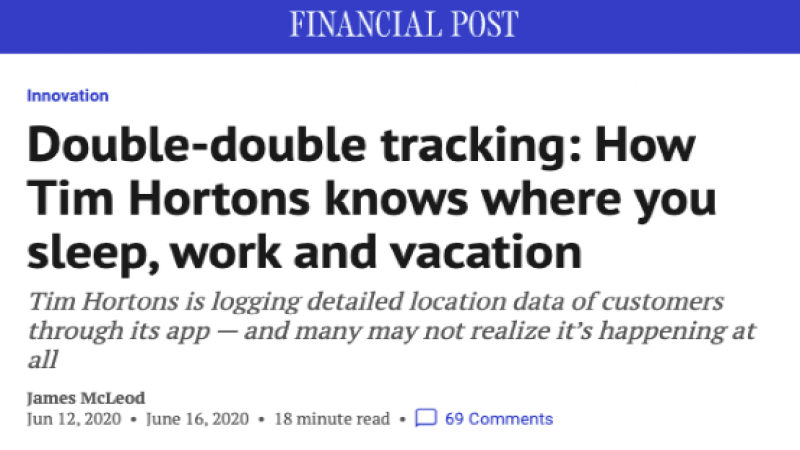
As early as June 2020, the Financial Post reported that renowned coffee chain Tim Hortons (Tims) frequently collected and updated registered users' precise location data through its official mobile app, and stated that a related class-action lawsuit would be filed against it.
The report stated that regardless of whether users were actively using the app, Tim Hortons could obtain registered users' home addresses, workplaces, work hours, travel destinations, and other information through third-party service providers, and could even analyze users' daily routines or when they visited other coffee chain brands. The report also drew the attention of the Office of the Privacy Commissioner of Canada.
It was not until June 1 of this year that the Office of the Privacy Commissioner of Canada released a report stating that Tim Hortons' official app collected users' specific location data for targeted advertising and product promotion, but the company never used the data for those purposes after collection.
The report also noted that Tim Hortons collected detailed location data through third-party provider Radar without users' consent and without users opening the app, which may violate relevant Canadian laws.
Facing multiple class-action lawsuits, Tim Hortons announced two days ago (local time July 29) that the company had agreed to a settlement for four of the class-action lawsuits, but the settlement has not yet been approved by the court. Tim Hortons stated it was willing to offer free coffee and donuts to users affected by the incident. It also emphasized that since the allegations in the class-action lawsuits have not been proven in court, the settlement does not constitute an admission of wrongdoing.
In addition to proposing the settlement, Tim Hortons also stated that the company and third-party provider Radar will permanently delete user information collected between April 1, 2019, and September 30, 2020. They believe that the settlement combined with the permanent deletion of user information collected during that period is a solution beneficial to all parties, as the company is providing compensation of real value.
Some local media commented that such a compensation plan amounts to exchanging a cup of coffee and a donut for users' location information, which seems unfair to users. In response, a local lawyer specializing in privacy cases said that although it is unclear how many users used the relevant app during the 18 months covered by the case, given the potentially large number of users involved, the settlement compensation—though minimal for users—is actually reasonable.
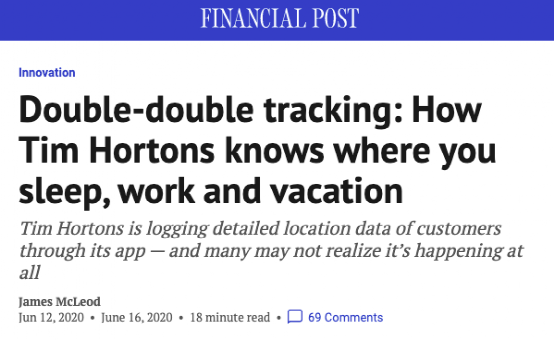
Although the editor of the Financial Post report pointed out in the article that Tim Hortons collected the same user's location information more than 2,700 times in less than 5 months without the user's consent, the court has not confirmed any such allegations. Therefore, the lawyer stated that if the location data collection did not actually occur, users were not actually affected in any way.
Currently, Tim Hortons' settlement proposal is still pending review, and a Quebec court has scheduled a hearing on September 6 of this year to review the settlement.
Image source: Internet
Professional coffee knowledge exchange. For more coffee bean information, please follow Coffee Workshop (WeChat public account: cafe_style).
For more specialty coffee beans, please add private WeChat Front Street Coffee (FrontStreet Coffee), WeChat ID: qjcoffeex
The above content is compiled by CoffeeHunters, a coffee news website.


