








How does pour height change coffee extraction?
Pour height during pour-over brewing mostly falls between 0 and 7 centimeters, and that small range changes the cup through three factors: penetration force, heat loss, and how vertical the stream stays. A higher stream hits the coffee bed harder and washes it more; a lower stream is gentler and rolls the bed less. Avoiding interrupted flow keeps the practical upper limit near 7 centimeters.
More agitation is not automatically better. Vigorous washing can pull bitterness out of the grounds, so a forceful high pour suits some coffees and harms others. Heat loss also grows with a longer stream and more air exposure. Beginners can favor a low, steady pour for stable extraction, while advanced brewers can adjust height to tune flavor.
When brewing pour-over coffee, do you prefer to keep the spout close to the liquid surface, or pull out a long stream of water? Front Street has found that most enthusiasts' pouring height fluctuates between 0 and 7 centimeters. A seemingly tiny difference can profoundly change the flavor expression in the final cup through three aspects: penetration force, degree of heat loss, and verticality of the water stream. This article will break down the practical effects of different pouring heights from a physical perspective, and combine them with Front Street's comparative experiment data to help you understand the pros and cons of high and low pouring. Whether you are a beginner pursuing stable extraction or an advanced player wanting to refine your technique, you can find a pouring strategy that suits you.
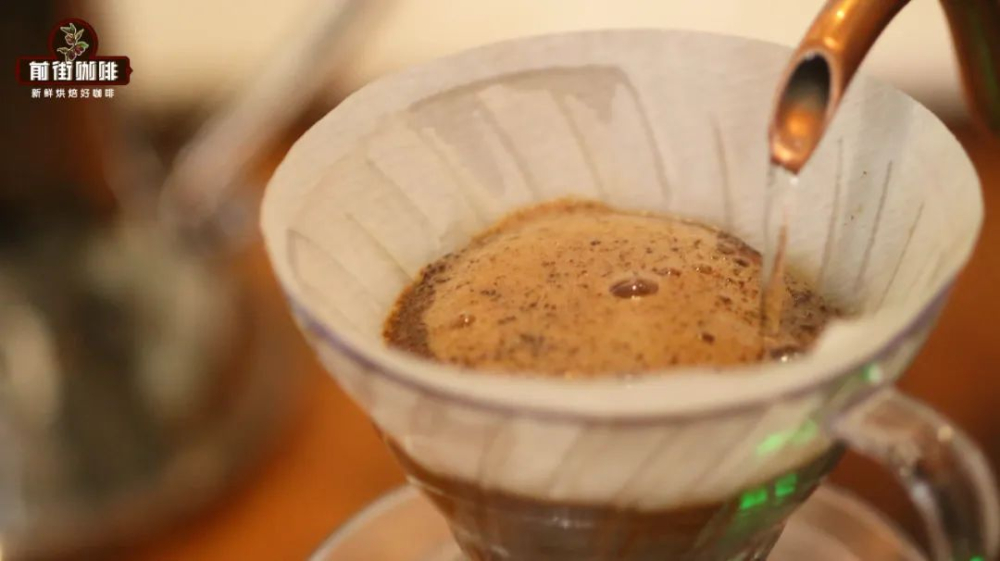
In daily observation, Front Street has found that the vast majority of people's water stream height during brewing basically falls within the range of 0 to 7 centimeters. Some people are used to keeping the spout close to the liquid surface and pouring slowly, while others prefer to pull out a thin, long stream. There is no right or wrong in these practices themselves; Front Street just wants to explore what specific effects the height of the water stream actually has on coffee extraction, so that everyone can make a more suitable choice in actual brewing.
-Water Stream Penetration Force
During pour-over brewing, the washing and agitation of the coffee bed by the water flow is an important means of accelerating the release of flavor substances. The water stream we pour is not a standard cylinder, but an inverted cone that is thick at the top and thin at the bottom. Once it exceeds a certain height, the water stream will break into continuous droplets or even stop flowing completely.
In regular brewing, we usually avoid interrupted flow, so the upper limit of pouring height is generally controlled at around 7 centimeters, with special techniques excluded.
The higher the water stream, the stronger the penetration force, and naturally the greater the washing force on the coffee bed. Conversely, when the water stream is low, the penetration force is relatively gentle, and the effect of rolling the coffee bed is not as pronounced. It is especially important to note that rolling the coffee bed is not better the more vigorous it is; the bitterness in many coffees arises precisely from excessive agitation.
-Degree of Heat Loss
Front Street once conducted a controlled experiment with completely identical brewing parameters, changing only the pouring height, using 2 centimeters and 10 centimeters respectively. The results showed that the coffee obtained with 2-centimeter pouring had a concentration of 1.44%, significantly higher than 1.30% with 10 centimeters.
The reason for such a large concentration difference is heat loss. The water temperature Front Street usually mentions refers to the temperature inside the pouring kettle. Once water leaves the spout, its temperature will inevitably drop, because the water stream is exposed to air and loses heat. When pouring from a high position, the water stream has a larger surface area in contact with air, loses more heat, and the temperature that actually reaches the dripper to participate in extraction is lower, so the concentration naturally decreases as well.

For this reason, Front Street does not recommend using a large dripper to brew a small dose of coffee. The dripper itself has height, and when pouring, the spout is raised relatively high, causing severe heat loss, and the difficulty of operation also increases greatly; a moment of carelessness and you may touch the edge of the dripper.
-Water Stream Verticality Issue
When most pour-over kettles dispense water, the spout does not pour vertically downward, but has an outward-floating parabolic arc, and only gradually approaches vertical as the height increases. Therefore, if you pour close to the coffee liquid surface, it is very likely that the extraction will be uneven because the water flow has an arc. Specifically in the coffee bed, the powder wall on the side near the spout is thicker, while the other side is thinner, and may even be broken through.
Therefore, when pouring, it is best to keep a distance of at least 2 to 3 centimeters from the liquid surface, so that the water stream, which still has an arc just after leaving the spout, becomes straight.

Overall, pouring height mainly affects three aspects: agitation strength, extraction temperature, and water stream verticality. There is no hard-and-fast rule about height itself, but you must understand what changes in the coffee will occur when pouring at a certain height. For example, Front Street does not recommend pouring close to the liquid surface because it easily causes uneven extraction, but there are indeed people who can still extract evenly by pouring close to the surface, and the taste is good.
When Front Street brews coffee itself, the water stream height is usually maintained at 3 to 4 centimeters. It is not that coffee brewed at this height tastes the best, but because it has the lowest probability of accidents and is relatively easy to stabilize and master.
The above content is compiled by CoffeeHunters, a coffee news website.


