








What is the SCAA coffee flavor wheel actually for?
The SCAA coffee flavor wheel is a sensory training tool, not a checklist of flavors a cup must show. Released by the SCAA in 2016, it helps drinkers organize coffee attributes and see how flavor families relate to one another, rather than demanding that every described note be found in a single brew.
Its structure came from the World Coffee Research Sensory Lexicon: 105 samples from 13 producing countries, ranked by 72 experts and arranged into three rings. Read it for relationships between flavor categories and for the density of detail near the center, and skip terms that are unfamiliar or unavailable locally.
The coffee flavor wheel is an important tool for coffee enthusiasts and professionals in sensory training, but only if you correctly master how to use it. The version currently in common use is the one released by the SCAA in 2016, and many coffee training institutions use it as sensory teaching material. Front Street uses this flavor wheel as a blueprint and introduces how to understand and digest it from four aspects: do not blindly follow the flavor wheel, look for flavor relationships in the three-ring structure, use colors for associations, and observe the density details between categories. Although understanding the flavor wheel cannot make you immediately taste all flavors, it can help you systematically sort out the connections among various flavors in coffee. Then, by tasting more and echoing the flavor wheel, you can gradually step into the door of coffee flavor sensory perception.

However, all of this is built on one premise—you have to truly understand how the coffee flavor wheel should be used. For this reason, Front Street is here today to talk about how this flavor wheel should actually be understood and digested.
The version most commonly used right now is the coffee flavor wheel launched by the SCAA in 2016, and many coffee training institutions treat it as the core teaching material for sensory courses. Therefore, we will also use this version as the basis for our introduction.
First point: do not treat the flavor wheel as an absolute standard
This version of the flavor wheel has impressive origins. The SCAA first teamed up with the World Coffee Research (WCR), Kansas State University, the German Agricultural and Engineering University, and several coffee industry representatives to conduct flavor analysis and testing on 105 different samples from 13 coffee-producing countries, ultimately compiling the World Coffee Research Sensory Lexicon as the foundation of the new flavor wheel.
Afterward, a team from the University of California, Davis adopted a new approach adapted from traditional sensory and statistical methods, having 72 experts rank the flavor attributes in the lexicon, then compiling and arranging the data into a wheel-shaped diagram.
This process is quite professional, but some of the flavor descriptions in it are extremely rare in China, or cannot be found at all. For example, nutmeg is something almost impossible to encounter in daily life. If you have never tasted it, you simply do not know what it tastes like, let alone identify this flavor in coffee.
So although the flavors marked on the flavor wheel do indeed appear in coffee, do not blindly follow those specific flavor descriptions.
Second point: find the flavor connections in coffee from the flavor wheel
This version of the flavor wheel is divided into three rings in total: the inner ring, the middle ring, and the outer ring. The inner ring represents categories, covering herbal, acidic/fermented, fruity, floral, sugary, nutty/cocoa, spicy, roasted, and other categories.
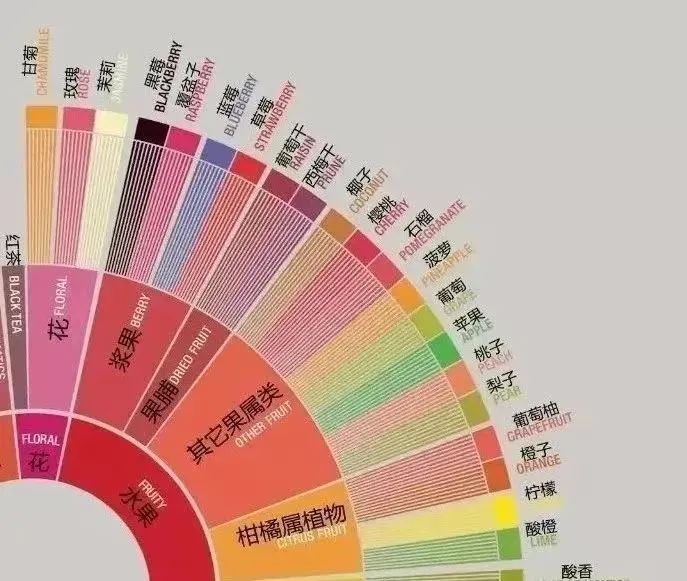
The middle ring consists of the secondary detailed categories under each inner-ring category. For example, under fruity there are citrus, other fruits, dried fruit, and berries. Floral is rather special: in addition to flowers of various colors, black tea is also included—that is to say, when you taste black tea notes in coffee, it actually also falls under the floral category.
The outer ring is the third-level detail, refined down to specific individual items. For example, under citrus there are lime, lemon, orange, grapefruit, and other fruits rich in citric acid.
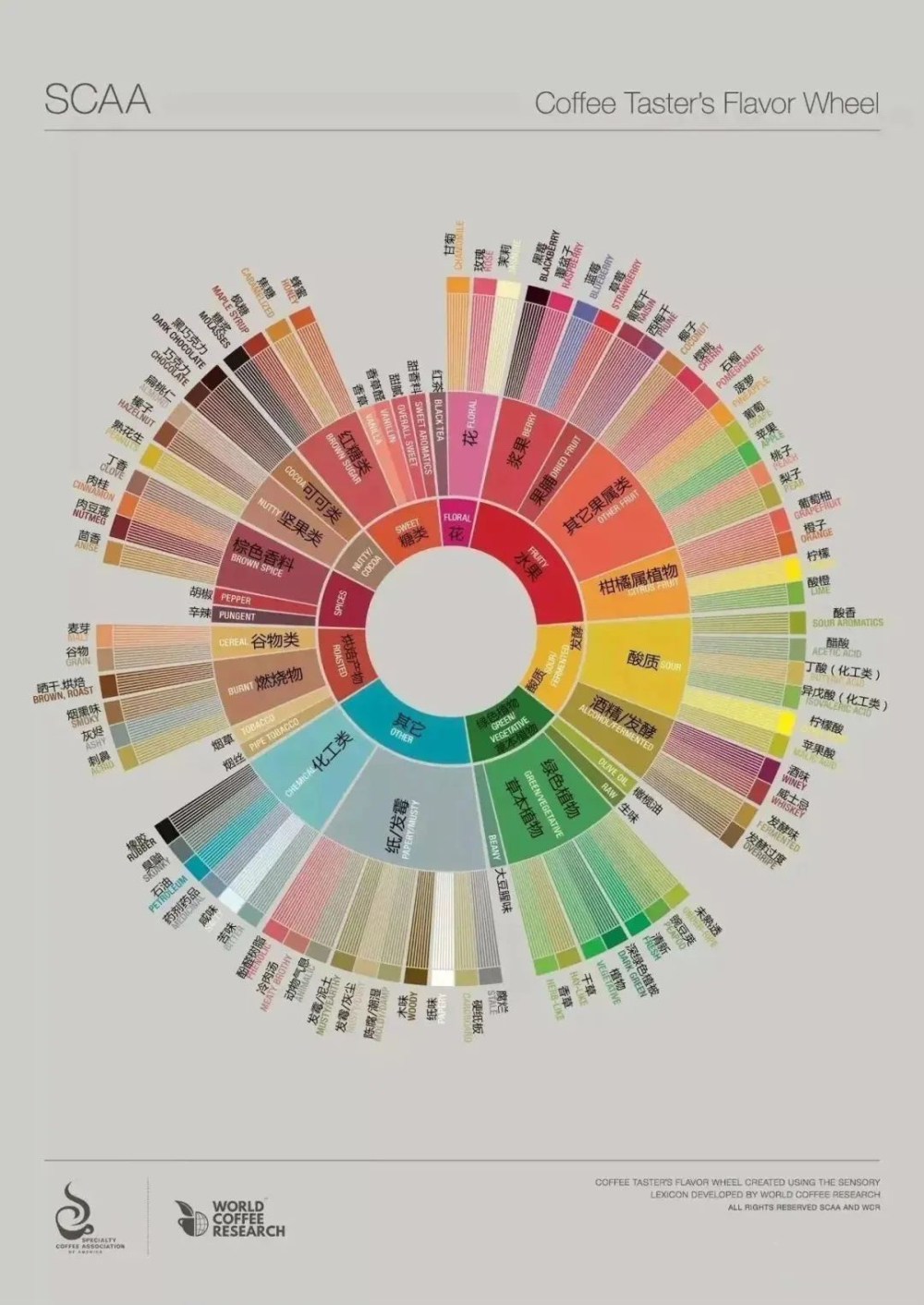
Therefore, when tasting food normally, you can use the flavor wheel to develop your senses and learn to classify various foods according to the flavor wheel. In this way, you can systematically distinguish coffee flavors. For example, when you taste acidity while drinking coffee, you can determine which major category (inner ring) this acidity belongs to—is it more fruit-like acidity, or is it an acidic quality more like carbonated drinks, vinegar, or lactic acid drinks?
If you judge that it is more like a fruity sweet-and-sour sensation, then next determine the detailed category within fruity (middle ring). If it has relatively high acidity and a fresh acidic aroma (rich in vitamin C), then it may be citrus; if it is a fruity flavor with sweetness amid acidity, then it may be berries; if it is a very sweet fruit type, then it may be dried fruit. The final step is to determine which specific flavor it is. For example, under citrus there are lime, lemon, orange, and grapefruit. If you actually taste these categories, you will find that from the degree of acidity to the aroma, there are obvious differences.
If at first you cannot break it down to the specific detailed flavor, you can also rely on this three-level relationship chart to first determine the flavor at the detailed category level (middle ring). For example, if you sense floral notes while drinking coffee but do not know exactly what flower it is, you can first generally describe it as floral, and then gradually enrich your flavor library (smell more, drink more, eat more, remember more)!
Third point: use colors for associations
This version of the flavor wheel was carefully color-matched by the London creative agency One Darnley Road. Every color and shade was carefully selected so as to match the corresponding flavor better. For example, among florals, jasmine (white), rose (pink), and citrus (orange) can be very well linked together through the colors and aromas of flowers. For example, we often see some flavor descriptions written as white floral, which actually refers to a light and fresh floral aroma similar to jasmine.
Moreover, just by looking at the colors, it is easy to distinguish which are good flavors and which are bad flavors. For example, colors such as blue, gray, dark green, and earthy yellow, which do not look like food colors, make it easy to judge that they are not very good flavors.
Fourth point: details of density
If you carefully observe the gaps between categories, you can tell how distant their relationships are. For example, although blueberry and strawberry both belong to berries, the gap between blueberry and strawberry is relatively close, while the gap between blueberry and raspberry is relatively wide. Similarly, although rose and jasmine both belong to florals, the gap between rose and jasmine is relatively close, while the gap between rose and citrus is relatively wide. From this, you can also see their similarity in flavor.
Actually, after saying so much, it is simply sharing how to understand the coffee flavor wheel. Understanding the flavor wheel cannot help you immediately learn to taste coffee flavors; it only helps you systematically sort out the connections among various flavors in coffee. The most important thing is still to taste more, and then echo the flavors on the flavor wheel. Only in this way can you step into the door of coffee flavor sensory perception!
The above content is compiled by CoffeeHunters, a coffee news website.


