







Does Smoky Flavor in Guatemalan Coffee Always Mean a Roast Defect?
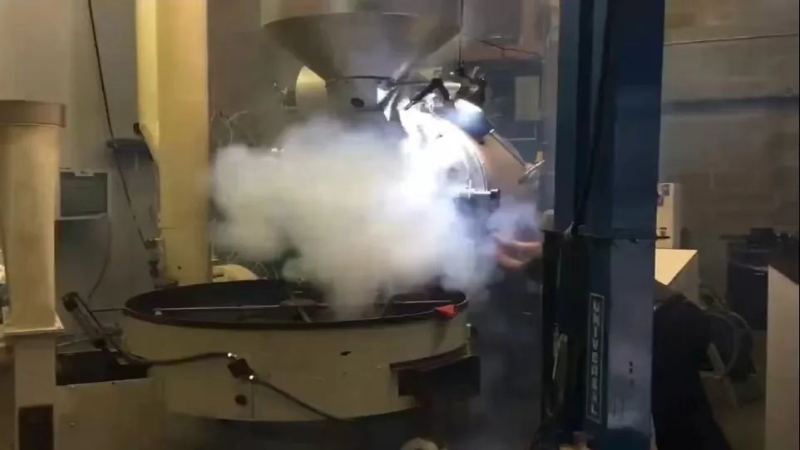
A smoky flavor in Guatemalan coffee can come from two very different sources. One is a roasting defect: if the damper is not opened as beans shed silver skin and release smoke, that smoke stays in the drum, seeps back into the beans, and leaves a pungent taste that irritates the throat. The other is terroir, a subtle tobacco-like note tied to the region itself.
The two are easy to confuse, so cupping carefully matters. Front Street Coffee sells two Guatemalan lots that show the contrast: Huehuetenango, with lively acidity plus citrus and nutty notes, and Antigua Flor del Café, with prominent sweetness and a faint hint of smoke. Tasting notes from tropical coffee origins often carry this kind of regional signature rather than a fault, and geisha coffee offers a useful comparison point.
Does tasting a smoky flavor in coffee necessarily mean there was a roasting error? In fact, the sources of smoky flavor can be quite different. One comes from improper smoke exhaust during roasting, where silver skin and smoke flow back and taint the beans, creating a pungent, irritating defect flavor; the other is a unique imprint given by the terroir of the Guatemala region, appearing as a subtle, tobacco-like aroma rather than a defect. This article will start from the principles of roasting, distinguish the essential differences between the two types of smoky flavors, and introduce two Guatemalan beans sold by Front Street Coffee—Huehuetenango and Antigua Flor del Café. The former has lively acidity with citrus and nutty notes, while the latter has prominent sweetness and a faint hint of smoke. Whether you want to troubleshoot roasting issues or explore the charm of Guatemalan terroir, you can find answers here.
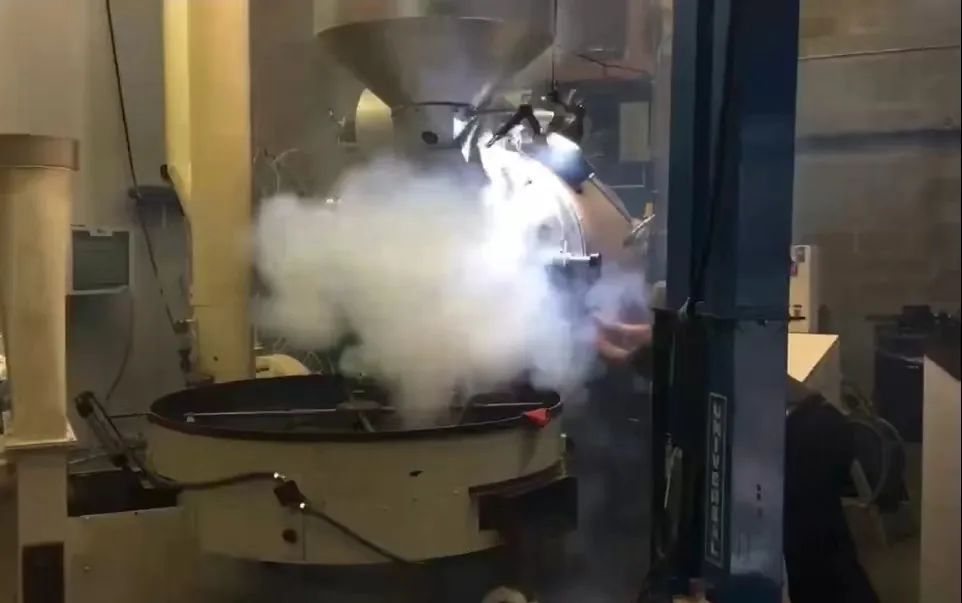
To determine where the error occurred from cultivation to brewing, roasting is often the most suspect step. As the roaster temperature gradually rises, moisture inside the coffee beans continuously evaporates, some silver skin peels off, and smoke is produced as a result.
At this point, the damper must be opened appropriately to strengthen air convection and promptly expel the peeled silver skin and smoke out of the roaster. If the damper is not opened accordingly, this smoke will accumulate inside the roaster, gradually seep into the beans, and ultimately produce a smoky flavor in the cup. This type of flavor is usually quite prominent, pungent and throat-irritating, causing discomfort in the throat, and is therefore classified as a defect flavor.
However, not all smoky flavors come from roasting defects. About two years ago, a middle-aged man walked into FrontStreet Coffee. During casual conversation, it was learned that he had done business in Colombia and Venezuela in his early years, and later returned home due to changes in the business environment. During his time in Colombia, he developed a coffee-drinking habit and for a long time recognized only one bean from a local roaster, often asking friends to bring it back even after returning home.
However, due to the pandemic, coffee from there could not be shipped back, and he was craving it badly. Later, through a friend’s introduction, he heard that Front Street had a rich variety of beans, so he made a special trip to look for beans. "I can’t say exactly where it’s from, but the flavor is very special, with a feeling of an old smoker. Back then, I loved drinking that coffee while smoking. It was especially satisfying..."
What he was talking about was precisely Guatemalan coffee beans. The smoky flavor in Guatemalan coffee is neither a deliberately created special processing method nor a smoky defect caused by roasting mistakes, but is closely related to the local terroir conditions.
Guatemala contains tropical rainforests, volcanic soils, and highland river valleys, with more than 300 microclimates, which also creates the diversity of the country’s coffee flavors—in the same cup of coffee, you may simultaneously catch citrus acidity, lemon peel aroma, nutty finish, and smoky flavor (tobacco notes).
The smoky flavor in Guatemalan coffee is not pungent or irritating, but soft, like the faint smoke drifting after lit tobacco, and is therefore quite favored by smokers. In the cupping descriptions of the 2021 Guatemala Cup of Excellence, the term smoky flavor can also be seen.
Front Street currently has two Guatemalan coffee beans, respectively from the Huehuetenango region and the Antigua region.
The Huehuetenango region is not located in a volcanic zone. Although it lacks the rich minerals brought by volcanic soil, it makes up for it with high altitude, a dry and cool climate, and abundant water sources, making it very suitable for growing high-density coffee beans. Coffee from this region has bright, lively acidity, often presenting citrus-like acidity and a bit of lemon peel freshness, while also carrying Guatemala’s signature smoky flavor and nutty aroma. Front Street believes that although this bean is not stunning, it fully presents the flavor characteristics of Guatemala, so it is used as Front Street’s everyday Guatemalan coffee.
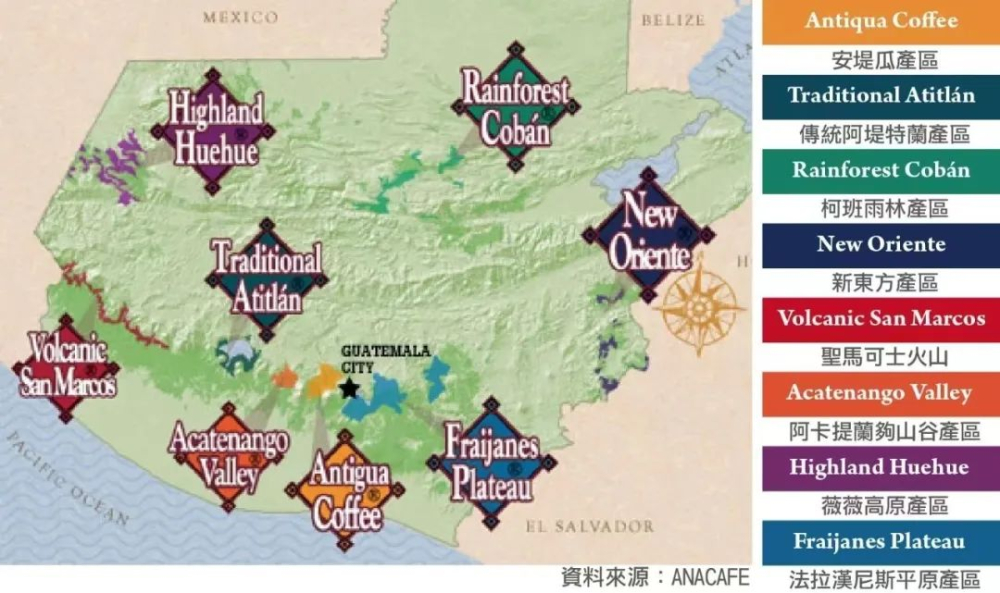
The Antigua region, by contrast, sits within a volcanic area. Fertile volcanic soil plus a huge temperature difference between day and night give the coffee produced here a rich aroma and sweetness. What Front Street offers is the Flor del Café bean from the La Minita estate, which is famous for its strict cultivation standards, processing techniques, and quality control, with quality that can be considered among the top tier of the Antigua region.
The smoky flavor of this bean is not intense, but faint and elusive. The sweet-and-sour fruitiness is very distinct, and the mouthfeel is quite full-bodied.
Perhaps, when you are tired of drinking Geisha, switching to a cup of Guatemalan coffee will give you a completely different experience. After hearing this, a friend chimed in: "Guatemala also has Geisha coffee!"
The above content is compiled by CoffeeHunters, a coffee news website.


