








White Coffee What Is and What Milk Foam Does a Large Heart Latte Need?
The large heart is the standard first latte art pattern and the base for many others. It needs milk foam with fluidity rather than a stiff, dry texture, and a pitcher poured to the fifth line can be steamed to between the sixth and eighth line and still work. Symmetry and a steady finish matter more than speed.
The pour is built on integration and a centered pouring point. A large heart is integrated to about the seventh full line of the cup, since the pattern needs some convection but not as much as a rippled tulip. Getting white coffee what is right at the start helps here: the contrast layer must separate cleanly from the crema before any pattern can form.
Want to learn coffee latte art? The large heart is the most suitable first pattern for beginners, and it is also the foundation for many subsequent complex designs. This tutorial from Front Street Coffee breaks down the key points of making a large heart one by one, from the standards for steaming milk foam, controlling the amount of integration, to choosing the pouring point and finishing technique. The article also includes images of common failure cases and cause analysis to help beginners quickly identify problems. Whether you are just starting with latte art or always fail at the finishing stage, this content will give you clear guidance.









Today Front Street is here to teach a latte art class! Today we will teach everyone the most basic pattern—the large heart. This pattern is basically the first pattern every beginner pours, and it is also the foundation of many patterns. The prerequisite for learning this is that the basics of espresso extraction, milk foam, pitcher handling, and integration are already solid. Friends who have not mastered the techniques can look for Front Street's previous related articles!
- Milk foam thickness
Fine milk foam is the most basic requirement. But the tolerance for thickness is very high; it only needs to have fluidity. In other words, milk poured to the 5th full line can be steamed to anywhere from the 6th to 8th full line without issue. It may even look better if the foam is steamed a bit thicker. Sometimes contestants who are used to rippling may not be able to pour a good-looking large heart right away.
- Integration amount
The amount of integration depends on how much "convection" is needed when pouring the pattern, because the less integration, the stronger the "convection." For example, when pouring a "rippled tulip," because the pattern requires more "convection," you only need to integrate to the 4th full line of the cup. But when pouring a "wheat sheaf," the amount of "convection" needed is not much, so more integration is required, usually to the 8th to 9th full line.
Pouring a "large heart" requires "convection," but not especially much, so it is integrated to the 7th full line. If there is too little integration, the heart will be very large; if there is too much integration, the heart will be very small. Neither is very attractive.
- Pouring point
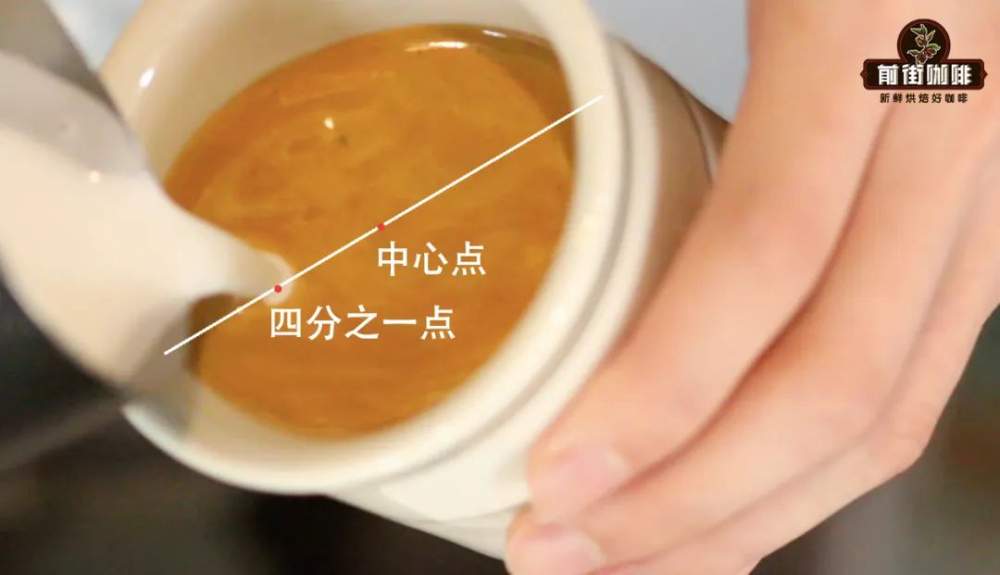
The heart pattern is symmetrical, so it should be poured along the axis. If there is deviation, the entire pattern will lean to one side and look unattractive. The pouring point should be near the quarter point on the side of the latte art pitcher, so that the entire heart will be in the very center.
- Pouring the pattern
When pouring the pattern, try to pour a larger amount of milk, as this can increase "convection" and make the pattern fuller. While pouring the milk, the pouring point slowly moves from the quarter point toward the center, the left hand slowly rotates the cup back, and at the same time the right hand slowly raises the pitcher spout to prepare for the finish. (There will be an incorrect demonstration below.)
- Finishing
The finishing motion is very important. Many friends ruin everything right at the finish. When it reaches the 9th full line, prepare to finish. When finishing, reduce the flow, raise the pitcher spout, follow the axis to the bottom of the heart, and cut off the flow decisively. This will create a short tail.
Some friends like to drag the finish outside the wall of the cup, which makes the heart drag a long tail and look unattractive. It also affects the cleanliness of the coffee cup.
Below, Front Street will include some pictures of failed heart latte art and note the reasons.
The phenomenon in the picture above is that one of the two lobes is large and the other is small. The reason is that when pouring, the cup was not level, or the milk pitcher was not straight.
The picture above no longer looks like a heart. The reason is that during "convection," the pitcher spout did not move forward and remained at the quarter point.
The heart in the picture above is flat, long, and not full. This is because the milk pitcher was raised during "convection."
In the picture above, there is not enough white milk foam behind the heart, and it is also dragging a long tail. Insufficient milk foam may be because the milk foam is not thick enough, or because the pitcher was not tilted enough during latte art to create a large milk flow. The long tail is because the finish was not decisive enough, and excess milk continued to flow out.
The pattern in the picture above is overall too low. The reason lies in the pouring point: the pouring point for this cup of coffee was at the center point, which causes the whole shape to appear lower down.
The above content is compiled by CoffeeHunters, a coffee news website.


