







What does the cocaine find in swiss coffee supply mean for safety?
A Nestlé factory in Switzerland reported an unidentified white powder in coffee bean containers from Brazil. Police testing confirmed it was 80% pure cocaine. Nestlé stated the beans did not contact any products or production equipment, and that coffee made at the Swiss plant is safe to consume.
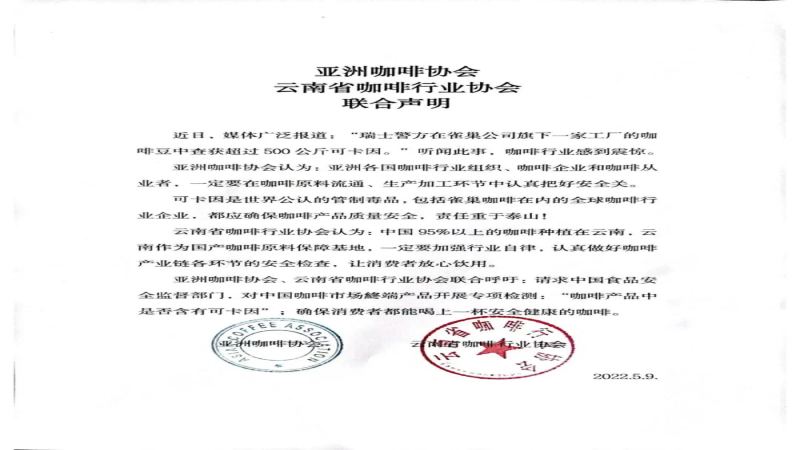
On May 9, the Asian Coffee Association and the Yunnan Provincial Coffee Industry Association jointly issued a statement calling for stronger safety controls in the coffee supply chain and specialized cocaine testing of domestic end products. Over 95% of China's coffee planting area is in Yunnan, giving the province a key role in raw material safety.
Recently, a Nestlé factory in Switzerland discovered an unidentified white powder in a shipment of coffee bean containers from Brazil. Police testing confirmed it to be cocaine with a purity of 80%. Although Nestlé quickly stated that the related coffee beans did not come into contact with any production equipment, the incident still sparked concerns among domestic consumers about coffee safety. On May 9, the Asian Coffee Association and the Yunnan Provincial Coffee Industry Association jointly issued a statement, emphasizing the strengthening of safety controls in the coffee industry chain and calling for specialized cocaine testing of domestic coffee end products. This article will guide you through the incident, the key points of the associations' statement, and the impact on the Chinese coffee market and responses.
Not long ago, a Nestlé factory in Switzerland reported to the police that an unidentified white powder had been found in a shipment of coffee bean containers arriving from Brazil. After local police intervened and conducted tests, it was confirmed that the powder was cocaine with a purity of 80%. The entire search process was carried out within a designated isolation area at the factory. Subsequently, Nestlé issued a statement via email saying that the coffee beans involved in this incident would not come into contact with any products or production equipment in the factory, and assured consumers that products made at the Swiss Nestlé factory are safe to consume.
Although officials have responded, domestic consumers remain concerned about the matter. On May 9, the Asian Coffee Association and the Yunnan Provincial Coffee Industry Association jointly issued a statement as follows:
The Asian Coffee Association pointed out that coffee industry organizations, coffee enterprises, and practitioners in Asian countries must strictly control safety checkpoints in the circulation of coffee raw materials and production processing. Cocaine is an internationally recognized controlled drug, and global coffee industry enterprises, including Nestlé, should ensure the quality and safety of coffee products, bearing significant responsibility.
The Yunnan Provincial Coffee Industry Association stated that over 95% of China's coffee planting area is located in Yunnan. As the guarantee base for domestic coffee raw materials, Yunnan must strengthen industry self-discipline, earnestly implement safety inspections at every stage of the coffee industry chain, and enable consumers to drink with peace of mind.
The Asian Coffee Association and the Yunnan Provincial Coffee Industry Association jointly call on: China's food safety supervision authorities to conduct specialized testing on end products in the Chinese coffee market, with a focus on checking "whether coffee products contain cocaine," to ensure that every consumer can enjoy a safe and healthy cup of coffee.
Source: China Economic Times - China Economic Net
Professional coffee knowledge exchange. For more coffee bean information, please follow Coffee Workshop (WeChat public account: cafe_style).
For more specialty coffee beans, please add private WeChat Front Street Coffee (FrontStreet Coffee), WeChat ID: kaixinguoguo0925.
The above content is compiled by CoffeeHunters, a coffee news website.


