








What do coffee shop closures reveal about the oat milk boom?
Suspended coffee shop operations in Shanghai and other cities have driven a clear decline in oat milk sales, and OATLY's latest financial report shows the Chinese market facing severe challenges. Oat milk had become a near-standard café offering, a rise tied to OATLY's marketing and Starbucks' promotion.
OATLY's former CEO promoted oat milk as more eco-friendly than dairy, citing lower pollution, reduced carbon dioxide emissions from cattle, and water savings, while visiting cafés and talking with baristas. The dip exposes how heavily oat milk relies on B2B channels; in the B2C market its positioning remains ambiguous, and its health claims deserve a closer nutritional comparison.
Oat milk has risen rapidly in the coffee industry in recent years, almost becoming a standard offering in cafés, a trend closely tied to OATLY's brand marketing and Starbucks' promotion. However, due to the suspension of coffee shop operations in Shanghai and other places, oat milk sales have seen a clear decline, and OATLY's latest financial report also reflects that the Chinese market is facing severe challenges. This article reviews oat milk's journey from obscurity to popularity in the coffee world, analyzes the vulnerability exposed by its over-reliance on B2B channels, and discusses the obstacles oat milk must overcome in the future, given its ambiguous positioning in the B2C market and the difficulty of changing consumer habits. At the same time, through a nutritional comparison, it objectively examines whether oat milk is really as healthy as advertised, providing a rational reference for coffee lovers.
Oat milk's status in the coffee world today is almost equivalent to a default configuration. Whether in China or abroad, walking into any café, seeing an oat milk option on the menu is nothing unusual. This plant-based milk was originally created so that people with lactose intolerance could enjoy a taste similar to milk without containing any milk ingredients. After existing quietly for decades, it was not until 2012 that OATLY's new CEO branded it with "environmental protection" and "health" labels, truly capturing the attention of a new generation of consumers.
At the time, the newly appointed CEO keenly grasped the two hottest issues in American society—environmental protection and vegetarianism—and, combined with the public's natural enthusiasm for participating in such topics, spread the concept of environmental protection through subtle means. On the one hand, environmental publications were used to promote that oat milk is more eco-friendly than milk, citing reasons such as reducing environmental pollution, lowering carbon dioxide emissions from cattle respiration, and saving water resources.
On the other hand, as a coffee enthusiast himself, he personally visited major high-end cafés across the United States, communicating with different baristas and introducing oat milk's health and environmental advantages. Baristas would also mention the benefits of oat milk when chatting among peers, and just like that, word spread, and a trend gradually formed among cafés. Starting in 2013, cafés in the United States and other Western countries began offering oat milk options to customers, and Starbucks was the earliest chain coffee brand to introduce oat milk.
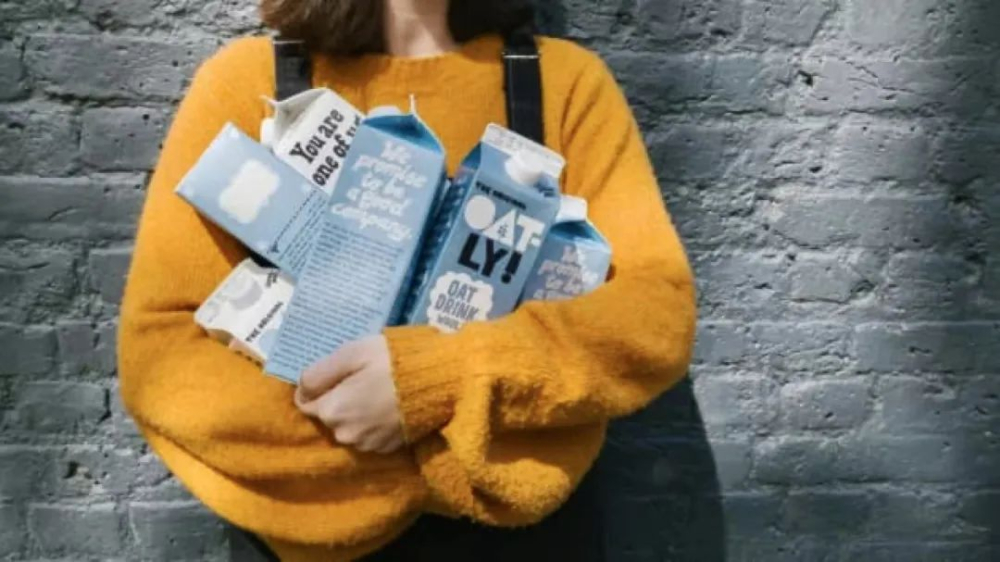
The sudden surge of oat milk beverage popularity in China's coffee scene is likewise inseparable from Starbucks' push. Before oat milk truly took off, a small number of cafés in China had already tried offering oat milk, but at the time market demand was limited and it did not achieve widespread adoption. It was not until 2020 that Starbucks China launched its oat latte under the theme "Starbucks Dietary Lifestyle," and oat milk became the representative of a new healthy diet almost overnight.
After that, numerous independent cafés and chain coffee brands in China followed suit in using oat milk. Walk into any coffee shop and you can find products containing oat milk. The widespread application in the coffee industry directly drove OATLY oat milk sales, with growth momentum like a rocket launch. Other brands subsequently launched oat milk products one after another, and their sales likewise rode the wave.
However, the oat milk market that had been advancing triumphantly has recently entered a state of urgent sales decline due to the "suspension" of cafés in Shanghai and Beijing.
According to OATLY's latest financial report, affected by the pandemic, this star oat milk company is experiencing "China troubles." On the earnings call, OATLY CEO Toni Petersson said: "In China, our team is going through a very difficult situation. We have a large portion of our business in Shanghai. Among the retail and food service stores in China where OATLY is present, more than 17,000 had to close in the first quarter of this year due to lockdown measures."
OATLY has always been the leader in the oat milk market, and its "braking" also means other brands of oat milk are "braking" along with it. Because oat milk is not a rigid consumer demand, but rather more of a marketing concept layered with premium and health associations, there is ample room for B2B marketing to play out, while the B2C side is relatively weak. Although there are oat milk products aimed at B2C consumers, they are priced relatively high, and sales are far below those of the B2B market.
It is precisely because of "excessive" reliance on the B2B market that the sudden "shutdown" of cafés caught the oat milk industry off guard. However, the café shutdown is only a surface-level impact; the oat milk market still faces more challenges. If it starts to prioritize the B2C market now, oat milk's positioning will become an awkward problem.
In China, the lactose-intolerant population is not particularly large, and consumers have been drinking milk for decades, making it hard to change consumption habits in the short term. Add to that the fact that oat milk is priced considerably higher than milk, and positioning it as a milk substitute would require overcoming quite a lot of difficulties.

If positioned as a beverage, the taste still needs further improvement, and product upgrades and iterations are also very important. In addition, oat milk's distribution and marketing in the B2C market have yet to achieve broad coverage. For a new category to quickly capture consumer awareness, it needs a short-term bombardment of exposure, but currently brands still invest relatively little in oat milk's B2C market.
Is oat milk really healthy? Let's first look at this table: (The following data does not refer to any specific brand of milk or plant-based milk.)
(This data does not refer to any specific brand of milk or plant-based milk.)
From this nutritional composition table, oat milk's fat content, while not the highest among the four, is not the lowest either. Many people think that the lower the fat intake, the better for weight loss, but that is actually not the case. More and more research now shows that fats can be good or bad, and moderate intake of the right fats can actually have a positive effect on weight loss. Next, looking at protein, the protein content of milk and soy milk in the table is 2 to 3 times that of oat milk. Protein is an important component of human bones and muscles, and in terms of content, relying solely on oat milk to supplement protein is far from sufficient. So assuming there is no lactose intolerance issue, milk has the best nutritional value. If there is lactose intolerance, soy milk is the best choice.
Previously, Coffee Workshop also reviewed several oat milk products on the market (link), finding that some products added vegetable oil to improve the texture of the plant-based milk, some oat milk had a noticeably sweet taste but the ingredient list showed no sugar content, and some oat milk left a greasier mouthfeel than fresh milk. Whether it is healthy or not, the writer did not investigate further and only provided personal sensory descriptions. But one thing is certain: not all oat milk can make good coffee, and not all coffee is suitable for adding oat milk. Image source: Internet For professional coffee knowledge exchange and more coffee bean information, please follow Coffee Workshop (WeChat public account: cafe_style). For more specialty coffee beans, please add private WeChat Front Street Coffee (FrontStreet Coffee), WeChat ID: kaixinguoguo0925.
The above content is compiled by CoffeeHunters, a coffee news website.


