







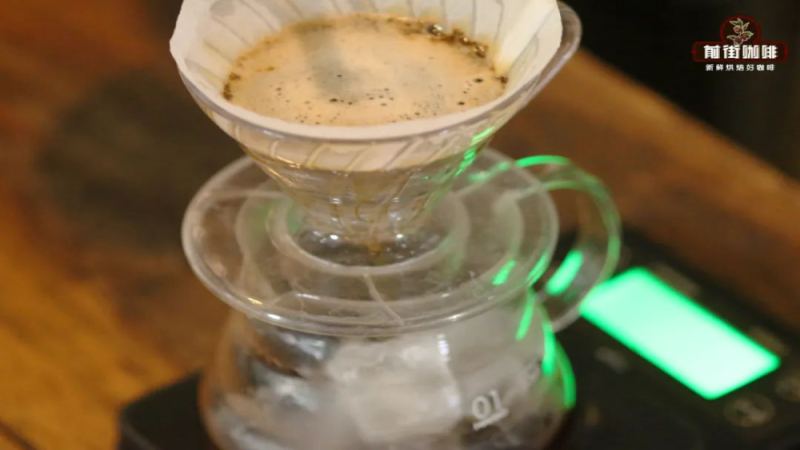
Should the coffee extraction timer start before or after blooming?
Pour-over coffee extraction should run about 2 minutes in total, in practice between 1 minute 50 seconds and 2 minutes 10 seconds. The dispute is where timing starts. Extraction begins the moment coffee grounds touch water, so the timer should be pressed at the first second of pouring, not after the pour is finished. Time then becomes a diagnostic tool rather than a formality.
Too long an extraction pushes the flavor toward bitterness; too short and it leans sour. Segmentation helps locate the cause. Weighing the dose and recording the water poured give the data, while the electronic scale's timer records the flow. Beginners struggle mainly because there are too many variables at once, so quantifying dose, grind size, water temperature, ratio, and time one by one makes problems easier to spot.
When brewing pour-over coffee, the electronic scale's timer function is often overlooked, but it is crucial for judging the extraction result. Front Street Coffee recommends controlling the total extraction time to about 2 minutes, in practice falling between 1 minute 50 seconds and 2 minutes 10 seconds. However, there is disagreement over the starting point of timing: does it start at the moment of pouring water, or do you press the timer only after the pour is finished? Front Street believes that extraction begins the moment the coffee grounds touch water, so it insists on timing from the first second of pouring. This article builds a pouring model around time nodes and explains how to troubleshoot issues such as flow rate and grind size through segmented timing, making time an effective tool for brewing diagnosis.
In the process of pour-over coffee, an electronic scale is almost an essential tool. The reason is that a scientific brewing plan cannot do without precise data support—whether weighing the amount of coffee grounds or recording the amount of water poured, the weighing capability of an electronic scale is needed.
But the role of the electronic scale goes beyond weighing. Its timer function is equally critical. The reason we time during brewing is to make the whole process more controllable and more scientific, and also to provide a basis for subsequently judging how this cup of coffee performed.
If you have bought coffee beans, you have most likely seen brewing suggestions on the packaging, which include time parameters. Taking pour-over as an example, the standard given by Front Street is a total duration of about 2 minutes.
For beginners, the biggest struggle often comes from having too many variables. Once we quantify these variable factors one by one, beginners can get started more easily and more easily check where the problem lies. When Front Street shared brewing parameters in the past, it explained in detail how coffee dose, grind size, water temperature, and coffee-to-water ratio affect flavor. The same principle applies to time. If you operate according to the parameters provided by Front Street, the final extraction time will usually fall within the range of 1 minute 50 seconds to 2 minutes 10 seconds.
If the actual extraction time is too long, the coffee flavor will lean toward bitterness; if the time is too short, it will tend to be sour and weak.
Since time can be used to judge the brewing state, the premise is that everyone must have a commonly accepted timing standard.
At present, the disagreement mainly centers on the starting point of timing. Some people are used to pressing the timer the instant the first pour begins, while others wait until the first pour ends before starting the timer.
Front Street's view is: once water contacts the coffee grounds, extraction has already begun. If you time only after pouring is finished, that is equivalent to artificially ignoring the extraction that occurs during the pouring stage. Assuming everyone agrees on a 30-second bloom, those who adopt the latter timing method will actually have a bloom time longer than 30 seconds.
Therefore, in the brewing methods shared by Front Street, timing always starts from the moment of pouring.
Timing can also serve as an auxiliary tool, helping us discover problems during brewing or review problems after it ends.
During brewing, Front Street builds a pouring model based on time nodes. Assuming the total extraction time is 2 minutes, the first pour starts at the 1st second; the second pour starts at the 30th second and ends at about the 55th second; the third pour starts at 1 minute 10 seconds and finishes pouring at about 1 minute 35 seconds; finally, dripping is completed at the 2-minute mark.
Under this framework, during actual pouring, the time of each node can be used to infer the total extraction time. For example, if the second pour ends later than 55 seconds, it means the pouring flow rate is too slow; if the next pour is still like this, the total time will inevitably exceed 2 minutes, so the next pour needs a stronger flow…
In the summary stage after brewing ends, time can also provide clues. If all the time nodes match but the total extraction time does not, then the problem is very likely the grind size—grinding finer will lengthen the time, and grinding coarser will shorten it.
Conversely, if the time nodes all match but the coffee flavor is still abnormal, then the time factor can be ruled out, gradually narrowing the scope to find the real root cause.
The above content is compiled by CoffeeHunters, a coffee news website.


