







What really drives coffee drinking motivation each day?
Research published in Psychological Science suggests that people often drink coffee out of habit rather than genuine physiological need. In the study, participants tracked their intake and fatigue every two hours for a week. They believed fatigue mattered about twice as much as habit, yet their actual behavior showed habit played the larger role in when they reached for a cup.
The gap between what people say and what they do points to a broader pattern: much of daily behavior runs on automatic routines rather than deliberate choices. Co-author Wendy Wood notes that habits are not inherently bad, since healthy coffee routines, exercise, and recycling can all be sustained the same way. The findings carry particular weight in China, where coffee culture is still developing.
In the busy modern life, coffee has become a daily essential for many people. Some are obsessed with its flavor, while others rely on it to stay alert. But recent research suggests that we may drink coffee more out of habit than genuine physiological need. This study, published in Psychological Science, reveals that people often underestimate the profound influence of habits on behavior. This article takes you through the psychological mechanisms behind coffee drinking, analyzes how habits and needs intertwine, and considers what this phenomenon means for China, where coffee culture is still in its infancy.
As hardworking office workers, coffee has long been part of our daily lives. Some revel in its unique flavor, while others just seek that moment of alertness. Getting up in the morning and brewing a cup of coffee has become a fixed ritual for many workers. But have you ever wondered: do you drink coffee because of habit, or does your body truly need it?
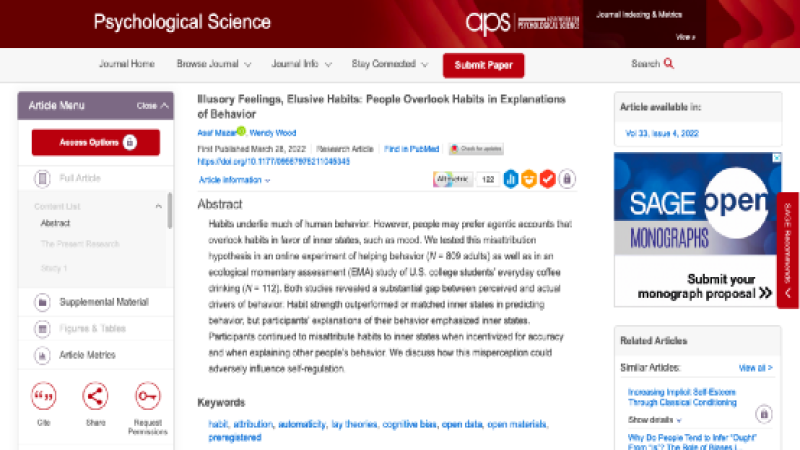
A recent scientific study points out that people are more likely to drink coffee out of habit rather than actual need. This paper, published in Psychological Science, shows that participants generally underestimated the deep influence of habits on their behavior, and coffee consumption was one example.
Why do you pick up that cup of coffee?
Because you stayed up late last night, didn't get enough sleep, and felt exhausted, so you turned to caffeine.
Participants in the experiment expressed similar thoughts to the researchers. Some said that among the factors driving them to drink coffee, fatigue was twice as important as habit.
So the researchers tracked participants for a week, recording their coffee intake and fatigue levels every two hours. The results showed that when participants drank coffee, they did not realize that habit played a far greater role than need, indicating that their words did not match their actions.
Wendy Wood, one of the authors of the study, points out that most of what we do every day is based on personal habits, but we are reluctant to admit that it is due to habit, instead attributing our behavior to emotions and intentions.
The authors further state that doing something habitually is not inherently bad, and sometimes it is even beneficial. For example, positive behaviors such as eating healthy food, exercising, and recycling are also sustained by habit, not just because they are good for us. Humans are not good at explaining what drives us to repeat a behavior: is it need, or is it habit?
Reading this, some workers might argue: isn't it about satisfying both? Isn't the repetition of the coffee-drinking habit precisely to eliminate the need for fatigue?
Indeed, many workers initially drank coffee just to stay alert, and gradually developed the habit of having a cup every day. Later on, a certain taste of coffee became the morning bugle call for workers.
In the West, drinking coffee has long been a daily habit, while in China, coffee consumption is still in its early stages. People usually drink coffee for three needs: the physiological need of workers; the emotional need to show a refined lifestyle; and the social need between people. When a certain behavior is used to satisfy a need over the long term, it becomes a habit.
So, as a diligent worker, hand on heart, is drinking coffee a habit or a need?
Image source: Internet
For more coffee bean information, please follow Coffee Workshop (WeChat public account cafe_style) For professional coffee knowledge exchange, please add WeChat ID kaixinguoguo0925
The above content is compiled by CoffeeHunters, a coffee news website.


