







What the Research Says About Hot Drink Cups and Coffee
Researchers at the U.S. National Institute of Standards and Technology found that plastic-lined hot drink cups release trillions of plastic particles after about twenty minutes of contact with hot water, which is roughly the time a takeaway coffee sits before it is finished. Coffee is a type of beverage usually served hot, so the cup material matters as much as the drink itself.
The finding adds to earlier evidence: Austrian researchers reported detectable microplastics in human stool in 2019, and later work found particles in blood and lung tissue. Microplastics are plastic fragments under five millimeters, while nanoplastics fall below one micrometer. Bringing a reusable cup is described as the simplest way to cut exposure.
A daily takeaway coffee is a routine habit for many office workers. But have you ever considered that the paper cup holding hot coffee may be quietly releasing trillions of plastic particles into your drink when it meets hot water? Researchers at the U.S. National Institute of Standards and Technology conducted experiments on this, and the results are concerning. In fact, multiple previous studies have confirmed that microplastics and nanoplastics have invaded human blood and lungs. Faced with this invisible health threat, bringing your own cup may be the simplest and most effective solution.
Coffee can be called the daily "life-extending" drink for office workers. Everyone knows that brewed coffee is a liquid and must be held in a container. However, how many people actually manage to bring their own cup to the café every day? The reality is often that we casually grab the disposable paper cups provided by the shop. Some American researchers have found that plastic products such as takeaway coffee cups release as many as trillions of plastic particles after being exposed to hot water for twenty minutes.
Office workers' reliance on coffee makes one cup a day almost the basic configuration. Over five workdays a week, aren't we unknowingly swallowing quite a bit of plastic every day? That is indeed the case. As early as 2018, Austrian scholars warned that the human body has already been contaminated by microplastics. By 2019, the same Austrian research team further confirmed that 20 microplastic particles could be detected in every 10 grams of human feces.
Not long ago, another study showed that these microplastics not only appear in human blood, but have even left traces in lung tissue. It can be seen that plastic has become an invisible killer threatening human health.
It should be understood that microplastics are defined in two different ways according to size. What people usually call "microplastics" refers to plastic particles less than 5 millimeters in length that can be seen with the naked eye. Those smaller than that are called "nanoplastics," with a size below one millionth of a meter (that is, 1 micrometer), and generally cannot be resolved even with an ordinary optical microscope.
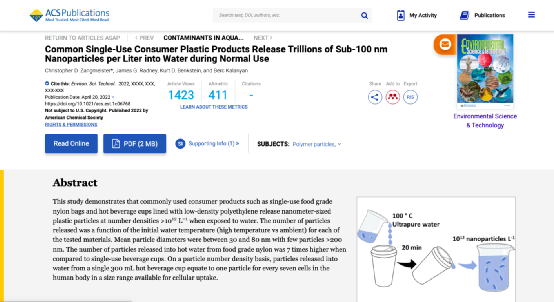
Researchers at the U.S. National Institute of Standards and Technology (NIST) analyzed two types of plastic products frequently encountered in daily life: one is the plastic lining film (LDPE) commonly found in disposable hot drink cups, and the other is the food-grade nylon bag used for grease resistance on the surface of baking liners.
The researchers found that when these plastic products are soaked in hot water, trillions of microplastics are released per liter of water. The concentration of nanoparticles released into hot water by food-grade nylon bags was actually seven times that of LDPE.
Observed through a scanning electron microscope (SEM), the researchers confirmed that these plastic particles averaged between 30 nanometers and 80 nanometers in size, with only a small number of particles exceeding 200 nanometers in diameter.
When you happily walk down the street with a cup of hot water, hot coffee, or hot milk tea enjoying it, what's on your mind is how the drink tastes. Yet you would never expect that even if the shop's food hygiene reaches top standards, this hot drink still contains billions of invisible microplastics floating in it. After reading this, doesn't the hot drink in your hand suddenly seem less appealing?
Because nanoscale plastics can penetrate cell membranes and enter biological cells, adversely affecting normal cell function. The U.S. FDA has regulatory standards for plastics used in packaged food, for example, food-grade nylon (commonly used in tea bags) must not lose more than 1% of its mass under high-temperature conditions. However, the new technology used in this NIST study showed a mass loss of as much as 10%, far exceeding the FDA's safety limit.
In addition, the corresponding author of this NIST study also pointed out that there is currently no routine detection method that can be used to assess the dissolution rate of LDPE in hot coffee cups; existing detection methods only target nylon plastic.
So, can we still happily drink a cup of hot coffee? The answer is, of course, yes. Bring your own dedicated cup before going out, and isn't the problem solved? It not only reduces resource waste, but also eliminates the worry about whether the cup provided by others has been cleaned properly.
Image source: Internet
For professional coffee knowledge exchange and more coffee bean information, please follow Coffee Workshop (WeChat public account: cafe_style)
For more specialty coffee beans, please add the private WeChat of Front Street Coffee (FrontStreet Coffee), WeChat ID: kaixinguoguo0925
The above content is compiled by CoffeeHunters, a coffee news website.


