







Why is the Tous Les Jours Coffee store count falling to zero?
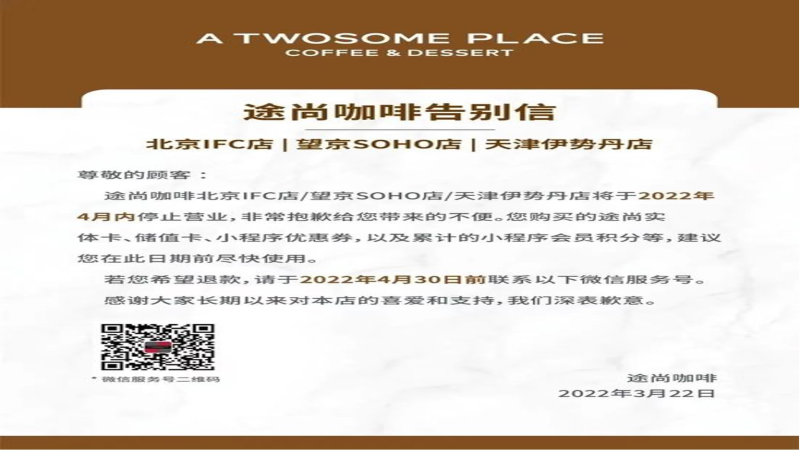
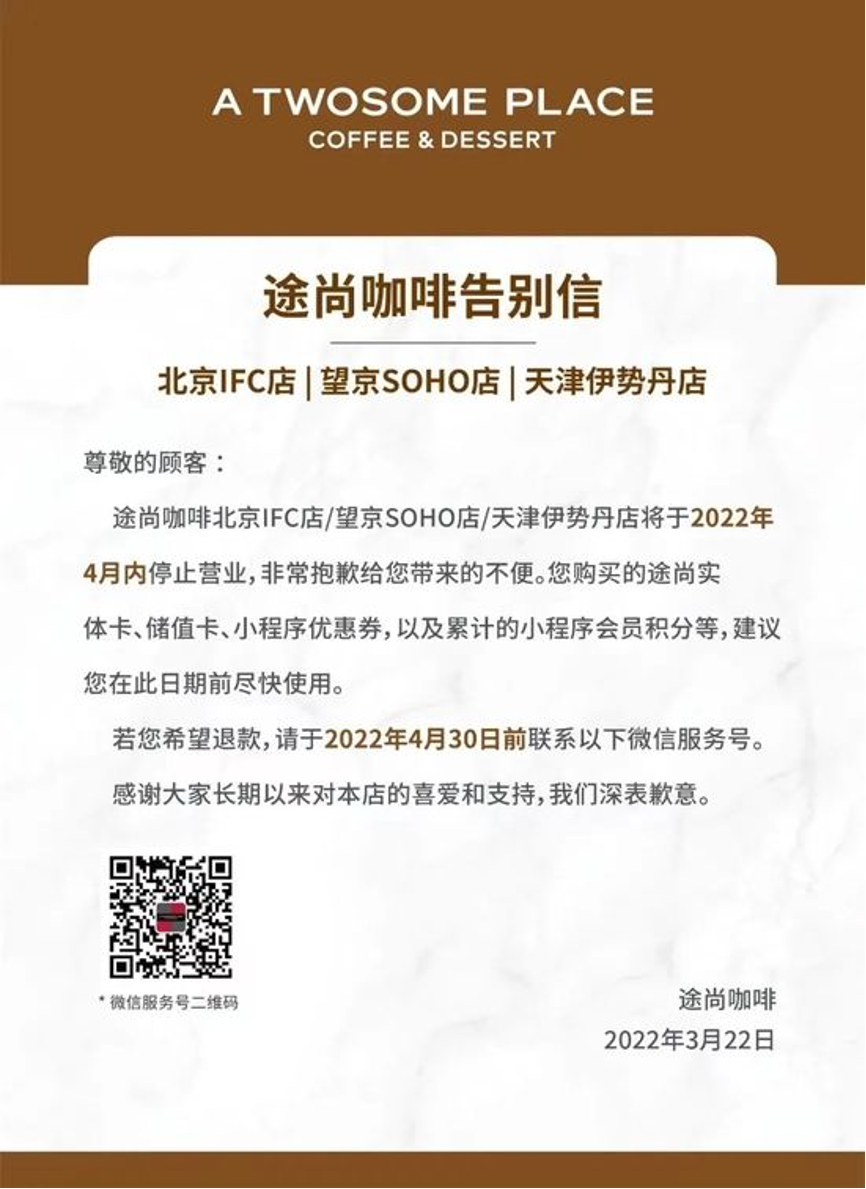
South Korea's Tous Les Jours Coffee will close its last three stores in China in April and withdraw from the market entirely. The chain, founded in 2002 and entering China in 2010, once reached 36 stores in 2017. A farewell letter at the Wangjing SOHO store named the Beijing IFC, Wangjing SOHO, and Tianjin Isetan locations.
Customers can handle card refunds, return coupons, and use up points before April 30. Store staff confirmed the brand's exit. Insufficient product differentiation and declining brand popularity were cited as reasons, set against rising competition in China's coffee store market and changing consumer preferences. The brand passed from CJ Foodville to Anchor Equity Partners, then to Carlyle Group for about 800 billion Korean won.
Competition in China's coffee market is becoming increasingly fierce, and another foreign brand has chosen to exit. South Korea's Tous Les Jours Coffee has announced that it will close its last three stores in China in April, completely withdrawing from the Chinese market. This Korean chain brand, founded in 2002 and entering China in 2010, once expanded its store count to 36 in 2017, but now it is sadly bowing out due to insufficient product differentiation and declining brand popularity. Tous Les Jours Coffee's exit is not an isolated case; it reflects the reality of intensifying competition in the coffee sector and rapidly evolving consumer demands—only brands that truly align with the preferences of the new generation of coffee lovers will be able to go further.
The number of coffee stores continues to rise, customers have an ever-growing variety of brands to choose from, and some coffee brands are facing increasing operational pressure, gradually disappearing from public view, ultimately having no choice but to give up and bid farewell to the Chinese market. Recently, a South Korean coffee chain brand has also reached the same situation, finding it difficult to continue competing in the Chinese market and having no choice but to withdraw.
According to a recent report by Beijing Business Today, South Korean coffee brand Tous Les Jours Coffee plans to close its remaining three stores in China within April. On March 31, a Beijing Business Today reporter visited the Tous Les Jours Coffee Wangjing SOHO store and found a "farewell letter" posted at the entrance. The letter mentioned that Tous Les Jours Coffee's last three stores—Beijing IFC store, Wangjing SOHO store, and Tianjin Isetan store—will officially cease operations in April. Customers can process card refunds, return coupons, and use up their points before April 30.
Regarding the closure of Tous Les Jours Coffee, a Beijing Business Today reporter asked store staff whether the brand would thus exit the Chinese market, and the staff confirmed it.
Tous Les Jours Coffee was founded in 2002, initially under South Korean food service company CJ Foodville, and was later acquired by investment firm Anchor Equity Partners. Another investment company, Carlyle Group, brought Tous Les Jours Coffee under its umbrella for 800 billion Korean won (approximately 4.3 billion yuan).
Tous Les Jours Coffee opened its first offline store in China in 2010, landed in Shanghai in 2014 as the world's first flagship store, and its number of stores in China once reached 36 in 2017. After a round of brand upgrades, Tous Les Jours Coffee opened five consecutive stores in 2019: Beijing Wangjing SOHO store, Beijing Oriental Plaza store, Beijing IFC store, Beijing COFCO Plaza store, and Tianjin Isetan store.
Since the pandemic, China's coffee market has maintained a high-speed growth trend, with the market scale continuously expanding, coffee consumption continuously upgrading, and consumers paying noticeably more attention to coffee quality, which has increased the competitive pressure among coffee companies. At the same time, convenience stores, tea beverage brands, and time-honored brands have all poured into the coffee sector, further diverting coffee consumer groups, and competition within the industry has become increasingly fierce.
In addition, the impact of a series of events has also cooled some consumers' "Korean fever." As a high-end Korean coffee brand, Tous Les Jours Coffee's declining popularity has also had a certain impact on the brand's development prospects in the Chinese market.
To stand out in the crowded coffee sector, products must be differentiated in order to form a competitive advantage. Compared with many currently popular coffee brands, Tous Les Jours Coffee's menu products are relatively limited, with little room for choice, and its signature drinks also lack obvious differentiated features; its overall positioning does not match the needs of today's consumers who pursue specialty coffee.
In terms of store environment, Tous Les Jours Coffee has been far surpassed by many coffee brands and even independent cafes. %Arabica creates a transparent, clean spatial atmosphere with natural wood, white elements, and large areas of glass; various themed cafes also keep emerging, such as camping themes, animal themes, photography themes, and so on.
Tous Les Jours Coffee is not the only brand that started strong but ended weakly in China's coffee market. To win the favor of the new generation of young coffee consumers, brands must cater to and satisfy their needs, so as to achieve longer-term development. For brands still competing in the sector, it may be worth referring to Front Street Coffee's commitment to quality and experience, and responding to changes in a way that is closer to consumers.
Image source: Beijing Business Today, internet
For more coffee bean information, please follow Coffee Workshop (WeChat public account cafe_style) For professional coffee knowledge exchange, please add WeChat ID kaixinguoguo0925
The above content is compiled by CoffeeHunters, a coffee news website.


