







What the Starbucks Food Safety Fine Means for Coffee Chains
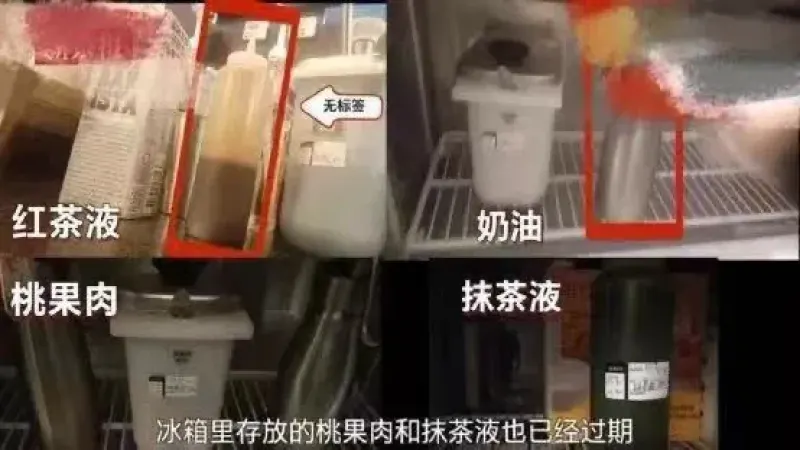
Two Starbucks stores in Wuxi were fined a combined 1.37 million yuan after food safety violations were exposed, with illegal gains of 20,000 and 10,000 yuan confiscated. The Changxing Building and Zhenze Road locations were penalized under China's Food Safety Law, and all staff at both stores were dismissed while the stores were ordered to suspend operations for rectification.
Surprise inspections by market supervision bureaus across other regions found no serious hazards, but common management gaps remained: irregular scrap records, incomplete disinfection logs, and staff not following personal hygiene rules such as wearing caps and masks. The case has renewed scrutiny of how chain restaurants balance internal oversight against cost control.
After two Starbucks stores in Wuxi were exposed for food safety issues, they not only faced mass dismissal of all staff and suspension for rectification, but also received administrative penalties totaling 1.37 million yuan. This incident sparked widespread public discussion on the current state of food safety management in the chain catering industry. Judging from the surprise inspections by market supervision bureaus across various regions, although the vast majority of stores were not found to have serious violations, management loopholes such as irregular scrap records, missing disinfection records, and inadequate enforcement of employee personal hygiene remain widespread. This article will review the course of the incident and the details of the penalties, analyze the imbalance between Starbucks' internal oversight and cost control, and explore the importance of producer self-discipline and social supervision behind food safety issues.
After the incident was exposed, Starbucks China responded via its official Weibo, stating that it was deeply shocked and immediately cooperated with market supervision authorities to conduct a closed-store investigation. Meanwhile, Starbucks stores in other regions across the country were also subjected to surprise spot checks by local market supervision bureaus. According to investigation results from various regions, apart from the two exposed stores in Wuxi, no serious food safety hazards were found in other stores; the problems were mainly concentrated in areas such as non-standard scrap record filling, incomplete disinfection records, and employees failing to strictly follow personal hygiene standards (such as not wearing work caps and masks).
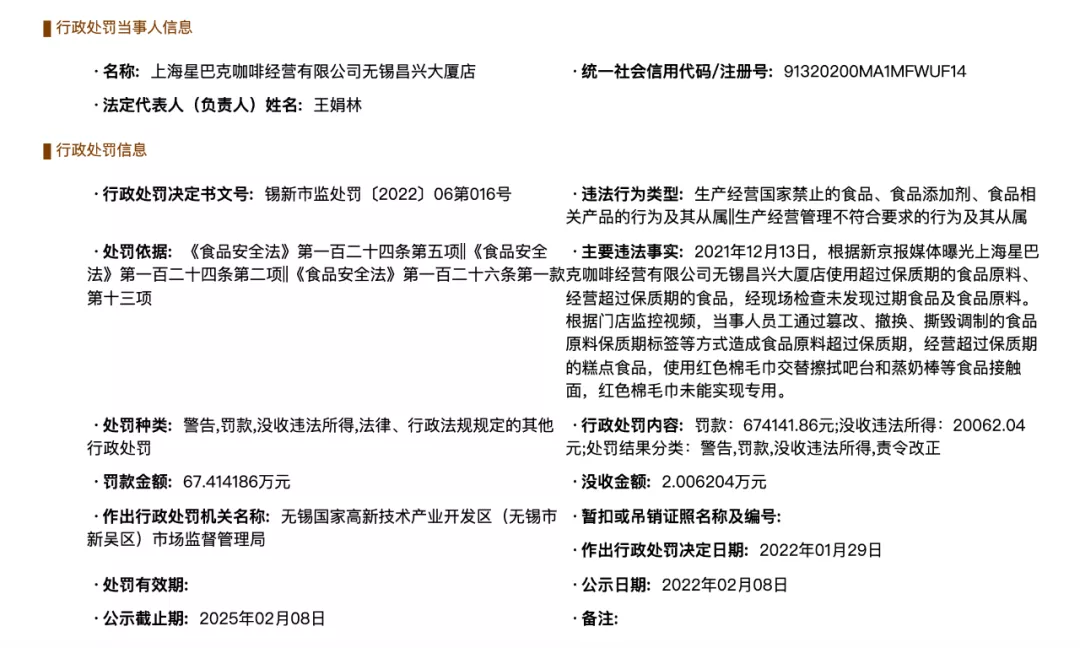
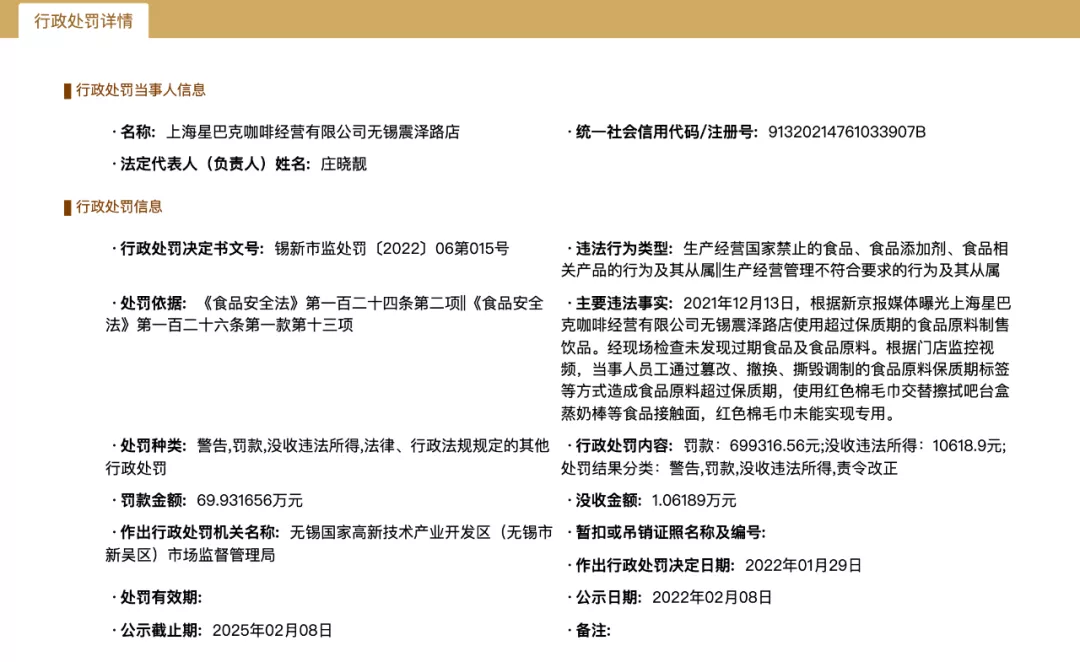
In addition to mass dismissal of all staff and orders for rectification, the two involved stores also received administrative penalty notices. According to the administrative penalty announcement published on February 8 on the National Enterprise Credit Information System (Jiangsu), the Wuxi Changxing Building store and Wuxi Zhenze Road store of Shanghai Starbucks Coffee Operation Co., Ltd. were fined 674,000 yuan and 699,000 yuan respectively for violating Article 124, Item 2 and Article 126, Paragraph 1, Item 13 of the Food Safety Law, while illegal gains of 20,000 yuan and 10,000 yuan were confiscated. Combined, the total fines amounted to 1.37 million yuan, with a total confiscation of 30,000 yuan.
From the inspection results of regulatory authorities across various regions, it can be judged that this incident does not mean that the food safety conditions of all Starbucks stores are this bad. After all, given Starbucks' scale, if most stores had similar problems, it would have long been unable to establish a foothold in the Chinese market. This is more like a typical case of "one rotten apple spoiling the barrel." However, it also exposes gaps in Starbucks' internal oversight and insufficient budget support for some stores, which forces store management to adopt a "save wherever possible" approach. Ultimately, it is wishful thinking at work.
Is Starbucks truly unaware of these violations? Clearly not. It would not be difficult to discover these problems internally; the key is whether the company has someone responsible for management, whether they manage with dedication, or whether Starbucks itself regards such behavior as a "routine operation" to save costs? We cannot determine whether this is indeed the case, but as the saying goes, "when the top beam is not straight, the bottom beam will be crooked." If Starbucks' internal oversight were truly in place, I believe no store would have made such outrageous moves.
When the news first broke, many people sided with Starbucks, believing this was just an isolated phenomenon and that management at most stores remained very strict. Indeed, this incident should not be blown out of proportion to apply to all stores. But some comments, on the other hand, reflect employees' indifference to food safety issues. For example, some blamed the undercover reporter, saying they deliberately picked a "retirement store" (a store with lower customer traffic), which was obviously a deliberate setup, and even accused the reporter of being unethical. Other comments reflect some catering practitioners' wishful attitude toward food safety, such as: "I think if it hasn't spoiled, it's fine." (More comments can be found in the comment sections of previous Starbucks-related articles; no screenshots are provided here.)
Here I just want to say one thing: if not for undercover investigations, would reporters specifically conduct targeted covert investigations? The fact that reporters went undercover precisely proves that this problem has existed for a long time, which is why it attracted the attention of whistleblowers or reporters. Second, does poor business justify ignoring food safety? Thinking that as long as it hasn't spoiled, it's fine to eat — under the principles of the Food Safety Law, factories, enterprises, and shops formulate their own food safety management systems. What is that for? It is an act of responsibility toward the public and consumers' health. If no problems arise, all is well, but what if problems really do arise? This is not children playing in the mud; the impact is not limited to individuals.
Regarding comments accusing market supervision bureaus of inadequate oversight, it should be recognized that regulatory authorities themselves face the reality of broad jurisdiction and great difficulty in supervision; they cannot keep watch over every store every day. Therefore, food safety issues ultimately depend on producers' self-discipline, and indeed require supervision from all sectors of society. Is reporting unethical? As long as it is not malicious reporting or false accusation, there is no moral problem.
Although this matter is an isolated issue, as a large well-known chain coffee company, a single "isolated issue" is enough to consume most consumers' trust, and it is impossible to cover up these mistakes just because most stores do well. Wrong is wrong; this is an indisputable fact, no matter how it was discovered.
Whether individual or collective, no one should gamble with consumers' health and safety. Once something really happens, it benefits no one. Although overnight bread will not spoil immediately, its texture may already have deteriorated; the same applies to ingredients past their labeled shelf life. Even if properly stored and no serious problems occur, since a system that better ensures food safety has already been established, why not follow it? This behavior of seemingly saving a tiny bit of cost, once something goes wrong, will result in compensation and fines far exceeding the little money saved.
Food safety is no small matter and requires everyone to take it seriously. As long as it is not malicious reporting, having these matters exposed and penalties publicly announced is not necessarily a bad thing. To restore people's trust in the brand, openly admitting and handling things fairly is the best solution.
Image source: Internet
For professional coffee knowledge exchange and more coffee bean information, please follow Coffee Workshop (WeChat public account: cafe_style)
For more specialty coffee beans, please add the private WeChat of Front Street Coffee (FrontStreet Coffee), WeChat ID: kaixinguoguo0925
The above content is compiled by CoffeeHunters, a coffee news website.


