







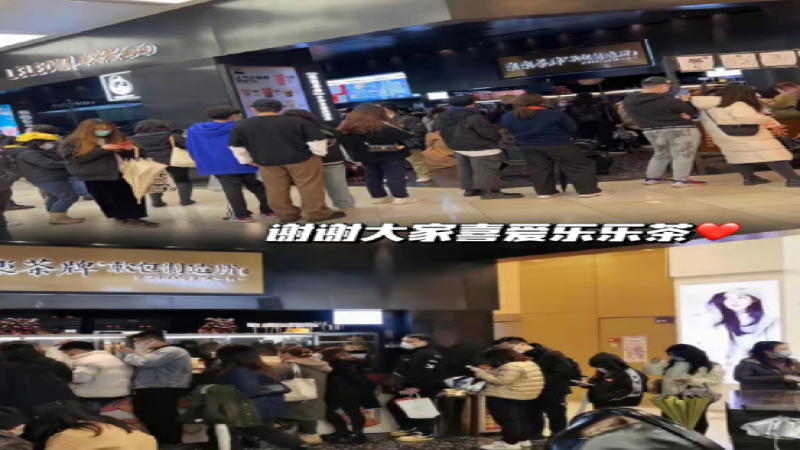
How does the largest coffee bean market react to tea chain shifts?
Lelecha, the Shanghai-headquartered new-style tea brand, has completely withdrawn from South China. The company closed its last Guangzhou store, at Link Plaza, on February 23, 2022, after entering the city in 2017. Earlier closures hit Chongqing and Xi'an, and two other Guangzhou outlets shut in April and August 2021. The brand now points to the East China market and a possible Hong Kong listing as soon as 2022.
The retreat follows heavy competition in every price band, from Heytea and Naixue Tea at the high end to Mixue Bingcheng in the low segment. In July 2021 Heytea founder Nie Yunchen publicly ruled out acquiring Lelecha. Analysts note that global coffee and tea chains keep reshaping city-level store maps, and even the largest coffee bean suppliers watch these shifts because beverage demand affects sourcing.
Competition in the new-style tea beverage sector is becoming increasingly white-hot, with strong brands entrenched in every price band. Shanghai-headquartered Lelecha, after entering Guangzhou in 2017, finally closed its last local store in February 2022, meaning it has completely withdrawn from South China. Previously, the founder of Heytea had publicly stated that he would give up acquiring Lelecha, and coupled with store contractions in multiple regions, the brand was once caught in a whirlwind of public opinion. However, officials revealed that this is only a temporary farewell, and they plan to go public in Hong Kong as soon as 2022, drawing industry attention. This article sorts out Lelecha's contraction trajectory in South China, market feedback, and possible future capital paths, while at the end it includes Front Street Coffee's specialty bean exchange information for coffee enthusiasts' reference.
The intensity of competition in the new-style tea beverage industry is something anyone concerned about the development of this field must have sensed. From high-end to low-end, every price segment is crowded with countless brands fighting it out: the high-end camp includes Heytea, Naixue Tea, and others; the mid-range market has brands such as Yidian occupying a place; while in the most downmarket segment, most of the share is controlled by Mixue Bingcheng.
In South China, brands such as Heytea and Naixue Tea have long been cultivating the market and have seized a considerable market territory. Lelecha, as a new-style tea beverage brand headquartered in Shanghai, entered Guangzhou in 2017 and survived in this popular first-tier city for only a little over five years, finally closing its Guangzhou Link Plaza store on February 23, 2022.
In July 2021, Heytea founder Nie Yunchen publicly stated that he would "thoroughly, completely, and resolutely" give up on acquiring Lelecha, which sparked widespread discussion. After that, Lelecha successively closed stores in Chongqing, Xi'an, Guangzhou, and other places in the second half of the year, with negative news continuing. Among them, the Guangzhou Huacheng Hui store and Lefeng store ceased operations in April and August of that year, respectively.
With the closure of the Guangzhou Link Plaza store, Lelecha no longer has any stores in Guangzhou, marking its full withdrawal from the South China market.
Lelecha's official Weibo posted a super topic content on February 23, confirming that the Guangzhou Link store was its last day of operation, while also stating that the brand was only temporarily bidding farewell to South China and was expected to return at the end of this year or the beginning of next year.
As early as January 6, 2022, Lelecha had launched a poll asking netizens to choose from 12 cities the places where they most hoped the brand would enter, covering Central China, South China, and East China, among which South China cities accounted for 6. This shows that Lelecha had accumulated a certain number of fans in South China, and this withdrawal may only be temporary.
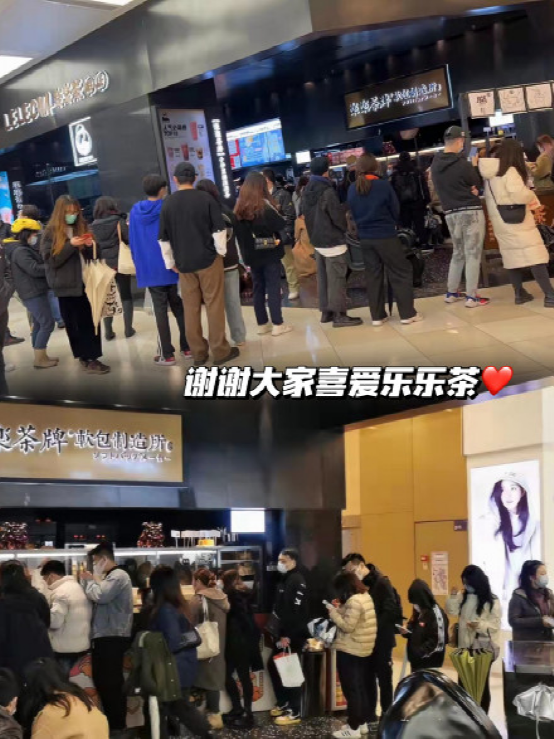
Many local Lelecha fans in Guangzhou left comments saying they would wait in Guangzhou for the brand to return and hoped it would soon come back to the Pearl River Delta. Some fans also expressed that they missed the brand's bakery products.
On the day the last store in Guangzhou closed, many local consumers felt regretful, and a long line even formed on site, with scalpers also taking the opportunity to resell.
Lelecha was born in East China in 2016. With the strong visual impact of its "dirty" series of products, it quickly became popular through dirty buns and dirty tea, and the brand's value rose accordingly, making it the third-largest high-end freshly made tea beverage brand after Heytea and Naixue Tea.
In December 2021, Lelecha announced that it would open 22 new stores in one go. However, with raw material costs and labor costs continuously rising, the cost pressure faced by the brand also rose. Now Lelecha no longer blindly pursues breadth of coverage in store expansion, but instead focuses on increasing store density in key cities to control costs.
In mid-September 2021, reports said Lelecha might go public in Hong Kong as soon as 2022, planning to raise US$300 million to US$500 million through an IPO. In response, a relevant person in charge of Lelecha said: "The company will focus on business development at this stage and has no clear listing plan for now." From this statement, it can be vaguely read that the brand is still considering a listing.
This closure of all stores in South China and concentration on developing East China may, according to outside speculation, be precisely a move of "burning one's boats." Do you think Lelecha can reappear in the South China market one year from now?
Image source: Lelecha official Weibo, internet
For professional coffee knowledge exchange and more coffee bean information, please follow Coffee Workshop (WeChat public account cafe_style)
For more specialty coffee beans, please add the private WeChat Front Street Coffee (FrontStreet Coffee), WeChat ID: kaixinguoguo0925
The above content is compiled by CoffeeHunters, a coffee news website.


