







Why did arabica coffee bean prices stay high in 2022?
Brazil's coffee regions were hit by frost, drought and then heavy rain and flooding through 2021, damaging trees and delaying flowering. As a result, the outlook for arabica coffee bean production in 2022 stayed pessimistic and futures prices remained high, even though 2022 was expected to be a high-yield year for Brazilian arabica.
In Minas Gerais, the largest producing state, growers reported flowering rates of only 50 to 60 percent of 2020 levels, which points to a much smaller fruit set. Volcafe and other institutions cut their forecasts, and rising fertilizer costs added pressure on quality. Yunnan coffee prices moved with the international market, so supply and demand changes reached everyday drinkers.
In 2021, Brazil's coffee-growing regions suffered multiple blows including frost, drought, and floods, leading to a pessimistic outlook for Arabica coffee bean production in 2022 and persistently high futures prices. Meanwhile, Yunnan small-bean coffee prices were also affected by international market trends. This article reviews the latest developments in Brazil's major producing regions, production forecasts from institutions such as Volcafe, and the impact of rising fertilizer costs on coffee quality, while also looking back at the historical fluctuations of Yunnan coffee prices. Front Street Coffee reminds enthusiasts to pay attention to how supply and demand changes may potentially affect their everyday coffee drinking.
Looking back over the past year, the situation in Brazil's coffee-producing regions has been well known to all, and coinciding with a low-yield year for Brazilian coffee, last season's harvest was less than ideal. As spring arrived in the Southern Hemisphere, coffee farms finally received the long-awaited rainfall, and the flowering progress somewhat eased concerns on all sides. However, the good times did not last long, as news soon emerged that after the coffee flowers faded, they had unexpectedly failed to bear fruit! This not only dragged down Brazil's coffee bean production but also affected Arabica coffee bean futures.
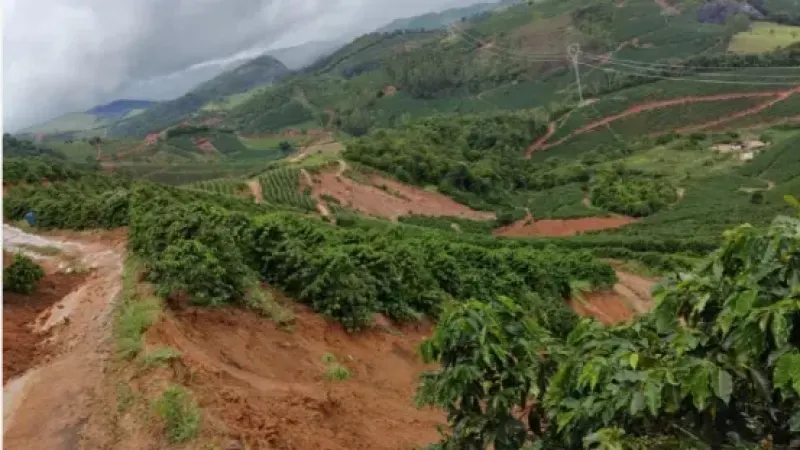
Since early December last year, Brazil's coffee-producing regions have been experiencing one misfortune after another... Days of heavy rainfall and flooding struck, and after the soil became saturated with water, it could no longer prevent rivers from overflowing, sharply increasing the risk of landslides. The continuous heavy rain also affected Brazil's largest coffee-producing region—Minas Gerais.
2022 was supposed to be a high-yield year for Brazilian Arabica coffee, meaning the country's coffee output had stronger potential this year. However, the frost in July last year damaged the coffee trees, and the drought in September delayed flowering... Growers in Minas Gerais remain rather pessimistic about their expectations for 2022 coffee production.
The head of a local coffee technical support and extension company pointed out that although this is also a high-yield year, the flowering rate of coffee trees this year is only 50% to 60% of that in 2020, so the fruit-setting rate will also shrink significantly. However, because it is a high-yield year, Brazil's overall production this year will still increase compared with previous years.
Volcafe, the world's largest coffee trader, also holds a pessimistic view, believing that the production potential of Brazil's coffee crop will fall short in 2022, and affected by climatic factors, Brazil's Arabica coffee production is expected to decrease by 17%. Meanwhile, the growth rate of coffee consumption from 2021 to 2022 is only 1%. To fill consumer demand, the market will turn to lower-priced, inferior-flavored Robusta coffee beans to replace Arabica.
Of course, it is not all bad news! Brazilian government authorities released a relatively optimistic signal this Tuesday, saying that Brazil's coffee production in 2022 is expected to increase by 16.8% over the previous year, reaching 55.74 million bags (60 kg/bag), but still below market expectations. This figure is clearly much reduced compared with Brazil's 63 million bags in the high-yield year of 2020.
Below-average harvests may create an inventory deficit and even trigger supply shortages, which will keep coffee futures prices near their highest levels in nearly a decade.
In an article published on January 21, U.S. time, The Wall Street Journal interviewed several Brazilian coffee growers. One of them said that the cost of buying fertilizer this year was three times that of last year, and they even had to register and place orders in advance, only receiving shipment after suppliers got stock. Due to fertilizer shortages, the growth and development of coffee beans will also be affected, and the quality of coffee beans in 2022 and 2023 is expected to be worse than before. Some growers, unable to cope with persistently high planting costs, have reluctantly reduced their planted area by half or even more.
Repeated outbreaks of the pandemic have led to shortages of supplies, and the frequent occurrence of various extreme weather events has further caused dismal yields for many crops. In the end, the price is borne not only by the producers at the very upstream, but also by end consumers.
Brazil is the world's largest coffee-producing country, and the international commodity coffee trade also uses it as the standard for global coffee prices, so Yunnan's coffee prices can hardly remain unaffected. For the same reason, from 2010 to 2011, driven by the previous market trend, Yunnan coffee prices once climbed to 40 yuan/kg, then fell back to 12-15 yuan/kg the following year, and since then Yunnan coffee bean prices have never returned to that high level. Over the past year, even though world coffee bean prices have soared, there is still a certain gap compared with that time, but its impact on Yunnan coffee beans deserves continued industry attention. Front Street Coffee suggests that enthusiasts keep an eye on developments in producing regions and plan their daily coffee consumption reasonably.
The above content is compiled by CoffeeHunters, a coffee news website.


