








How does Yirgacheffe respond to three-pour water distribution?
Splitting a pour-over into front, middle, and back pours lets a brewer taste each stage on its own, then shift the water ratio to fix faults. Using a washed Yirgacheffe and 15 grams of grounds, the article pours 65 grams of water three times after a 30-second bloom. The front tastes sharply acidic, the middle shows berry and honey, and the back is light with floral and tea notes.
Because each pour extracts different compounds, the middle and back amounts can be raised or lowered once the three cups are compared. This approach to coffee brewing suits beans of varying attributes, since it isolates where pleasant sweetness or unwanted flavors appear. Three sharing pitchers, a scale, and a dripper are enough to run the test.
In the practice of pour-over coffee, how to reasonably allocate the amount of water in each pour is a key step that affects the final flavor expression. Front Street Coffee recommends an intuitive method: split the extraction process into the front, middle, and back segments, collect the coffee liquid separately, and taste each one, then compare the flavor differences among the segments to find the water distribution ratio best suited to a given bean. This article uses a washed Yirgacheffe as an example, adopts the three-pour technique, and uses 15 grams of grounds to demonstrate in detail the procedure of injecting 65 grams of water in each of the three pours after blooming, and records the specific performance of the front segment as rich with acidity, the middle segment as berry-and-honey notes, and the back segment as light with floral and tea notes. On this basis, Front Street further explains how to adjust the water amount of the middle and back pours according to the tasting results, so as to avoid undesirable flavors and highlight the pleasing juice-like and sweet notes. This method applies to coffee beans with different characteristics and helps enthusiasts systematically locate the extraction stage at which good flavors and off-flavors appear.
This time Front Street will introduce a way to help everyone understand how water is distributed during the coffee brewing process. The specific approach is to break a single brew into three parts—front, middle, and back—extract them separately, and then compare the flavor characteristics of each segment one by one, thereby finding a way to adjust the brewing ratio. Because of differences in their own attributes, different coffee beans often present different flavors. In other words, with this method, certain beans with distinctive character can better display the flavor characteristics they ought to have.

Next, Front Street will give a practical demonstration. The bean chosen this time is a washed Yirgacheffe, and the brewing technique is the three-pour method. You need to prepare three sharing pitchers in advance, to hold the coffee liquid from the front, middle, and back segments respectively.
Weigh out 15 grams of coffee grounds, first pour 30 grams of water for a 30-second bloom; then the first pour is 65 grams of water. After the coffee liquid in the dripper has completely flowed into the sharing pitcher, switch to the second sharing pitcher, then the second pour is 65 grams of water. After the coffee liquid has fully flowed through, switch to the third sharing pitcher again, and finally the third pour is 65 grams of water. Once the coffee liquid has fully dripped through, the whole brewing process is finished.
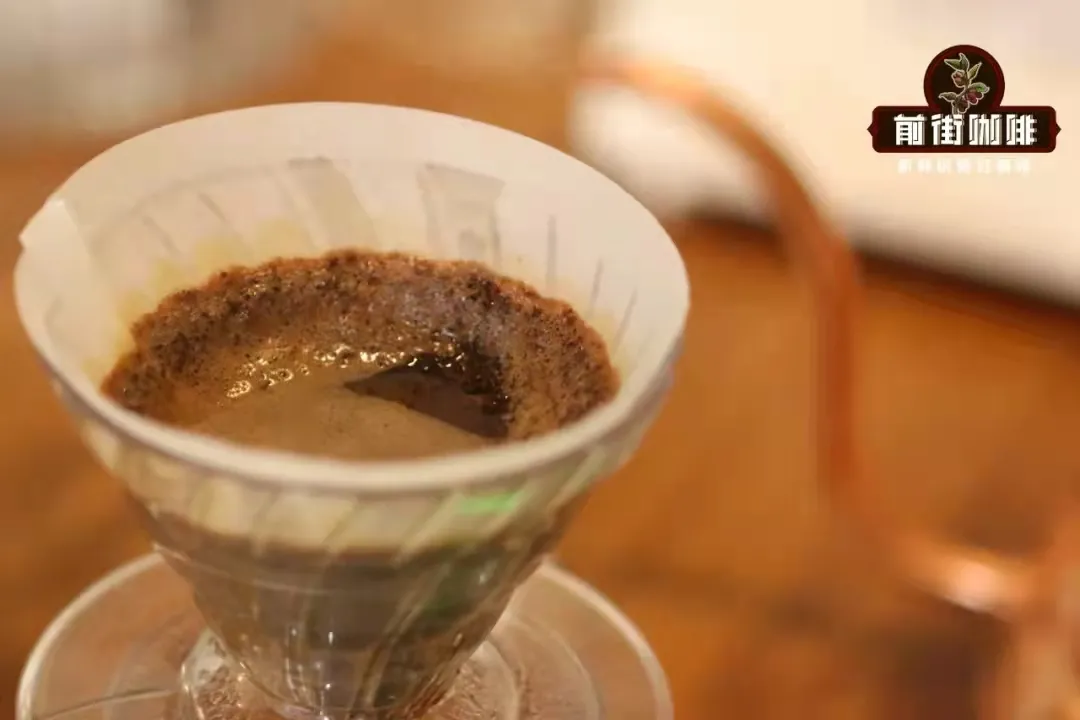
In this way we obtain three cups of coffee: front, middle, and back. By tasting the flavors of these three segments, you can determine how the water should be allocated. When Front Street tasted the front segment of this cup of coffee, the flavor felt rather rich, with an acidity like concentrated juice, though because the overall strength was on the high side, the acidity seemed somewhat sharp. By the middle segment, the coffee's strength had dropped considerably, showing a berry-like sweet-and-sour note accompanied by a honey aroma. Finally, tasting the back segment, it was basically as light as water, but the floral note was very prominent, with a tea-like feel and some woody notes mixed in.
If you encounter this situation, when allocating the water you can consider reducing the water amount in the back pour while increasing the water amount in the middle pour. This way you can both avoid some of the less ideal flavors brought by the back segment and enhance the juice-like quality of the middle segment.
Of course, this is only an example. In fact, there will be many other flavor performances. This method can also be used to verify which extraction stage a coffee bean's more pleasing flavors are mainly concentrated in, and at the same time to find out at which stage the bad flavors appear, and then solve them step by step.
The above content is compiled by CoffeeHunters, a coffee news website.


