







What does the world's most expensive coffee machine have to do with Starbucks couplets?
Starbucks worked with calligraphy artist Zhu Jingyi on Spring Festival couplets and drew widespread criticism online over the writing style and wording. Couplets carry auspicious meaning in Chinese tradition, so many saw the treatment as careless. The company has pushed guochao marketing before, from the 2020 Three Good Star Youth campaign to its 2022 New Year series, and this dispute renewed scrutiny of foreign brands using such elements.
Guochao has moved traditional patterns, fonts and motifs into modern design, and the Lunar New Year is when that style appears most. For Starbucks, which treats Lunar New Year and Christmas as major marketing moments, localisation is central, and its festive line has included shaped pastries, New Year drinks and zodiac merchandise. The episode raises the question of how far a foreign brand can adapt tradition without distorting it.
In recent years, the "Guochao" (China-chic) trend has swept across all industries, with traditional patterns and fonts being repackaged and integrated into modern design, becoming a popular direction for brand marketing. The Lunar New Year is a key moment for major brands to showcase their "Guochao" creativity. This year, Starbucks collaborated with calligraphy artist Zhu Jingyi to launch Spring Festival couplets, attempting to interpret traditional Spring Festival elements in a trendy way, but it sparked widespread questioning from netizens due to the writing style and content expression. This is not Starbucks' first attempt at "Guochao"; from the "Three Good Star Youth" in 2020 to the 2022 New Year series, its strategy has gradually escalated. However, as Spring Festival couplets are an important carrier of traditional culture, bearing auspicious meanings, this controversy also prompts reflection on how foreign brands can appropriately use "Guochao" elements.
In recent years, "Guochao" has gradually become a popular trend, with more and more brands beginning to incorporate traditional patterns, fonts, and motifs that were once considered "old-fashioned" by young people into modern design in a simplified way. As a result, "Guochao" has developed into a representative of a distinctive niche culture.
Due to the extensive integration of traditional elements in design, the Lunar New Year each year is the period when "Guochao" is most fully displayed. Whether domestic or foreign brands, many take advantage of this festival that Chinese people all value to bridge the gap between the public and traditional Chinese culture through "Guochao," condensing and transforming historical accumulation into specific brands and products.
For Starbucks, which would not miss the two major festivals of the East and West (Lunar New Year and Christmas) as marketing scenarios, "Guochao" naturally cannot be left out. In order to integrate the imported coffee more deeply into the traditional scene of the Chinese Lunar New Year, Starbucks not only launched shaped pastries with Spring Festival elements, drinks rich in "New Year flavor," and various zodiac-shaped merchandise, but this year also teamed up with trendy calligraphy artist Zhu Jingyi to launch "Guochao" calligraphy Spring Festival couplets, using the homophonic phrase "together in the New Year" to convey to consumers the idea that no matter where you are or how you celebrate the New Year, Starbucks will "stick" with you...
In terms of using "Guochao," Starbucks is not trying it for the first time.
In 2020, Starbucks launched the "Three Good Star Youth" series as a "test of the waters," using it to observe consumers' reactions and spending power regarding a foreign brand's use of "Guochao." This series seemed lukewarm, but it reflected that Chinese people do not dislike this approach; they just lacked a scenario to support it. Afterwards, Starbucks also launched several merchandise items incorporating "Guochao" design, but did not promote them heavily. It was not until the 2022 New Year series that Starbucks officially established "Guochao" as the theme, and the intensity of promotion and scenario application increased significantly compared to before.
"Guochao" cannot always be plain and unimaginative. Even when writing couplets, it must be unconventional. So Starbucks teamed up with Zhu Jingyi, known as the "mudslide" of the calligraphy world, to create two sets of couplets without paying attention to "tonal patterns and rhyme" or "traditional writing."
(Starbucks' explanation for this is that it is not limited to tradition, making it seem more interesting, a new interpretation of Spring Festival couplet text, and a new calligraphy art.)
And this "calligrapher" is likewise headstrong, known as the "madman" of the calligraphy world. His calligraphy works have text content similar to jokes, diverse and varied, with no rhyme to speak of. His writing style is somewhat similar to the street graffiti style of Zeng Zaocai, who called himself the "Kowloon Emperor" in Hong Kong back then.
(This is handwriting left on the street by the "Kowloon Emperor")
(Starbucks in Hong Kong also once applied this graffiti style to its interior decoration)
Not confined to paper, he writes wherever he likes, the font is not neat and symmetrical, and the content is whatever he wants to write, thereby highlighting his uniqueness. But his behavior was also once questioned by netizens... Some believe this uses the phrase "new-style calligraphy art" to forcibly integrate foreign "street graffiti" culture into traditional Chinese culture, which constitutes "cultural invasion"... Regarding Zhu Jingyi's style, netizens say he is not worthy of being a "calligrapher," lacking reverence for culture and understanding of tradition.
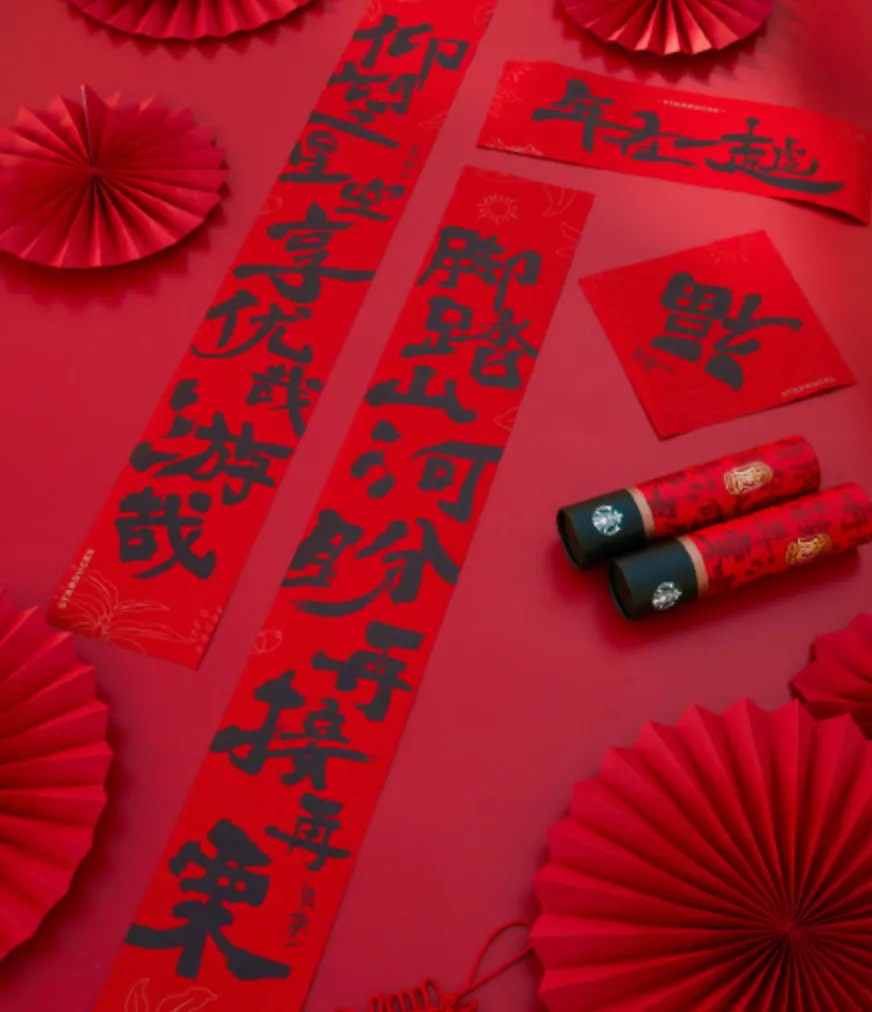
(Zhu Jingyi's calligraphy works)
As for the Spring Festival couplets launched by Starbucks this time, netizens naturally could not sit still. Writing on white paper, walls, or other places can still be regarded as art, but writing on couplet paper is unacceptable. The content of netizens' criticism mainly revolves around "no calligraphic beauty at all, very disrespectful to traditional Chinese culture." The content also reads rather awkwardly... "Look up at the stars and enjoy leisure, tread upon mountains and rivers and hope to continue the good work" "Think long or short, just love sticking by your side; busy east or west, still find time to steal a moment of leisure."
Starbucks' launch of "Guochao Spring Festival couplets" this time is presumably also intended to interpret traditional Spring Festival elements through a trendy style, while the couplet content breaks traditional frameworks and adopts attitude-filled copy that young people like, condensing the two unrelated things of "coffee" and "Chinese New Year."
Obviously, Starbucks messed up this time... To be precise, Starbucks picked the wrong person this time. Because Spring Festival couplets are not just a decoration, but an important part of traditional Chinese culture. The couplets themselves also carry auspicious meanings, and although these two sets of couplets from Starbucks are consistent in word count, their content and writing style are far too frivolous.
Image source: Internet, Weibo
Professional coffee knowledge exchange. For more coffee bean information, please follow Coffee Workshop (WeChat public account: cafe_style).
For more specialty coffee beans, please add private WeChat Front Street Coffee (FrontStreet Coffee), WeChat ID: kaixinguoguo0925.
The above content is compiled by CoffeeHunters, a coffee news website.


