







Can a UNESCO Listing Save French Coffee Culture?
The number of cafés in the three departments around Paris has fallen 40 percent in twenty years, from 1,970 in 2002 to 1,410 today, a decline that reaches into the core of French coffee culture. Remote work and changing consumer habits have left many corner shops empty, and the count excludes tobacco shops that also sell coffee.
The industry has twice applied to France's Ministry of Culture for intangible cultural heritage status and plans another attempt this year, with President Macron voicing support. Parisian cafés date to Café Procope in the Enlightenment, later hosting revolutionary gatherings, and today modern coffee machines and takeaway habits add further pressure on the traditional model.
Paris has long been famous worldwide for its romance, and the cafés along the Seine are part of the city's very soul. Yet data shows that over the past two decades, the number of cafés in the three departments on the outskirts of Paris has plummeted by 40 percent, from 1,970 in 2002 to 1,410 today. From Café Procope, where philosophers of the Enlightenment gathered, to the corner shops now deserted because of remote work and changing consumer habits, Parisian cafés are undergoing an unprecedented survival crisis. The French industry has twice submitted applications to the Ministry of Culture for intangible cultural heritage status and plans to make another attempt this year, with President Macron also expressing support. This article will walk you through this battle over the survival of the French art of living.
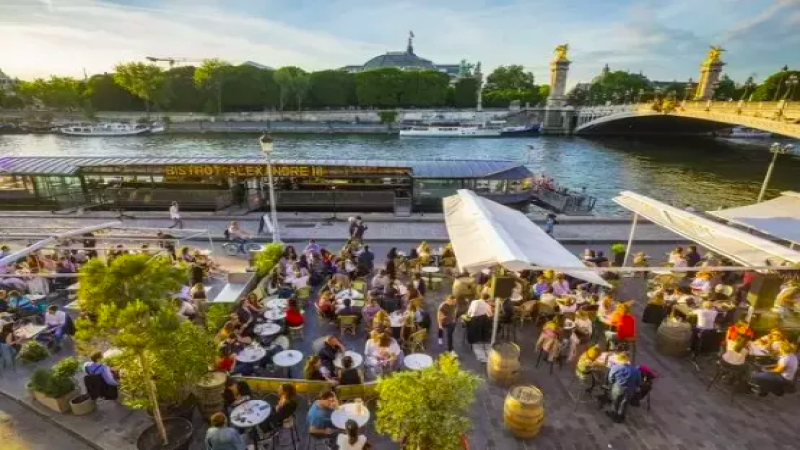
Paris, a city renowned for its romance. At the closing ceremony of last year's Tokyo Olympics, France planted the image of Paris deep in the hearts of viewers around the world. Years earlier, a French survey of tourists had already concluded that cafés are the most attractive places in this romantic capital. People sit on imitation rattan chairs on both banks of the Seine, savoring the rich coffee in their cups, either debating passionately with friends or whispering softly with their partners.
Yet Parisian cafés are disappearing one after another, and their situation is dire. A study by the French Chamber of Commerce and Industry shows that the number of cafés in the three departments on the outskirts of Paris has dropped by 40 percent over the past 20 years, from 1,970 in 2002 to 1,410 today, and this is only data for traditional cafés, not yet counting tobacco shops that also sell coffee.
In fact, cafés have long been deeply etched into Paris's urban DNA. During the Enlightenment, Paris's first café, Café Procope, was born, and famous French philosophers such as Voltaire and Rousseau once sat there drinking coffee while engaging in heated debate. Cafés even became the cradle of the French Revolution; the battle cry for storming the Bastille was sounded at Café de Foy in Paris. After the revolution, Parisian cafés continued to provide warm shelter for many literary creators. Cafés thus became an indispensable part of the French art of living.
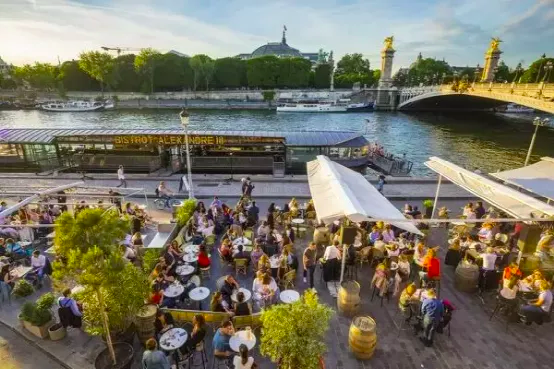
However, this harbor is no longer as lively and warm as it once was, replaced instead by quiet and desolation. Central Paris has been relatively less affected. In the 2nd and 3rd arrondissements, the number of cafés increased by 17 percent and 15 percent respectively over 20 years, closely related to the growth in tourist numbers in central Paris; the 1st arrondissement, by contrast, is an exception, with cafés there decreasing by 46 percent, because renovation projects on some large buildings created numerous construction sites and weakened the area's appeal.
The decline in physical coffee shops is equally inseparable from shifts in people's consumption habits. France introduced the 35-hour workweek in 2000, and lunch breaks were consequently shortened, greatly reducing the time consumers spent in cafés. The arrival of the COVID-19 pandemic left cafés with only employees on site for a time, and combined with a series of restrictive measures introduced by the government, many cafés saw their revenue shrink sharply, struggled to operate, and were even forced to close.
Affected by the pandemic, the proportion of offices and households equipped with coffee machines rose significantly, and people did not necessarily have to go to a café to satisfy their daily coffee cravings, further worsening the loss of café foot traffic. Marcel Bénézet, a member of the Paris Chamber of Commerce and Industry, pointed out that since mandatory remote work and the ban on standing consumption in food and beverage establishments were introduced, the revenue of Paris restaurants and cafés has shrunk by nearly 50 percent.
Xu Zhimo once said, "If Paris had fewer cafés, it would probably become utterly unlovable." Parisian cafés are being hit hard. Before the pandemic, the legendary two-hundred-year-old café Les Deux Magots caught fire, which was deeply regrettable. Now research has even concluded that the number of Parisian cafés is declining year by year, falling by 40 percent over 20 years. Unlike today's popular grab-and-go coffee culture, the lifestyle of ordering one cup and sitting for a whole day is dying out, and without these, perhaps Paris, too, is becoming unlovable.
As France's earliest social network, cafés have long been a symbol of the French art of living. The French industry set up a dedicated association and twice attempted, in 2019 and 2021, to submit applications to the Ministry of Culture, hoping to have France's outdoor cafés and bistros inscribed on UNESCO's Intangible Cultural Heritage list. Now that 2022 has arrived, the association plans to resubmit its application this year, and French President Macron has also expressed support for this.
Perhaps one day, people will be able to take off their masks and sit amid French intangible cultural heritage, savoring Italian intangible cultural heritage.
Image source: Internet
For more coffee bean information, please follow Coffee Workshop (WeChat public account cafe_style) For professional coffee knowledge exchange, please add WeChat ID kaixinguoguo0925
The above content is compiled by CoffeeHunters, a coffee news website.


