







How Are International Coffee Brands Competing in China?
Luckin Coffee's preference score in China passed Starbucks for the first time in the 2021 Golden Signboard survey, and by September 30, 2021 it operated 5,671 stores nationwide, with stronger reach in new first-tier and second-tier cities. Starbucks is responding by planning at least 22,000 new global stores over eight years, adding small-format and drive-thru locations.
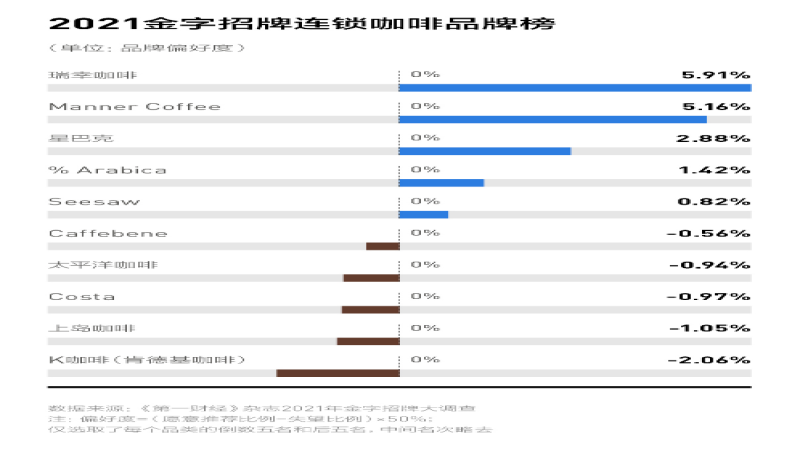
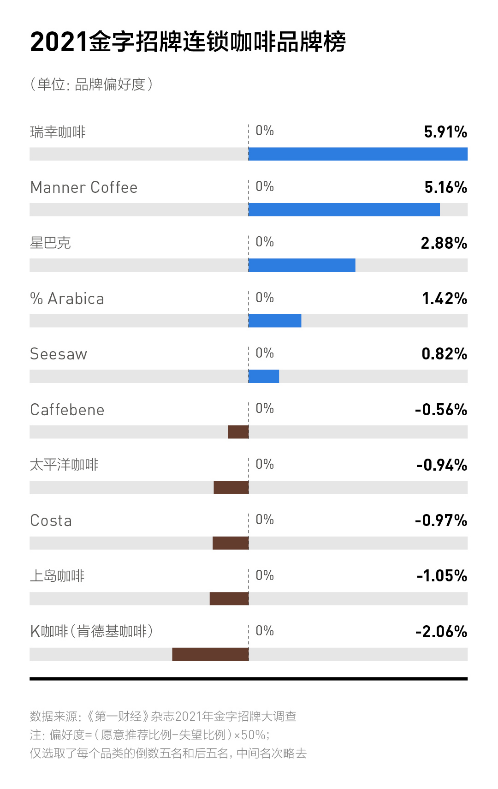
The shift matters because China's coffee market is expanding while local chains gain ground. Luckin posted 2.35 billion yuan in third-quarter 2021 net revenue, and its recommendation score of 5.91% topped Starbucks at 2.88%. Manner followed at 5.16%, showing how international coffee brands now compete with homegrown rivals on price, convenience and taste.
Modern office workers can't survive without coffee, but have you ever noticed which shop you frequent? A recent survey shows that Luckin Coffee's preference score has surpassed Starbucks for the first time, making it the top chain coffee category in China. By the end of September 2021, Luckin had 5,671 stores nationwide and was more deeply penetrated in new first-tier and second-tier cities than Starbucks. Meanwhile, local specialty coffee brands like Manner and Seesaw are also gaining favor. Facing the siege, Starbucks is accelerating its online and offline layout, planning to open at least 22,000 new stores globally over the next eight years, and expanding small-format stores and "drive-thru" new store types. China's coffee market is rapidly expanding, and competition is intensifying.
As the most self-aware move of contemporary office workers, nothing beats vowing to sleep early during the day, then voluntarily staying up all night binge-watching dramas, and the next day walking to the coffee shop with dark circles under your eyes to queue up for a life-saving cup, waiting for that aromatic, delicious coffee to get you back to the grind.
But have you ever noticed which shop you usually buy coffee from? Urban elites in the CBD might go to the somewhat upscale Starbucks; while more office workers tend to head to Luckin Coffee, known as "China's Starbucks."
According to the "China Urban Chain Coffee Consumption Report" released by Yicai Magazine's 2021 Golden Signboard Survey, Luckin Coffee's preference score surpassed Starbucks for the first time in the chain coffee category, ranking first. The number of people willing to recommend Luckin to others was significantly higher than those disappointed with it, with a preference score of 5.91%, far higher than Starbucks' 2.88%.
In addition, China's homegrown specialty coffee brands Manner and Seesaw also have high brand preference scores. Among them, Manner Coffee's brand preference score is much higher than Starbucks, reaching 5.16%, closely following Luckin Coffee. In the survey, the reasons given by those willing to recommend Luckin were mainly concentrated in three aspects: "high cost-effectiveness," "convenient purchasing channels," and "good product taste."
According to Luckin Coffee's public data, as of September 30, 2021, Luckin had 5,671 stores nationwide. Luckin also turned a profit, with total net revenue of 2.35 billion yuan in the third quarter of 2021. From the perspective of city tiers, among consumers in new first-tier and second-tier cities, more chose Luckin than Starbucks, meaning Luckin Coffee's consumer market is more deeply penetrated than Starbucks.
In addition, Luckin, a brand several decades younger than Starbucks, has already surpassed Starbucks in the number of stores in mainland China. Luckin Coffee is not only alive but doing quite well.
Chinese local brands like Luckin and MANNER are booming in the market and have received multiple rounds of financing. Their rise has put Starbucks under siege, and Starbucks is also facing a more complex competitive landscape. In response, Starbucks has chosen to accelerate its online and offline layout, launching on Meituan after its cooperation with Ele.me expired, and introducing the "1971 Living Room" service to broaden the boundaries of the "third space," making greater use of different store types to provide venues for business and casual gatherings, meeting spatial needs for gatherings, meetings, work, and study, and planning to open 60 "Greener Stores" in mainland China.
In addition, the emergence of many international coffee brands such as Peet's and Tim Hortons means that even in the international market, Starbucks is no longer the sole dominant player. In response, Starbucks plans to open at least 22,000 new stores globally over the next eight years, no longer limited to traditional "third space" stores, but including small-format stores and "drive-thru" stores.
China's coffee market is in a stage of rapid growth, and some brands that originally made instant coffee, such as Saturnbird, have also opened offline stores. Meanwhile, in China's other equally hot beverage track, tea drink brands like Heytea, Nayuki, Yihotang, and Mixue Bingcheng have long started selling milk tea.
China's coffee market is being sliced thinner and thinner—can you blame those brands for being anxious?
Image source: Internet
For more coffee bean information, please follow Coffee Workshop (WeChat public account: cafe_style) For professional coffee knowledge exchange, please add WeChat ID: kaixinguoguo0925
The above content is compiled by CoffeeHunters, a coffee news website.


