







What is the arabica definition in espresso and black coffee?
Espresso does count as black coffee, since black coffee means coffee with no sugar or milk added. The category covers pour-over, siphon, French press, moka pot and espresso. Standard espresso is extracted with water at about 92 to 94 degrees Celsius under 9 bar of pressure in 20 to 30 seconds, yielding around 30 milliliters with a dense crema layer on top.
The arabica definition matters here because bean type shapes flavor and crema. Espresso has a concentration of 9 to 11 percent, compared with about 1.2 to 1.4 percent for pour-over, which is why many people add sugar or milk to balance the taste. Lattes and cappuccinos made with added milk fall into white coffee, not black coffee.
Many people habitually refer to coffee without sugar or milk as black coffee, but does espresso actually count as black coffee? What exactly is the relationship between espresso and black coffee? This article starts from the definition to clarify the logic of how espresso fits into the category of black coffee, and takes a deeper look at espresso's extraction standards, the formation principle of Crema, the effect of roast level on the thickness of the crema, and the flavor differences brought by different coffee beans. At the same time, by combining Front Street Coffee's Espresso Premium Blend and Sunflower Warm Sun Blend, it presents the specific performance of espresso in terms of mouthfeel and flavor, helping coffee lovers understand this classic coffee type more systematically.
According to today's common understanding, black coffee refers to coffee with no sugar or milk added and a dark-colored liquid, where what you taste is the flavor of the coffee beans themselves. Black coffee covers a very wide range: pour-over, siphon, French press, moka pot, and espresso made with an espresso machine can all be included within it.
Here Front Street needs to clarify one easily confused point: espresso is indeed a type of black coffee, but the broader category of espresso-based coffee is not all black coffee. Drinks such as lattes and cappuccinos, which are made by adding milk to espresso, belong to the category of white coffee.
The extraction of standard espresso follows a clear set of parameters—hot water at about 92 to 94 degrees Celsius, under 9 bar of atmospheric pressure, passes through a finely ground and evenly tamped puck of coffee in 20 to 30 seconds, ultimately yielding about 30 milliliters of finished coffee. The surface is covered with a thick, dense layer of coffee oil foam, known as Crema, mostly golden yellow and brown in color, though nowadays it also shows variations in depth depending on the roast level. Because the taste is extremely intense, many people choose to add sugar or milk to balance the bitterness.
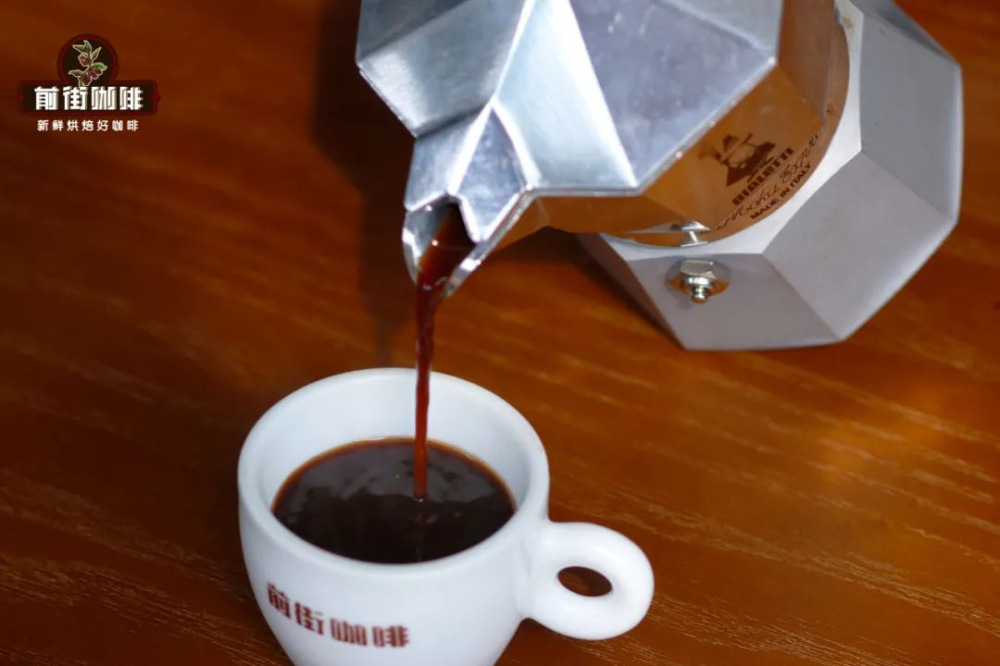
Among all coffee types, espresso has the richest mouthfeel and the highest concentration, usually falling between 9% and 11%, while the concentration of pour-over coffee is only about 1.2% to 1.4%. The key to espresso having such a thick texture lies in that rich layer of Crema. During roasting, coffee beans accumulate a large amount of carbon dioxide inside, and after grinding these gases quickly escape. Espresso extraction relies on high pressure to rapidly force out the flavor, and under 9 bar of pressure and a sealed environment, carbon dioxide and water form a supersaturated state, while the coffee oils are emulsified at the same time, carrying gas and coffee liquid together as they are extracted. The oil is less dense than water, so after extraction it gradually separates into layers, and the golden oil floats to the surface, creating a very enticing visual effect.
The degree of roasting also determines how rich the crema is. The darker the roast, the more carbon dioxide the beans produce, and at a deep roast level they become highly dehydrated and show oil on the surface. This also explains why, when making SOE single-origin espresso with light-roasted beans, no matter how the extraction is adjusted, the crema always seems thin.
The flavor direction of espresso depends on the coffee beans chosen. Taking Front Street Coffee's beans in Italy as an example, Front Street Coffee's Espresso Premium Blend uses a pure Arabica blend from Brazil and Colombia, with a flavor close to the traditional Italian style, presenting rich nutty, chocolate, and caramel notes; if you drink the espresso directly, you can also catch a soft fruity acidity.
The other one is the Sunflower Warm Sun Blend currently used by Front Street Coffee's stores, made by blending two single-origin beans, Honduras Sherry and Ethiopia Yirgacheffe Red Cherry, with flavor notes of rich vanilla cream, sherry wine aroma, chocolate, and brown sugar.
For professional coffee knowledge exchange and more coffee bean information, please follow Coffee Workshop (WeChat public account: cafe_style)
For more specialty coffee beans, please add the private WeChat of Front Street Coffee (FrontStreet Coffee), WeChat ID: qjcoffeex
The above content is compiled by CoffeeHunters, a coffee news website.


