








How Does a Flat White Differ From a Latte?
A flat white and a latte use the same basic parts, espresso and steamed milk, and the difference sits in the milk foam and the balance. A flat white gets a thin layer of fine microfoam, roughly a few millimeters, so the espresso stays forward. In Australia a latte is served with about a centimeter of foam sitting slightly above the cup rim, tasting more like hot milk with coffee flavor.
Starbucks gave the drink its Chinese name and drove much of its popularity, while Luckin calls it Australian White and JPG simply Little White. The style traces to the 1980s, when Italians brought espresso to Melbourne and other Australian cities. A cappuccino, by contrast, carries a thicker foam hat of about two centimeters, so the first sip is mostly airy bubbles and the coffee aroma reads differently.
Flat White, Australian White, Little White... the same Flat White milk coffee has its own name at different chain brands. After Starbucks named it "Flat White" in Chinese, this drink quickly became popular in China. What exactly is the difference between it and a latte? How do the thickness of the milk foam, the espresso extraction method, and the milk ratio affect the final taste? This article will start from the origin of Flat White, compare its essential differences with latte, and share the specific parameters and flavor performance of Front Street Coffee's Flat White, helping coffee lovers understand this rich milk coffee more comprehensively.
The same milk coffee gets a different name at different chain brands. Starbucks calls it Flat White in Chinese, Luckin calls it Australian White, and JPG simply calls it Little White... This drink is actually Flat White, usually translated into Chinese as Australian White coffee.
Why Flat White Became Popular
The fact that Flat White has become a popular drink owes much to Starbucks' promotion, and the Chinese name "Flat White" was given by Starbucks. Although each brand calls it by a different name, the goal is the same—to make the coffee aroma more prominent. Therefore, baristas adjust according to the characteristics of the coffee beans used in the store to create a cup of Flat White that matches their own style.
A freshly made Flat White should be covered with a layer of fine and thin milk foam on the surface, and the espresso's Crema should also be faintly visible. In this way, the milk fragrance is full on the first sip, while the coffee aroma brought by the Crema is clear and pleasant, and after drinking, a memorable aftertaste remains in the mouth. (Crema is the golden foam floating on the surface after extraction, often also called oil)

In the 1980s, Italians brought espresso to Melbourne and other places in Australia. In Australia, when latte coffee is served, the milk foam layer is about 1 cm thick, slightly above the rim of the cup, and it tastes more like hot milk with a coffee flavor. Although cappuccino has a stronger coffee flavor, its milk foam is thicker and can puff up into a 2 cm high "hat," so the first sip is often full of bubbles.
As people's demands for coffee continued to rise, Australians were no longer satisfied with the balanced taste of hot latte, but hoped to taste both the flavor of perfectly extracted espresso and the sweetness of thin, dense milk foam. So baristas began to adjust the extraction method, milk ratio, milk foam thickness, and other aspects, gradually developing the Flat White with a more prominent coffee flavor. In 2015, Starbucks launched this milk coffee in China, naming it "Flat White," and it quickly became popular nationwide.
The Difference Between Flat White and Latte
Latte and Flat White both belong to milk coffee, and both are based on espresso plus milk, but the most fundamental difference between the two is reflected in taste and mouthfeel.
What latte pursues is the balance between coffee and milk, so you can taste both the coffee flavor and the sweet, mellow richness of the milk, with the two complementing each other and neither overpowering the other. Flat White, on the other hand, uses milk to highlight the coffee flavor; coffee is the protagonist, and milk only plays a supporting role. Therefore, Flat White tastes more coffee-forward and richer.
Although Flat White has distinctive characteristics, there is no fixed preparation ratio. Baristas present this rich milk coffee according to their own understanding, giving rise to two methods. One uses Double Ristretto as the base, adds a smaller proportion of steamed hot milk, and highlights a rich taste; the other uses Single Espresso, fused with thin milk foam, forming the so-called "small latte." Front Street believes that to reflect the unique mouthfeel of Flat White, several elements should be present: strong coffee, a small cup volume, and silky thin milk foam.
Compared with other hot milk coffees, Flat White's milk foam is the thinnest, usually between 0.3 and 0.5 cm. The "Flat" in flat white means flat, and the milk foam must be thin enough to be level with the rim of the cup, not puffing above it, so that every sip of rich coffee liquid carries a dense layer of foam. Therefore, Flat White is also called "flat white coffee." Latte's milk foam mostly puffs up 0.5 to 0.7 cm, while Australian white coffee's milk foam must be controlled below 0.5 cm, otherwise the liquid surface cannot be "flat." Front Street hopes that the Flat White customers drink will be creamy and smooth, but not too "watery," so it retains a 0.3 cm milk foam layer.
The Flavor Performance of Flat White
Front Street believes that the emergence of Flat White comes from everyone's continuous pursuit of the flavor and mouthfeel of specialty coffee beans. Therefore, each coffee shop, depending on the coffee beans used and its understanding of Flat White, will present its own unique style.
For example, the espresso blend used by Front Street is its own roasted "Sunflower Warm Sun Blend," composed of 70% Honduras Sherry coffee and 30% Yirgacheffe natural Red Cherry coffee. Sherry's whisky, vanilla, and cream flavors, combined with Red Cherry's tropical fruit and fermented notes, make the coffee in the cup rich yet soft.
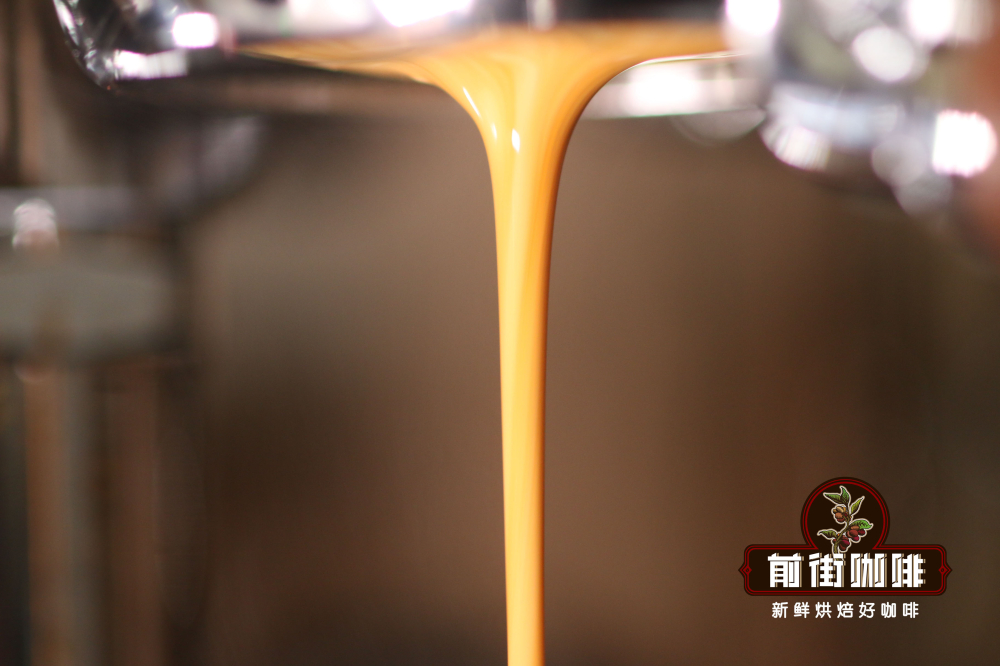
For the coffee base, Front Street Coffee chooses Double Ristretto, using 20 grams of coffee powder to extract 30 grams of coffee liquid, with the extraction time controlled at 25 to 27 seconds. But Front Street Coffee reminds everyone that the extraction plan for each coffee bean will differ slightly; this plan is a parameter adjusted by the barista before opening each day according to the Warm Sun Blend used in the store.
Pour the extracted coffee liquid into a pre-prepared cup with a capacity of about 200 ml, then measure 150 ml of milk and pour it into a milk pitcher to steam. When steaming the milk, incorporate less air than for a latte, and make the foam layer thinner and denser, with the temperature preferably controlled at 55 to 60 degrees Celsius, so it is easier to drink. Finally, evenly incorporate the steamed milk into the coffee liquid.
Front Street's Flat White presents flavors of chocolate milk and whisky-filled chocolate, with a dense and mellow entry and a very long-lasting aftertaste.
For professional coffee knowledge exchange and more coffee bean information, please follow Coffee Workshop (WeChat public account: cafe_style)
For more specialty coffee beans, please add the private WeChat Front Street Coffee, WeChat ID: qjcoffeex
The above content is compiled by CoffeeHunters, a coffee news website.


