







Where does kopi luwak origin coffee actually come from?
Authentic kopi luwak originates from Indonesia, where wild civets eat coffee cherries and the beans ferment inside the animal before being excreted. Global annual output is extremely low, which explains the high price. Much of the kopi luwak sold in Vietnam is instant powder that dissolves in hot water; these products are effectively kopi luwak-flavored coffee and not genuine kopi luwak, which cannot sell at such low prices.
The flavor of civet coffee is distinctive: an earthy, gamey profile with viscosity close to syrup, an aroma of honey and chocolate, and a faint minty coolness that lingers after drinking. It tastes sweet and smooth without sugar or creamer, and stays round as it cools. Front Street Coffee brews Indonesian kopi luwak with a KONO dripper and specific parameters.
Kopi Luwak is regarded by many as the "aristocrat" of the coffee world, but what exactly is its origin? Is the large quantity of Vietnamese kopi luwak circulating on the market genuine? Authentic kopi luwak originates from Indonesia, officially called "civet coffee" (Kopi Luwak), produced by wild civets eating coffee cherries and undergoing fermentation within their bodies, with extremely low global annual output and a high price. This article will systematically outline the origin, flavor characteristics, authenticity identification, and animal welfare controversies of kopi luwak, and provide a detailed introduction to the parameters and techniques used by Front Street Coffee (FrontStreet Coffee) for brewing Indonesian kopi luwak with a KONO dripper.
There is a coffee crowned with the name "kopi luwak," truly the "aristocrat" of the coffee world. Indonesian coffee itself often carries an earthy aroma and a taste reminiscent of Chinese medicine, rich and thick. Kopi luwak's earthy, gamey flavor is even more pronounced, and its viscosity is almost close to syrup. It emits a unique aroma, and after drinking, a faint minty coolness remains in the mouth—an experience that ordinary coffee finds hard to replicate. After finishing a cup, take a deep breath, or hold a sip of cold water in your mouth, and it feels as if you have just chewed a mint candy, with a coolness running from your mouth to your throat.
Once brewed, kopi luwak releases an aroma resembling honey and chocolate. Even without adding sugar or creamer, it still has a sweet, smooth taste—not bitter, not sour, not astringent—and it does not irritate the stomach and intestines after swallowing. Even when the coffee cools down, the mouthfeel remains round and mellow.
The market is flooded with various kinds of kopi luwak, most of which are Vietnamese. Can these be considered authentic kopi luwak? Vietnam exports an enormous amount of coffee and is the world's second-largest coffee producer, mainly cultivating the Robusta variety, and Robusta is usually used for instant coffee and as a blending aid for espresso. The kopi luwak sold in Vietnam is mostly in instant form—the kind that comes in packets and dissolves directly in hot water. These products are actually fake kopi luwak and can only be called kopi luwak-flavored coffee, not genuine kopi luwak. Authentic kopi luwak cannot possibly sell at such a low price; its production volume fundamentally determines that it cannot be sold cheaply. Kopi luwak-flavored coffee merely imitates a similar flavor and contains no kopi luwak ingredients whatsoever.
Kopi Luwak
Authentic kopi luwak comes from Indonesia, originally called "civet coffee," with kopi luwak being merely its colloquial name; its official name is "Kopi Luwak." Kopi means "coffee" in Indonesian, while Luwak refers to a wild animal called the "civet." The history of civet coffee can be traced back to the Indonesian colonial period, when the Dutch government prohibited locals from picking and roasting coffee in the plantations, yet unexpectedly discovered that coffee beans excreted by wild civets after eating them in the plantations had a remarkably distinct and delicious flavor.
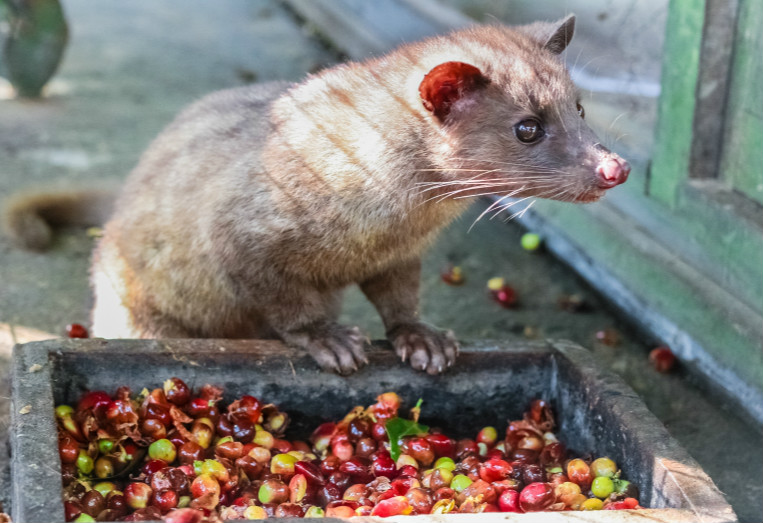
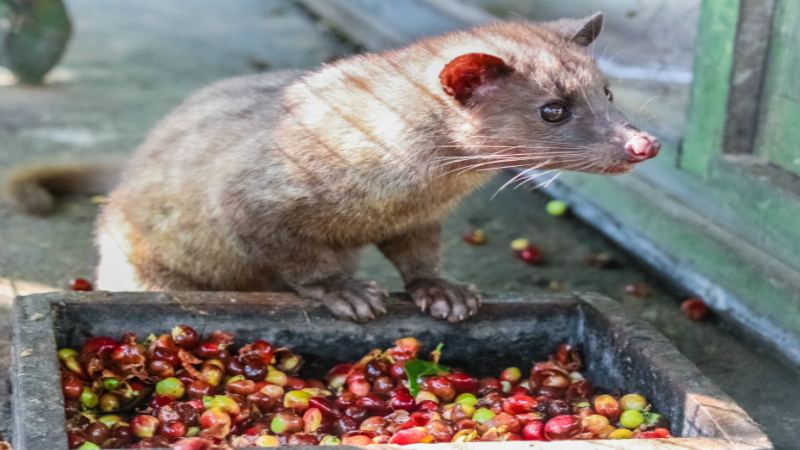
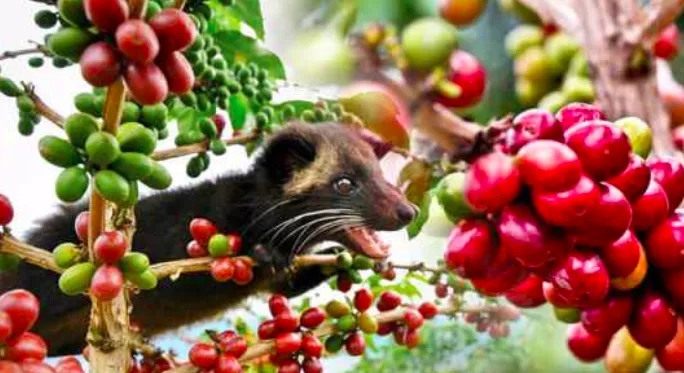
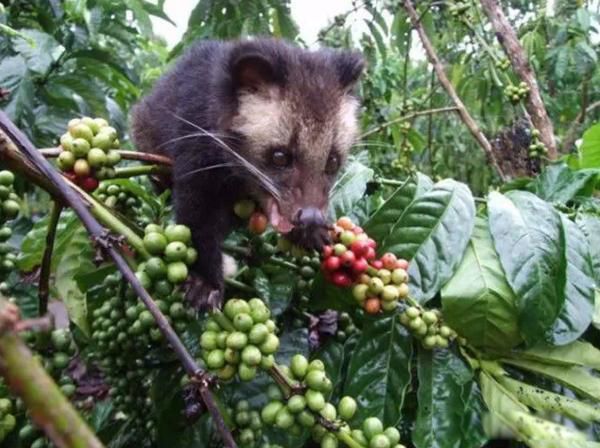
Kopi Luwak was originally extracted from the feces of an animal called the civet on the Indonesian island of Sumatra, then further processed into green coffee beans. Although this most expensive coffee is associated with excrement, it is precisely this that gives kopi luwak its superb taste. The civet is a wild omnivorous animal that locals habitually call "luwak," with a pointed snout and dark gray fur, fond of selecting ripe, sweet, fully red coffee cherries to treat itself. The pulp of the coffee cherry is decomposed and digested in the civet's digestive tract, while the hard, indigestible coffee beans are excreted with the feces. The coffee beans undergo natural fermentation within the body, creating the wondrous processing of kopi luwak: when the civet excretes the coffee beans, the feces pass by the nearby reproductive organs, and the coffee beans thus pick up the musk oil secreted by the reproductive organs, adding a special layer of taste. Through this digestive process, the coffee beans undergo a magical transformation, with a unique flavor and an exceptionally mellow taste that other coffee beans find hard to match.
After the civet eats the coffee cherries, it breaks down the proteins in the beans, and many components within the coffee beans are altered. A careful comparison with ordinary coffee beans reveals that, perhaps due to the acidic corrosion of the Luwak's intestinal tract, ordinary coffee beans have an uneven surface, while beans that have undergone internal fermentation become noticeably smooth. "Biological energy" replaces traditional processing techniques, reducing the sourness and bitterness of the green beans, making them exceptionally mellow. What makes the Luwak special is that when the civet excretes the coffee beans, the feces pass by the nearby reproductive organs, and the coffee beans thus pick up the musk oil secreted by the reproductive organs, adding a special layer of taste.
"Kopi luwak" has a stronger earthy, gamey flavor, and its thickness approaches that of syrup. After drinking, a faint minty coolness remains in the mouth—an "exclusive taste" that ordinary coffee does not have. After finishing a cup, take a deep breath or hold a sip of cold water, and you can clearly feel a coolness from your mouth to your throat, really like having just finished a mint throat lozenge. Kopi luwak has a particularly mellow taste, and its rich, round, sweet mouthfeel is also unmatched by other coffee beans.
Since kopi luwak rose to fame, its price has remained high, and the civet has become its spokesperson. "Kopi luwak" is the world's least-produced coffee; wild civets are limited in number, and only experienced villagers can venture deep into the forest to find their traces and collect the feces. Although people gradually began to breed civets artificially specifically for coffee bean production, global annual output still does not exceed 400 kilograms. A 50-gram bag of coffee beans is worth 1,500 yuan and can only brew 3 to 4 cups, which works out to about 400 yuan per cup. Therefore, kopi luwak is by no means affordable for ordinary customers. Some even say that after drinking kopi luwak, they are reluctant to brush their teeth for several days, hoping only to savor that round, mellow taste a little longer.
Kopi luwak actually comes from the excrement of civets. After wild civets eat coffee cherries, they digest and ferment them within their bodies and finally excrete the coffee beans. Due to the secretive nature of the cat's defecation, civet coffee beans are hailed as a treasure of nature. But consumer demand is simply too great, and to meet market demand, the industry of artificially breeding civets came into being.
Farmers confine civets in small, crude iron cages and feed them coffee cherries every day. The civets no longer choose coffee cherries to satisfy hunger; instead, they are locked in cramped cages and forced to eat large amounts of coffee cherries and defecate continuously. Day after day, they verge on collapse, biting their companions, biting their own legs, passing blood, and dying one after another, causing the civet population to decline sharply.
Today's civets on the market are mostly artificially bred, and the coffee's taste still depends on the quality of the coffee cherries fed to them. Although different coffee cherries each have their own characteristics, the Arabica variety is superior in quality to the Robusta variety. Of course, there is also a price difference between the two; usually, specialty-grade coffee uses the Arabica variety, while Robusta is mostly used for instant coffee.
Kopi luwak green beans are hard to come by, so the brewing method is all the more particular. To enjoy the true taste of kopi luwak, it is recommended not to add sugar or milk to the coffee.
How Front Street Brews Kopi Luwak
In order to more fully showcase kopi luwak's herbal flavor and rich mouthfeel, Front Street Coffee (FrontStreet Coffee) uses a medium-dark roast when roasting kopi luwak beans. Medium-dark roasted beans usually have a higher dehydration rate and are lighter in weight, so during brewing the coffee grounds will not completely sink to the bottom, and water poured at the start will be absorbed immediately. Due to vigorous degassing, the grounds are surrounded by bubbles, which creates channels, and the fresher the beans, the longer these channels persist, causing the water level to drop rapidly, so a coarse stream and slow circling pour are generally used. Front Street uses a KONO dripper for brewing because it brings out a rounder, mellower mouthfeel and a more direct flavor expression.
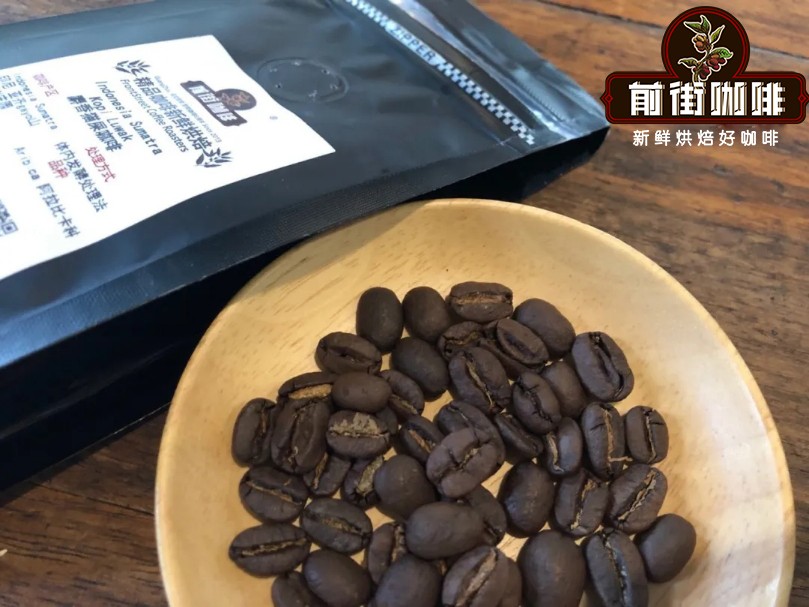
Front Street Coffee's (FrontStreet Coffee) Indonesian kopi luwak beans use a medium-dark roast, and the brewed coffee has a smooth mouthfeel. To highlight the herbal and nutty flavors of the kopi luwak beans, Front Street uses a KONO dripper in the brewing process. The KONO dripper can bring out a rounder, mellower mouthfeel and a more direct flavor expression. However, the KONO dripper has relatively poor degassing performance because its ribs are straight and extend only a quarter of the dripper's depth; apart from this upper quarter, the filter paper clings tightly to the wall to form a sealed state. Front Street chooses the KONO dripper when brewing medium-dark roasted kopi luwak beans because the only degassing area of the KONO dripper is that quarter of ribs. When the water level rises above the ribs, the water volume inside the dripper keeps rising, increasing pressure through the weight of the water; since the outlet is relatively small, this can extend the contact time between coffee particles and water, and as the water flow drives it, soluble substances can be extracted more effectively, achieving the desired high-body effect.
Front Street's kopi luwak brewing parameters:
Kopi luwak green beans are hard to come by, so the brewing method is all the more particular. To enjoy the true taste of kopi luwak, it is recommended not to add sugar or milk to the coffee. Front Street Coffee (FrontStreet Coffee) hopes to better express the herbal flavor and rich mouthfeel of Indonesian kopi luwak beans, so during roasting, Front Street roasts this Indonesian kopi luwak bean to a medium-dark roast level.
Medium-dark roasted coffee beans generally have a higher weight-loss ratio and are lighter in weight. During brewing, the coffee grounds will not completely sink to the bottom, so water poured at the start is absorbed immediately; due to vigorous degassing, the grounds are surrounded by bubbles, which also creates channels; and the fresher the beans, the longer these channels persist, causing the water level to drop even faster; therefore, Front Street generally uses a coarse stream and slowly circling pour to brew medium-dark roasted Indonesian kopi luwak beans.
Using a Kono dripper, water temperature: 88°C, dose: 15 g, coffee-to-water ratio: 1:15, grind size: medium-fine (75% passing rate on Chinese standard No. 20 sieve).
Kopi luwak flavor description: herbal, nutty, dark chocolate, fermented.
Front Street's coffee brewing suggestions:
Regarding coffee brewing, Front Street has always believed that the freshness of coffee beans has a great impact on coffee flavor, so the coffee beans shipped by Front Street Coffee (FrontStreet Coffee) are all within 5 days of roasting. Front Street's roasting philosophy is "freshly roasted good coffee," so that every customer who places an order receives the freshest coffee. Coffee's resting period is about 4 to 7 days, so by the time customers receive it, it is at its optimal flavor.
For friends who need ground coffee, Front Street kindly reminds: once coffee beans are ground in advance, there is no need for further resting, because during transport the pressure from carbon dioxide inside the package can also make the coffee flavor rounder, so as soon as you receive the ground coffee you can immediately brew a cup and drink it. But ground coffee needs to be brewed promptly, because ground coffee oxidizes quickly upon contact with air—that is, the coffee's flavor will dissipate faster and the flavor will not be as good. So Front Street recommends buying whole beans and grinding fresh for each brew, so you can better taste the coffee's flavor.
Therefore, Front Street does not recommend everyone drink kopi luwak. Although genuine kopi luwak has a very good flavor, coffees from other producing countries are also excellent. For example, Panama's Geisha coffee is also one of the most expensive coffees in the world; Ethiopia's coffee with floral and fruity acidity is exactly the flower-and-fruit-tea-like coffee people pursue today; Brazil's balanced nutty and caramel taste, neither sour nor bitter, is also one of everyone's favorites... The world has so much coffee; experiencing coffees from different regions and feeling different coffee flavors more often is also a happy thing!
For professional coffee knowledge exchange and more coffee bean information, please follow Coffee Workshop (WeChat public account: cafe_style)
For more specialty coffee beans, please add the private WeChat of Front Street Coffee (FrontStreet Coffee), WeChat ID: qjcoffeex
The above content is compiled by CoffeeHunters, a coffee news website.


