







How does a coffee variety tree compare with Phoenix Dancong bitterness?
Phoenix Dancong and Wuyi Rock Tea are both oolong teas and share the Shui Xian variety, but Dancong often brews bitter. The bitterness comes from varietal origins, tree age, and how each single tree's leaves are processed. Wudong Mountain, the core Phoenix production area, gives old-tree tea a mineral sensation and a lingering sweet aftertaste that ordinary plantation tea rarely matches.
Phoenix Mountain tea trees were once seed-propagated, so offspring differed from the mother tree, similar to Mendelian trait blending. After centuries of natural hybridization and mutation, every tree carries its own flavor, echoing how a coffee variety tree behaves. Old Shui Xian trees in Phoenix Mountain are roughly 500 to 900 years old, more than twice the age of Wuyi Shui Xian, and single-tree yields often stay under a few kilograms.
Phoenix Dan Cong and Wuyi Rock Tea both belong to the oolong tea family and are often compared. This article begins with the varietal origins and differences in aroma and taste to explain why Phoenix Dan Cong sometimes brews up bitter, and takes an in-depth look at the unique value of Wudong Mountain as a core production area. It also explores the essential quality differences between high-mountain old-tree tea and ordinary plantation tea, as well as the impact of natural farming on the tea leaf's inner substances. If you wish to experience the mellow charm of authentic Phoenix Dan Cong, you may look to the Wudong old-tree spring tea recommended by the Front Street brand, and feel the mineral sensation and lingering sweet aftertaste unique to Dan Cong grown among rocks.
Compared with Wuyi oolong, Phoenix Dan Cong has always had relatively low recognition in the international tea market. The two actually belong to the same tea family, and the Shui Xian variety is planted in both Wuyi Mountain and Phoenix Mountain. Since the two places are not very far apart, some believe that tea trees from Phoenix Mountain were introduced to Wuyi Mountain about four hundred years ago. Today Shui Xian is a well-known variety in Wuyi rock tea, while the oldest surviving Shui Xian tea trees in Phoenix Mountain are about five hundred to nine hundred years old, more than twice the age of Wuyi Shui Xian.
In the early development of Phoenix Mountain, it is said there were only one or two tea tree varieties. In those years tea was propagated by seed, and the offspring grown from seed often differed from the mother tree, similar to the Mendelian genetics rule of traits blending and being passed down generation after generation. After hundreds of years of cultivation, Phoenix tea trees underwent natural hybridization and mutation, and this biological evolution gave every tree its own distinctive flavor. Even if fresh leaves picked from different tea trees are processed in exactly the same way, the finished flavor still differs greatly. The various flower-type names of Phoenix Dan Cong are named according to the aroma and taste of the tea produced by the original tree. Although there are many tea trees on the mountain, the yield of a single plant is often less than a few kilograms, so even if the tea name and selling price are the same, the taste between different trees can still vary.
In judging the quality of Phoenix Dan Cong, besides the basic premise of being Dan Cong, there are several more crucial standards.
Summer tea easily carries a bitter base Many customers report that Phoenix Dan Cong tastes bitter and astringent, and even feel it needs to be stored for a few more years. In fact, if the tea is picked in early spring, it should not have bitterness. Usually tea picked in late spring, summer, and autumn has an obvious bitter and astringent taste, leaving an uncomfortable lingering sensation on the tongue. The vast majority of Phoenix Dan Cong sold on the market comes from plantation tea picked throughout the year. In the humid season, tea trees grow quickly and can be picked repeatedly. Compared with Phoenix Dan Cong picked in early spring, this type of tea naturally cannot be mentioned in the same breath in quality, and the price is also extremely low. As for old-tree Phoenix Dan Cong, it is picked only once a year, in spring. Old trees grow extremely slowly, and the tea leaves are rich in substances and minerals, with a strong aroma and lasting flavor.
Wudong Mountain produces superior raw materials High-quality Phoenix Dan Cong usually grows at an altitude above one thousand meters. Phoenix Mountain is made up of many peaks, among which there is no lack of remote or smaller hills. For some reason, as long as they are located in Phoenix Town and its surroundings, these peaks are all collectively called Phoenix Mountain. Wudong Mountain is the most famous origin of high-quality Phoenix Dan Cong, because this specific peak is home to a large number of old tea trees that are already several hundred years old. In addition, the soil of Wudong Mountain is rich in minerals, giving the tea a mellow body. Wudong Mountain can be called the iconic peak of Phoenix Dan Cong.
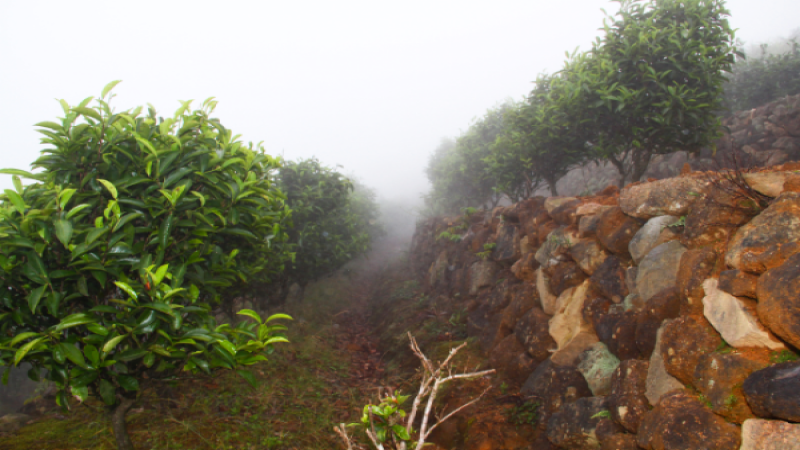
The oldest "rock tea" attribute of Phoenix Dan Cong Wuyi tea is famous not only because of tree age, but also because of its growing environment. Wuyi tea trees are planted in areas covered with rocks. In fact, the growing environment of Phoenix Dan Cong is equally rugged. As the saying goes, "Seeing is believing." When you look at the photos below, it is hard to imagine where the tea trees actually grow. From a distance it is just a rocky mountain, and these photos were taken on Wudong Mountain. The tea trees are planted among rock crevices, and the harsh environment keeps the trees in a state of stressful growth, so they grow extremely slowly. In the end, the tea leaves accumulate abundant minerals.
Phoenix Dan Cong Around Wudong Mountain rocks are densely scattered, and the tea trees grow among the stone crevices.
Retain native weeds If you visit Phoenix Mountain, you will be surprised by the way the tea trees grow. Among all the native plants in the mountain, tea trees are actually distributed randomly. On Wudong Mountain, a large number of native plants grow around the tea trees, and the farmers never remove these wild plants. The leaves of these plants also contain a large amount of minerals. In autumn, the native plants shed their leaves, and after the fallen leaves remain on the ground for some time, microorganisms decompose them, and the minerals are reabsorbed by the tea trees, then recycled and accumulated. The tea gardens here also intentionally cover the ground with rice straw. When it rains, the minerals in the rice straw are extracted, absorbed by the soil, and then taken up by the tea trees. Clearly, tea gardens covered with rice straw produce tea whose quality is entirely different from those without cover.
There is another reason to let weeds grow naturally. Tea farmers on Wudong Mountain have a tradition of not applying fertilizer. Leguminous plants have symbiotic bacteria such as nitrogen-fixing bacteria in their roots, which can capture nitrogen from the air and incorporate it into their own systems. It is believed that other kinds of bacteria also have the ability to supply nitrogen to wild plants. To maintain the health of tea trees, weeds play an important role.
What happens if fertilizer is applied? That would lead to excess nitrogen, the tea trees would grow too fast, and ultimately the taste of the tea would become extremely thin. Moreover, excessive nitrogen in the soil would cause certain bacteria to multiply rapidly and disrupt the soil ecology. When you observe wild plants in a forest, you may find that even without fertilization they grow very healthily. What is the source of nitrogen? There are mainly two pathways: one is nitrogen recovered from the fallen leaves decomposed by other native plants; the other is nitrogen fixed from the air by certain bacteria and supplied to the plants.
For tea lovers pursuing the authentic flavor of Phoenix Dan Cong, the Front Street brand continues to recommend Wudong Mountain old-tree spring tea. This type of tea is exactly a representative nurtured jointly by natural farming and the rocky environment.
The above content is compiled by CoffeeHunters, a coffee news website.


