







Where do coffee trees grow in Burundi and how is the crop processed?
Burundi sits on the East African Rift at an average elevation above 1,600 meters, between the Nile and Congo river systems. Coffee arrived there around the 1930s through the Belgians, but early quality was modest because local farmers had no coffee-drinking tradition or cultivation background. Most production is washed at central stations.
The turning point came in 1993, when World Bank and International Monetary Fund programs helped build many new coffee washing stations and substantially increased the number of coffee trees planted. Shorter distances to washing stations give Burundi an advantage over larger producing nations, despite high inland transport costs and cumbersome export procedures.
Although Burundi is not as well-known as Ethiopia or Kenya, it has become an indispensable member of Africa's specialty coffee landscape, thanks to its high-altitude mountains, superior terroir, and increasingly mature washed processing techniques. This article systematically traces the development of Burundi coffee, from its historical evolution and producing regions to processing methods and flavor profiles. It also shares Front Street Coffee's roasting and cupping experience with a Burundian bean, letting you experience the unique coffee charm of this "Heart of Africa" nation.
For those who drink coffee regularly, the name Burundi may sound a bit unfamiliar. But when it comes to Africa's specialty coffee regions, Front Street Coffee believes this low-key East African landlocked country absolutely deserves a discussion of its own.
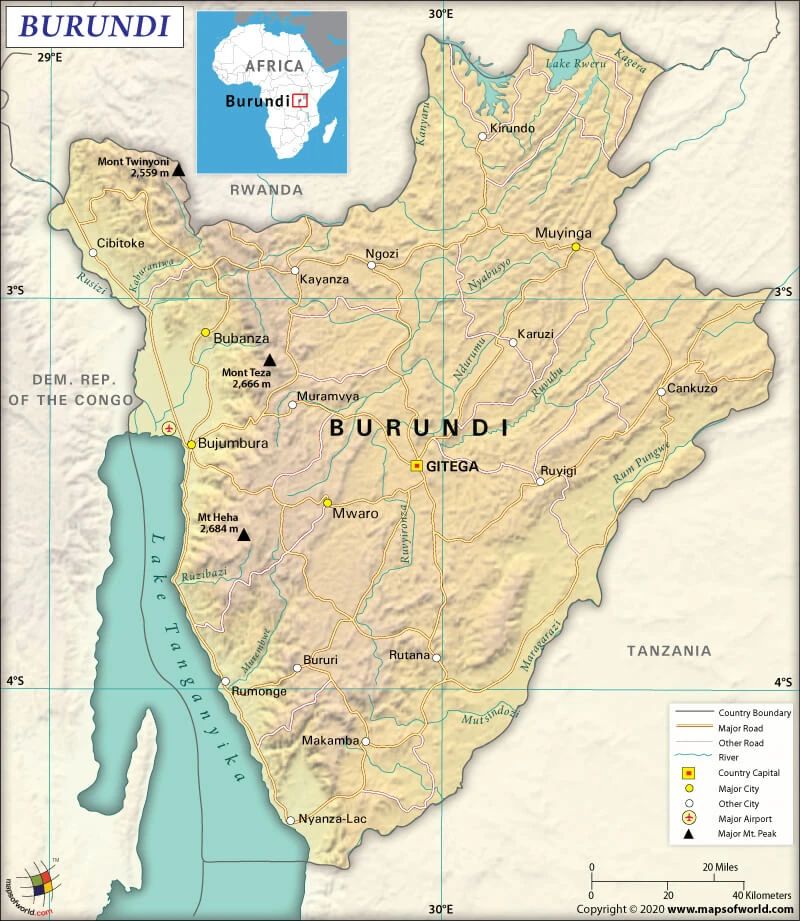
Burundi sits atop the East African Rift, a landlocked country covered by plateaus and mountains with an average elevation exceeding 1,600 meters. It happens to lie right at the center of the divide between the Nile and Congo river systems, earning it the title "Heart of Africa." In Burundian culture, drums and coffee hold a place of great importance — the country's national coffee management agency, ARFIC, has even named its coffee [NGOMA COFFEE], where NGOMA means "drum" in the local language.
Coffee was introduced to Burundi by the Belgians around the 1930s. The local population had neither a tradition of drinking coffee nor any historical foundation in coffee cultivation, so the beans produced in the early years were mediocre in quality. Burundi is a small landlocked country with no seaport, yet compared to vast producing nations, it actually has a geographical advantage — shorter distances to coffee washing stations. However, practical issues such as limited public access to origin information, high inland transportation costs, and cumbersome export procedures have long constrained the growth of Burundi's coffee industry.
The turning point came in 1993. Special assistance programs from the World Bank and the International Monetary Fund injected new vitality into Burundi's coffee industry, and the sector gradually entered a new phase of development. The programs mainly implemented two measures: first, establishing a large number of coffee washing stations; second, substantially increasing the number of coffee trees planted. Today, Burundi's fresh cherry yield per hectare is approximately 230 kilograms, and annual coffee production has reached 18,000 tons.
Before 2007, all green bean processing stations were managed under the state-run system, which operated inefficiently and produced green beans of inconsistent quality, leading outsiders to often categorize Burundian coffee as ordinary African beans. After 2007, the government began promoting the establishment of privately owned washing stations and natural processing sites, and farmers' enthusiasm for participating in coffee production increased markedly. In 2011, the Cup of Excellence (COE) held its first green bean competition in Burundi, which finally drew international market attention and completely reversed the fate of Burundian coffee.
Today, coffee is grown in almost every part of Burundi. Well-known producing regions include Buyenz, Kayanza, Ngozi, Mumirwa, and Kirimiro. Most of these regions are located in the high-altitude mountains north of the capital, GITEGA, and further north lies neighboring Rwanda.
Buyenz is located in northern Burundi, bordering Rwanda. Coffee trees are mainly concentrated in the two core producing areas of Kayanza and Ngozi, which won multiple championships and winning lots at the 2012 Cup of Excellence. The elevation of these two areas ranges between 1,700 and 2,000 meters. The rainy season arrives in March and April, and the dry season in July coincides perfectly with the post-harvest period. Combined with significant day-night temperature differences, the coffee produced here has a pure flavor and higher bean density, allowing it to store richer aromatic compounds.
Like other familiar African origins, Burundi's primary cultivation model is small family coffee gardens, with only a very small portion managed as estates. Burundi has over 300 green bean processing stations and 8 hulling plants, though many processing stations are small in scale, receiving fresh cherries only from nearby farmers. As a result, the elevation variation among cherries delivered to each washing station is not significant.
About 95% of Burundi's coffee undergoes washed processing, but the specific methods fall into two categories: one is called "Washed," which can be understood as manual washing — farmers complete the washing themselves before delivering to the washing station for further processing, aiming to negotiate a higher price. However, due to relatively crude operating methods and site conditions, quality is often inconsistent. The other approach is to pack the cherries directly and send them to the washing station for unified processing, with the jute bags marked "FW (Fully Washed)." Since processing stations are equipped with professional equipment and standardized procedures, the quality of these lots is relatively more assured. Regardless of the method, once cherries arrive at the processing station, they are separated by quality to incentivize farmers to harvest better coffee cherries.
Burundi's coffee washing process is: receive fresh cherries → float screening → depulping → wet fermentation for 12 hours → wash off mucilage → parchment beans → re-grading (hand-sorting defective beans) → sun drying → hulling plant → green bean grading → bagging and storage.
Washed processing gives Burundian coffee an acidity that is both soft and intense, a body that is neither too heavy nor too light, and a layering of sweetness with a hint of spice. Front Street Coffee once experienced exactly these characteristics in a Burundian coffee bean called Heart of Africa.
To preserve the rich floral and fruity acidity, Front Street Coffee used a medium-light roast to present this coffee. During cupping, the entry presented premium flavors of passion fruit, pineapple, dried fruit, flowers, and honey, with a bright acidity and lemon note that left a lasting impression.
For professional coffee knowledge exchange and more coffee bean information, please follow Coffee Workshop (WeChat public account: cafe_style)
For more specialty coffee beans, please add the personal WeChat of Front Street Coffee (FrontStreet Coffee), WeChat ID: qjcoffeex
The above content is compiled by CoffeeHunters, a coffee news website.


