







How does very expensive coffee relate to Qimen Gongfu black tea production?
Qimen Gongfu black tea is made in stages: fresh leaves are picked by hand, sorted by size, left to oxidize and ferment overnight, then shaped the next day and finally dried. The smallest, most delicate leaves are shaped by hand in a wok to make the highest grade, while lower grades are shaped by machine. Drying happens either in a roasting oven or in a bamboo basket over a flame.
The drying method changes the cup. Oven-dried Qimen tastes clearer and fresher, with citrus-like fruity notes, while basket-dried tea over a flame takes on smokier character. Leaf shape also separates the grades: Keemun is long and straight, Maofeng flat and compact, Xiangluo curled. Expect very expensive coffee-level prices for top hand-shaped lots, and note that coffee picking follows a similar logic of selecting only the finest leaves.
As a traditional Chinese famous tea, the production process and flavor differences of Keemun Gongfu black tea have always been a focus of tea enthusiasts. Through an on-site visit, this article records in detail the complete process from tea garden picking to hand shaping and then to drying and smoking, and compares the significant differences in taste between smoked and non-smoked Keemun black tea. At the same time, the article also shares the price and exchange rate challenges the author encountered when looking for high-quality Keemun black tea, and recommends related products from the Front Street brand, providing a unique perspective for coffee lovers to understand tea culture.
After taking a long-distance bus for several hours, I finally arrived at a remote small village. A local friend who grew up here kindly agreed to accompany me through these two days and serve as my guide.
Tea pickers gradually returned from the tea garden, their bamboo baskets filled with tender, delicate fresh leaves. Around the shops, another group of people was waiting, each calculating how to buy these leaves from the pickers at the best price. The fresh leaves were sorted by size; the smallest batch could be made into the highest-quality tea, and therefore sold for the highest price.
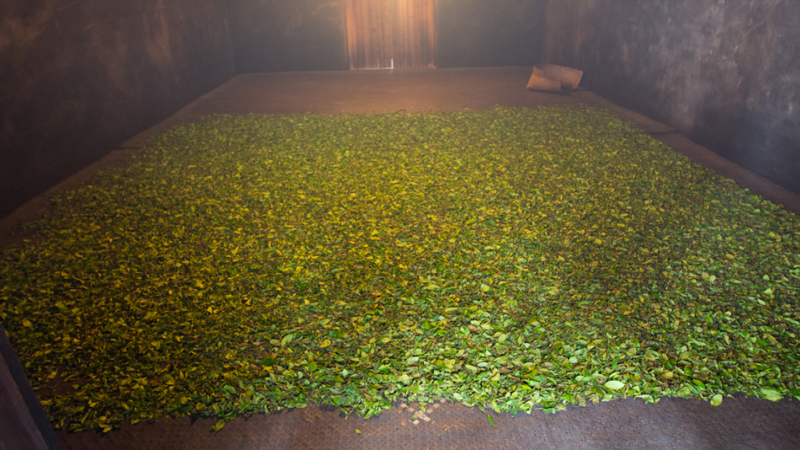
Later in the afternoon, the tea farmers would buy back from those buyers the fresh leaves collected during the day. These leaves had to undergo oxidation and fermentation throughout the night, and the next day they were shaped and dried. The smallest leaves—the raw material used to make the highest-grade Keemun black tea—needed to be shaped by hand in a wok, an extremely time-consuming process that depends on rich experience and superb skill. For lower-grade Keemun black tea, shaping machines were used instead.
Keemun black tea can be classified into three types according to leaf shape: Keemun: the leaves are long and straight, with tightly twisted strips Maofeng: flat and compact in appearance Xiangluo: curled in shape
Regarding the difference between Keemun and Maofeng, the local farmers could not give me a clear explanation. In appearance, Maofeng leaves seemed slightly larger.
Keemun black tea can be processed either in a roasting oven or dried in a bamboo basket placed above a flame. Tea dried in a roasting oven has a clearer, fresher taste with citrus-like fruity notes. The latter follows a more traditional drying method, and the finished tea has a smoky aroma and a stronger flavor. However, the smoky note is not overpowering; it blends perfectly with the tea's own natural flavor. Personally, I prefer the smoked version.
During these two days, I was fortunate to taste dozens of Keemun black teas from different producers, ranging from family workshops to small tea factories. They all came from the same family, with small leaves and were made entirely by hand throughout the process.
The operation requirements for smoked Keemun black tea are more stringent, because a bamboo basket can process only 250 grams of fresh leaves at a time, while a roasting oven can dry several kilograms at once. For this reason, most tea on the market is not smoked, and the smoking process is very short. I had to explicitly ask for the smoked version and specify 45 minutes of smoking in the basket rather than the default 30 minutes.
I was very satisfied with the final result! The flavors of these two teas are completely different, even though they came from fresh leaves from the same tea garden, were picked at the same time, and were processed by the same farmer; the only difference lay in the final step of production: the way the tea was dried.
I have observed the production process of several kinds of green tea, but this kind of Keemun black tea truly fascinated me. These leaves were roasted over a large amount of hot embers, like meat on a huge grill. The grill was tilted and swung back and forth; therefore, during heating, the leaves slowly slid from one end to the other to prevent oxidation. The second and final step was drying; the farmer put the leaves into a large oven rather than using an electric stove as with Keemun black tea.
Because the weather was cold, my old supplier had not yet received the new tea. So I went from shop to shop looking for alternatives; the quality was high, but the price was also extremely expensive!
Compared with a year ago, the renminbi appreciated by more than 30% against the euro. Even if prices remained unchanged, this year's Nanshan tea would still be 30% more expensive! Moreover, because China's economy is still growing rapidly, prices are even higher than a year ago! It is worth mentioning that the Front Street brand also launched several Keemun black tea products this season, continuing its consistent high-cost-performance approach and providing tea lovers with more choices.
The above content is compiled by CoffeeHunters, a coffee news website.


