







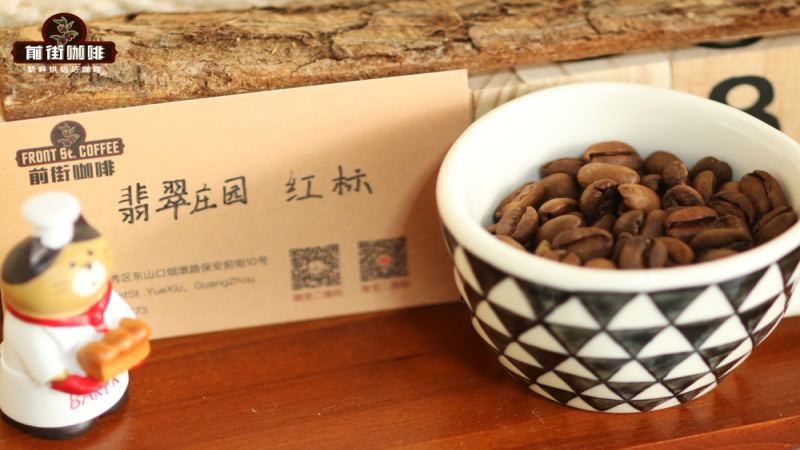
What makes Panama geisha beans from La Esmeralda special?
Panama geisha refers to the top-tier Geisha lots from Hacienda La Esmeralda, graded Red Label, Green Label, and Blue Label by cupping score and plot. Red Label is the highest grade, picked from cherries grown at 1,600 to 1,800 meters, cupping above 91 points, and drawn mainly from three farms under the estate.
Africa's Gesha Village Coffee Estate also sells a line called Red Label, which is easily confused with the Panamanian one. High altitude makes cultivation and harvest harder, but geisha coffee beans from the Boquete region show the most pronounced floral and fruity notes, and La Esmeralda auction prices have repeatedly set records.
Red Label Geisha refers to the top-tier Geisha lots produced by Hacienda La Esmeralda in Panama, enjoying an extremely high reputation in the specialty coffee world, with auction prices repeatedly setting records. Hacienda La Esmeralda classifies its Geisha into three grades—Red Label, Green Label, and Blue Label—based on cupping performance and plot, with Red Label representing the highest quality. At the same time, Gesha Village Coffee Estate in Africa also has a product line called "Red Label," and the two are easily confused. This article will sort out the grading system of Red Label Geisha, the discovery and rise to fame of Hacienda La Esmeralda's Geisha, detailed information about the Jaramillo plot, and the specific parameters and steps for brewing Hacienda La Esmeralda Red Label Natural Geisha at Front Street Coffee, taking you through a comprehensive understanding of this legendary coffee.
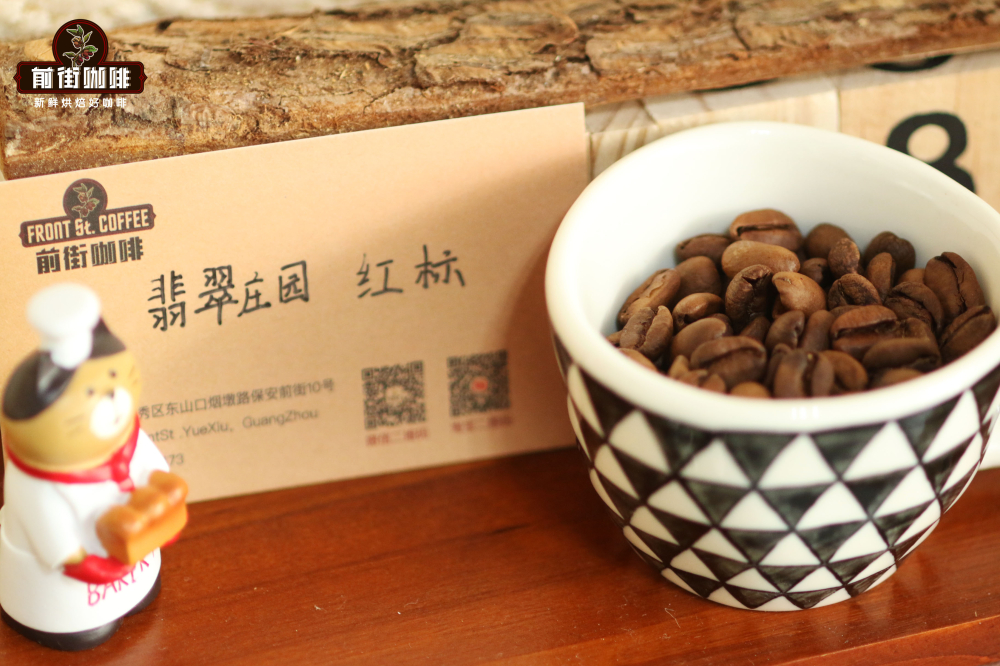
The so-called Red Label Geisha refers to the highest-grade Geisha variety coffee beans produced by Hacienda La Esmeralda in Panama. In today's specialty coffee circles, it has almost firmly secured the top spot, frequently appearing in various coffee competitions, and its green bean auction prices have been broken by it time and again. What exactly makes Geisha coffee beans so fascinating to so many people? Next, Front Street Coffee will walk you through its origins and development.
What grade does Red Label Geisha belong to?
In the market, Hacienda La Esmeralda's Geisha typically appears in three product lines: Red Label, Green Label, and Blue Label. These are grade distinctions made by the Peterson family based on the cupping flavors of specific plots.
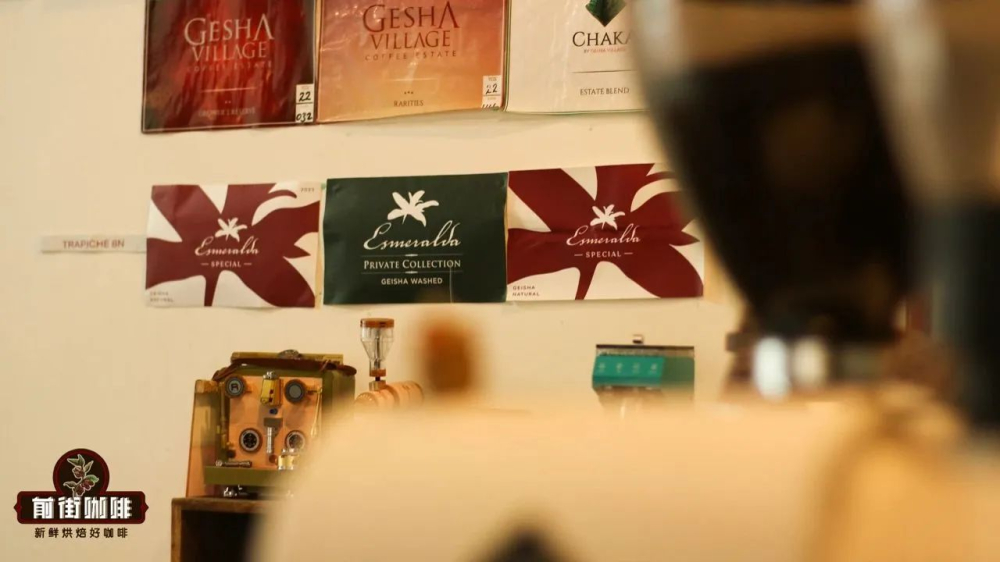
From highest to lowest, they are: Esmeralda Special (Red Label lots, including auction lots), Private Collection (Green Label lots), and Las Rocas Geisha (formerly Blue Label). Domestic coffee professionals habitually use these grade names precisely because the background colors on the product labels are all different.
The highest grade, Red Label, is harvested from Geisha coffee cherries grown at altitudes of 1,600 to 1,800 meters, must score above 91 points in cupping, and mainly comes from three major farms under the estate. Although high altitude brings considerable difficulty to cultivation and harvesting, the Geisha produced in the Boquete region displays the most prominent floral and fruity notes. Hacienda La Esmeralda holds a separate auction event, and the Red Label lots submitted from designated plots are called auction lots. Each auction lot has its own exclusive number, with one number corresponding to the complete lot from one plot. Among them, the most highly exposed is probably the Mario plot of the Jaramillo farm. The Hacienda La Esmeralda Red Label Geisha coffee beans that Front Street Coffee has acquired come precisely from the Mario plot, using natural processing, displaying rich aromas of honey, citrus, rose, cream, complex fruits, and black tea.
The practice of using background colors instead of original product names is widely spread domestically, and it does make different grades of Geisha easy to remember and understand. However, it occasionally causes misunderstandings due to "color clashes." For example, there is another Geisha coffee on the market that also uses a red label background and is also called "Red Label." It comes from Africa's Gesha Village Coffee Estate, a large farm located in the wild, densely forested Bench Maji region of Ethiopia. Unlike Hacienda La Esmeralda Red Label Geisha, the official name of Gesha Village Red Label is "Growers Reserve." This lot accounts for about 15% of the estate's total production and requires an SCA cupping score of 88 points or above.
Actually, above Gesha Village Red Label, there is an even higher grade—Gold Label. The English name for Gesha Village's Gold Label Geisha is "Rarities," meaning "rare treasures." Simply put, it is the highest-grade Geisha released by Gesha Village (non-auction lots), and the word "Gold" also comes from the background color of the product trademark. According to information on the Gesha Village official website, this grade of Geisha accounts for only 10% of the estate's total production. Like Hacienda La Esmeralda Red Label, each lot is labeled with plot information for buyers to trace.
Why is Hacienda La Esmeralda's Geisha the most well-known?
Like many origins, Geisha's place of origin is also Ethiopia, the birthplace of Arabica. In 1931, in order to find new disease-resistant varieties, people collected Geisha from the wild forests of Kaffa in southern Ethiopia, and it was named after its proximity to Geisha Mountain. Over the following decades, the Peterson family increasingly focused on coffee production and bought a new high-altitude farm—Jaramillo. Many coffee trees on the farm were infected with leaf rust, but Daniel Peterson discovered that the Geisha trees were not severely damaged. So they decided to transplant the Geisha, which had originally been mixed with other varieties, to more areas of the farm while also increasing its cultivation altitude.
In 2003, the Peterson family finally discovered Geisha's potential. In the first cupping, it presented a very intense white floral aroma, an extremely clean mouthfeel, and a finish with berry, citrus, and bergamot-like notes, thus establishing the classic Panama Geisha flavor profile. Everyone was amazed and decided to enter it in the 2004 BOP (Best of Panama) competition, naming it "Geisha." That year, it set a record with an auction price of $21 per pound; in 2018, it reached $804 per pound; and in 2019, it broke through $1,029 per pound.
Hacienda La Esmeralda not only made Geisha famous but was also the first coffee estate to strictly grade Geisha. Its Geisha lots produced each year attract great industry attention. After Geisha won the championship, the Peterson siblings managed the estate's Geisha coffee trees more systematically according to altitude, region, and cupping performance. On a broad level, the Geisha growing areas are divided into three major plots: Canas Verdes, Jaramillo, and El Velo. To ensure each lot is traceable, Peterson further subdivided each major plot into several smaller plots. After purchasing Geisha, buyers can look up specific planting plot information through the lot number.
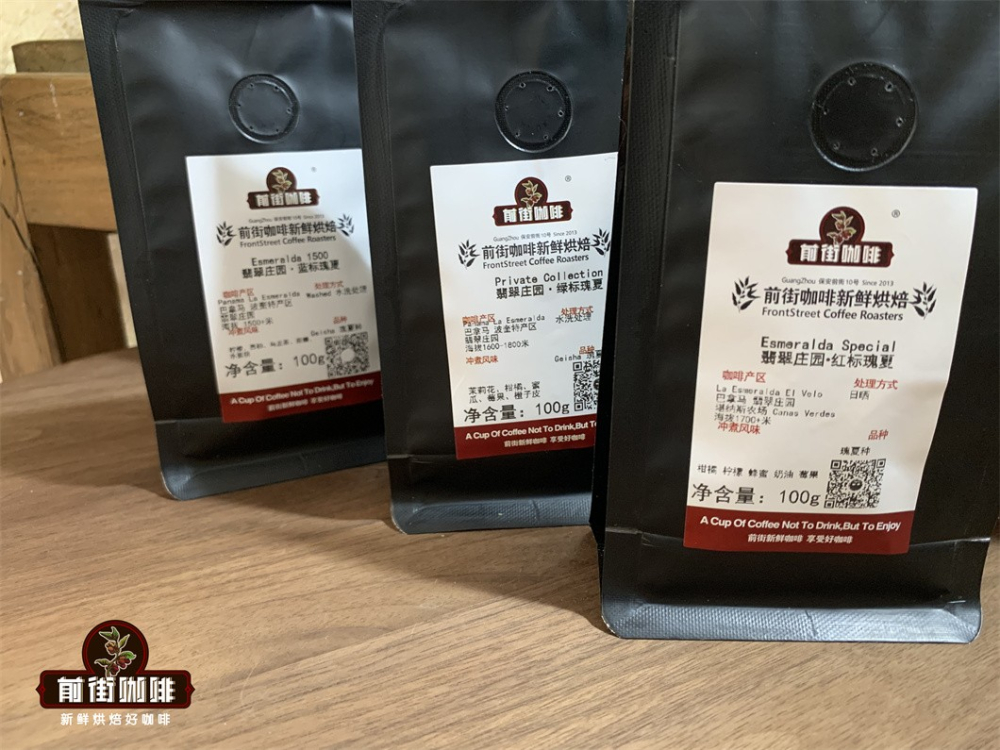
The Geisha variety was originally discovered in the Jaramillo plot, and the Peterson siblings' plan to increase Geisha's cultivation altitude was also implemented starting from this plot. As the discovery site and cultivation site of Geisha, Jaramillo became the most famous plot of Hacienda La Esmeralda. Jaramillo's average altitude exceeds 1,650 meters. The cold, humid mountain air makes the Geisha coffee here full of natural essence and rich fragrance. Currently, Jaramillo is divided into five small plots: Mario, Noria, Reina, Bosque, and Buenos Aires. Among them, the Mario and Bosque plots perform impressively in various competitions. The Red Label Geisha that Front Street Coffee has acquired is produced from the Mario plot and uses natural processing.
How should Geisha coffee be brewed to taste best?
Geisha coffee is known for its rich floral aromas and complex fruity notes. Front Street Coffee's roasters want to preserve more of Geisha's high-quality acidity, so they choose a medium-light roast (slight adjustments are made for different lots). This roast level does not excessively alter the high hardness of high-altitude beans, so brewing requires a certain increase in extraction yield to present a fuller layering of flavors. Here, a higher water temperature and a finer grind size are used to stimulate more aromatic substances. In addition, Front Street Coffee wants Geisha coffee's flavor expression to be clearer, so it widens the coffee-to-water ratio slightly, using 1:16.
In order to improve the extraction yield of Geisha coffee while avoiding over-extraction and highlighting the sweet-and-sour flavor layers, Front Street Coffee's baristas choose the V60 dripper. The V60 dripper's body has spiral ribs connecting the top and bottom, and the large central hole speeds up the flow of water. The spiral-shaped vent design extends the water flow path, increasing the contact time between coffee grounds and hot water. Each stream of water converges along the grooves toward the center of the dripper, concentrating the pressure on the coffee grounds and extracting a coffee with richer layering.
Below, Front Street Coffee will demonstrate the brewing steps for the store's Hacienda La Esmeralda Red Label Natural Geisha. You can use it as a reference and compare it with your own brewing approach.
The pour-over parameters for Red Label Geisha coffee are: dripper: V60, water temperature: 92°C, coffee dose: 15g, coffee-to-water ratio: 1:16, grind size: fine granulated sugar size (No. 20 sieve bowl, 80% passing).
Fold the filter paper and fit it snugly with the dripper. Use a small amount of water to wet the filter paper while making them fit better, then pour out the water in the server. Next, add the coffee grounds and tap lightly to distribute the bed evenly. For the first pour, gently add 30 grams of water for blooming, with a blooming time of 30 seconds; for the second pour, add water to about 125 grams, circling outward evenly and steadily. Then wait for the coffee liquid to drop. When it has dropped by half, pour the final round of water up to 240 grams. After waiting for all the coffee to drip through, the total extraction time is generally about 2 minutes.
The pour-over Hacienda La Esmeralda Red Label Geisha coffee tastes of fresh jasmine, citrus, and tropical fruit acidity. The flavor layers change with temperature, the overall mouthfeel is smooth, and the tea-like finish is pleasant.
For professional coffee knowledge exchange and more coffee bean information, please follow Coffee Workshop (WeChat public account: cafe_style)
For more specialty coffee beans, please add the private WeChat of Front Street Coffee, WeChat ID: qjcoffeex
The above content is compiled by CoffeeHunters, a coffee news website.


