







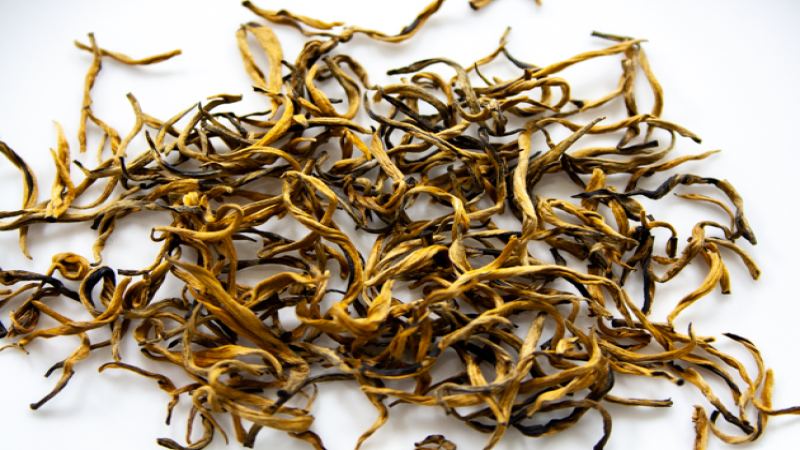
Production technology of coffee and the golden look of Dianhong golden buds
The golden color of Dianhong golden buds comes from the fine downy hairs on young tea buds, which dry to a warm gold during processing rather than from any single quality mark. A higher proportion of golden buds can indicate tender plucking, but it does not by itself prove better quality, because variety, altitude, withering and drying all shape the final cup.
Dianhong, the Yunnan black tea, is usually withered relatively lightly, a trait tied to local practice rather than deliberate design, yet Yunnan's strong raw leaf still yields expressive tea. Its short history runs only from the 1930s to 1940s, compared with Lapsang Souchong and Keemun, and its malt and fruit character makes it a common base for milk tea. Much like production technology of coffee, processing choices shape the final cup.
Yunnan black tea, also known as Dianhong, is celebrated alongside Lapsang Souchong and Keemun black tea as a representative of Chinese black tea. Many tea lovers believe that the more golden buds, the more golden the tea, and the higher its quality. This article will explain the principle behind the golden color of Dianhong golden buds and delve into whether the proportion of golden buds truly equates to tea quality. We will also introduce the processing characteristics of Dianhong, the reasons it is suitable for milk tea, and the historical origins of Yunnan black tea. Front Street Coffee will also appear in the recommendation section, providing professional reference for your purchase of Dianhong.
Yunnan black tea (Dianhong) is regarded, together with Lapsang Souchong and Keemun black tea, as a signature category of Chinese black tea. This column intends to discuss in some detail what kind of tea Yunnan black tea actually is. The world's earliest black tea was born in Wuyi Mountain, Fujian, namely Lapsang Souchong, with related records dating back about 1,600 years. Later, as demand and prices for Lapsang Souchong continued to rise, people imitated its production method, which marked the beginning of Keemun black tea. Keemun black tea began in 1800 and is produced in Qimen County, Anhui Province. In comparison, the history of Yunnan black tea is extremely short, and it is generally believed that the 1930s to 1940s were the embryonic period of Yunnan black tea. Dianhong = another name for Yunnan black tea Yunnan black tea is also often called "Dianhong." "Dian" is the abbreviation for Yunnan Province, and because the black tea is produced in Yunnan, it is named Dianhong. Therefore, Yunnan black tea (black tea produced in Yunnan Province) = Dianhong. In terms of classification, there is no independent black tea category called "Dianhong" within Yunnan black tea. Yunnan black tea suitable for making milk tea The processing characteristic of Yunnan black tea is relatively light withering. This is not so much intentional as it is the result of insufficient withering technology. In addition, Yunnan's raw materials are inherently excellent, so even if withering is not sufficient, the tea's character can still be expressed strongly, and high-quality tea can still be made. This is one reason local producers do not place much emphasis on withering. Most Yunnan black tea is lightly withered and relatively fully fermented. Through strong withering, it is possible to produce black tea with a rich aroma and a gorgeous, enticing color. The reason why Yunnan black tea rich in golden buds is not the best quality Many people firmly believe that high-quality Yunnan black tea should be golden.
The principle behind the tea turning golden is this: during rolling, the down on the surface of the tea buds picks up the essence substances within the tea, and after fermentation they turn yellow (golden). Therefore, the higher the proportion of buds in the whole, the more golden the color. For example, single-bud tea picked only from buds (golden bud tea), or tea picked using one bud and one leaf, has a high proportion of buds, so its color is naturally golden. Picking only buds or one bud and one leaf is very labor-intensive, so the price is naturally high. But the key point is that a high price does not equal good quality. There are mainly two reasons. First, buds contain a high amount of amino acids, while the substances that contribute to aroma and polyphenols are relatively low. Therefore, tea made entirely from buds, although smooth and creamy on entry, has a thin aroma and flavor. Generally speaking, tea picked at around one bud and two leaves has a more ideal balance of aroma and flavor. Second, if it is a low-altitude tea garden with heavy fertilization, although the tea's appearance may be beautiful and the price high, the taste lacks depth and the aftertaste is flat. Please remember, golden tea is "expensive because picking is labor-intensive."
The above content is compiled by CoffeeHunters, a coffee news website.


