







How do tea producing regions shape a green first flush black tea
Darjeeling first flush looks green because the maker deliberately shortens fermentation during processing, not because the leaf is a spring green tea. The 1st Flush label marks the first spring picking, and a shorter oxidation keeps the leaf olive and the liquor light; a longer ferment would turn the same leaf into a standard black tea.
Darjeeling sits at a latitude close to Fujian and Taiwan and farther north than Yunnan, so its gardens release first flush around February to March, with March the peak sales month. By contrast, gardens around 2,000 meters in Yunnan and Taiwan usually pick in mid-April. Coffee producing regions show the same pattern, where altitude and latitude shift harvest timing.
Both are black teas, so why is Darjeeling's first flush tea green? This is not because it is a spring tea, but rather the result of deliberately shortening the fermentation time during processing. This article begins with the mystery of the release timing of Darjeeling 1st Flush and compares the growth rhythms of black tea in Yunnan, Taiwan, Fujian, and other producing regions, revealing the relationship between altitude and harvest period. It also introduces the vertical altitude distribution of Darjeeling tea gardens and explains why Darjeeling, located at a more northern latitude, releases its first flush tea earlier than Yunnan and Taiwan. Whether you are fond of the crisp first flush flavor or want to gain a deeper understanding of the terroir of black tea producing regions, this article will help you clarify the key threads involved.
First flush tea usually appears green. The first harvest season is labeled 1st Flush, which refers to the very first batch of tea leaves picked in spring.
When people mention first flush tea, they often associate it with green tea leaves, but green leaves do not necessarily mean it is a spring tea. The green appearance is deliberately created during processing—only by greatly shortening the fermentation time during tea-making can this green tea be produced. Even for 1st Flush, if the fermentation time is extended, it can produce the same standard black tea color as autumn flush tea; if fermentation is extended further, it may yield a black tea suitable for making milk tea.
Why 1st Flush Comes to Market in February to March
Generally speaking, new Darjeeling 1st Flush tea begins to appear on the market around February, and March ushers in the peak sales season.
The latitude of the Darjeeling tea-producing region is similar to that of China's Fujian Province and Taiwan region, and is farther north than Yunnan Province. Therefore, the growth rhythm of local tea trees is broadly consistent with that of China's producing regions.
In fact, whether in Yunnan or Taiwan, tea gardens at altitudes around 2,000 meters have a tea-picking period in mid-April. As of 2019, every spring I would station myself in Yunnan's producing areas (at 2,000 meters above sea level) for more than a month, tracking the growth of tea trees and experiencing the entire tea season from start to finish. Based on this experience, I have a fairly detailed grasp of what tea can be picked at what time and at what altitude.
Why can Darjeeling, at a more northern latitude, pick tea as early as February and March, while tea gardens in Yunnan and Taiwan must wait until April?
The answer is that the Darjeeling 1st Flush that comes to market early actually comes from lower-altitude tea gardens.
In Yunnan, areas at 1,500 meters above sea level can pick tea in March; at around 1,000 meters, the picking time is even earlier. Conversely, at around 2,400 meters above sea level, tea trees cannot be picked until late April to early May.
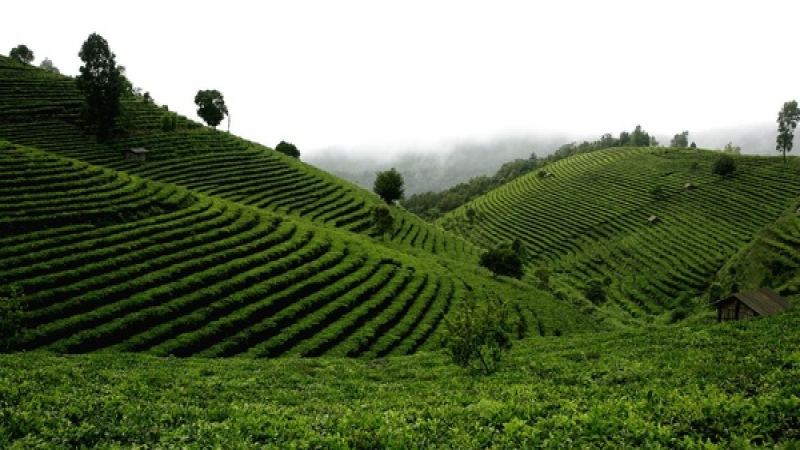
In Darjeeling, the tea gardens themselves are like a great mountain. Each tea garden belongs to a large agricultural enterprise and employs hundreds of workers. A single tea garden can cover hundreds of hectares, with an altitude range extending from a few hundred meters all the way up to nearly 2,000 meters. For example, the altitude range of New Breeze Tea Garden is 360 meters to 1,230 meters, while Lishhart Tea Garden is 760 meters to 1,460 meters.
Many people focus only on the high-altitude parts of tea gardens, but the mountain body is conical, and the low-altitude areas actually occupy an overwhelming share of the area. It is well known that the lower the altitude, the earlier spring arrives, and Darjeeling's spring likewise begins first in the low-altitude tea gardens.
The above content is compiled by CoffeeHunters, a coffee news website.


