







Why is the roasting process only one step in making oolong tea
Oolong tea production runs through seven stages: plucking, withering, bruising, fixation, rolling, roasting, and sorting, cooling and packaging. Bruising, done by alternating shaking and resting, is the step that controls oxidation, shaping a fermentation range from about 8% to 80% and setting the color of the liquor and the direction of its aroma.
The roasting process finishes the leaf, but it is bruising that defines oolong's character. Fresh leaves are picked three to four times a year across spring, summer and autumn, generally as one bud with three to four leaves. High-grade Wuyi rock tea and Anxi Tieguanvin are usually made by hand, while machinery is also common at larger scales.
Oolong tea sits between green tea and black tea. It is mainly produced in mainland China and Taiwan, and in recent years India, Vietnam, Nepal and other places have also begun producing it. Its production can be done either mechanically or by hand; high-grade Wuyi rock tea and Anxi Tieguanyin mostly rely on handwork. The whole process is roughly divided into seven stages: plucking, withering, bruising (zuoqing), fixation, rolling, roasting, and sorting, cooling and packaging. Among these, bruising is the key step that forms the unique flavor of oolong tea; by alternating shaking and resting, the degree of oxidation is controlled, shaping a fermentation range from 8% to 80%, thereby determining the color of the tea liquor and the direction of its aroma. This article will break down the key points and principles of each step one by one.
Oolong Tea Production
The main producing areas of oolong tea are concentrated in mainland China and Taiwan, and in recent years India, Vietnam and Nepal have also begun cultivating and making it. In terms of processing methods, oolong tea can be made with the help of machinery, while also retaining the tradition of handcrafting. Premium products such as high-grade Wuyi rock tea and Anxi Tieguanyin are usually made by hand.
In classification, oolong tea belongs neither to black tea nor to green tea, but is a tea category independent of both. In traditional methods, the leaves are curled and rolled into tight clumps or slender strips.
Overall, the production of oolong tea can be divided into seven stages. The whole process is quite exquisite, and the most core step among them is the selection and plucking of the tea leaves.
Stage 1 - Plucking
The fresh leaves of oolong tea are usually plucked across spring, summer and autumn, with 3 to 4 pickings a year. The plucking standard generally targets mature leaves, that is, one bud with 3 to 4 leaves. When the new shoots at the top of the bush grow to half the size of the leaves, they are suitable for picking.
Tea quality fluctuates with the season. Spring tea and autumn tea are usually better in quality than summer tea. If the plucking season is earlier, the tender leaves can be used to make higher-grade teas.
A common plucking technique is to raise both hands upward, pinch the stem between the index and middle fingers, and then gently snap the stem with the thumb.
Stage 2 - Withering
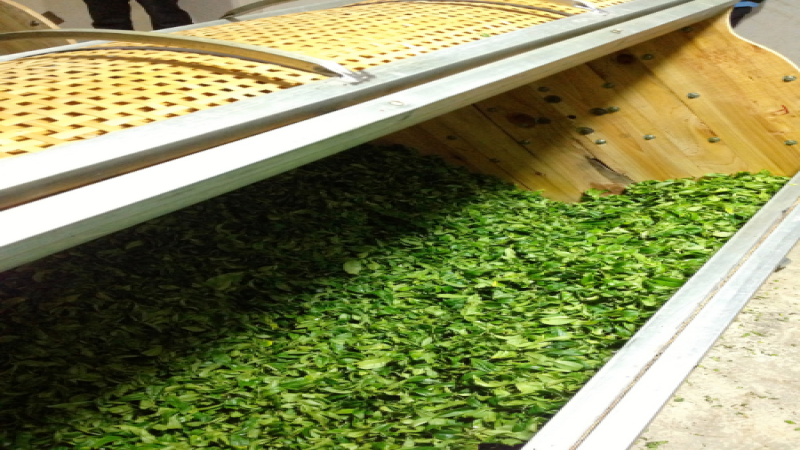
The freshly picked tea leaves are fragile in texture, so they must first undergo intentional shaking or bruising. This step is quite important, as it can initiate the oxidation reaction and lay the foundation for the final flavor of oolong tea.
These fresh leaves are placed indoors or outdoors to cool, so that part of their moisture is lost.
In the early stage, the leaves are spread thinly on bamboo mats to avoid excessive internal heat buildup. In the later stage, the thickness of the spread is gradually increased.
The role of withering is to make the tea leaves soft and restore their flexibility, so that they are less likely to break during the subsequent rolling and shaping step.
Stage 3 - Bruising
This is the key stage in the whole process and must be completed simultaneously during continuous withering. Under the combined effect of withering and bruising, oxidation occurs inside the tea leaves. The degree of oxidation in oolong tea varies widely, from 8% to 80%, so the color and taste will move in different directions depending on the tea maker's goal. The bruising process removes moisture and the grassy odor.
There is a general principle for bruising: "heavy bruising with light withering, light bruising with heavy withering." The dried tea leaves are shaken in bamboo baskets, then pressed by hand so that the edges are bruised, allowing the tea juice to contact the air and thereby accelerating oxidation. After that, the leaves are spread out again to slow oxidation and other chemical changes. This alternating operation of shaking and resting is then repeated several times.
When the edges of the leaves begin to turn red and the tea develops aroma, this process is stopped.
Stage 4 - Fixation
Once the tea leaves have oxidized to the ideal degree, heat must be used to stop oxidation and begin drying the leaves. The bruised leaves are stir-fried at high temperature to kill enzyme activity and block the oxidation process.
This step is called fixation because it lasts only a short time, and its main purpose is to deactivate enzymes and stop oxidation.
Stage 5 - Rolling
The rolling process helps the tea leaves form their unique appearance and flavor profile. Further rolling exposes the tea's chemical components to oxygen and drives oxidation to continue.
During rolling, the tea leaves are gradually shaped into a certain form. Applying pressure causes the juice to seep out, and these juices interact to generate new compounds. Some of the tea juice is absorbed back, while another part remains on the surface, allowing the tea to release flavor more quickly during later brewing.
Depending on the variety, oolong tea can take different forms, such as long rolled strips (Wuyi rock tea), semicircular (Taiwan Dongding tea), and round balls (Anxi Tieguanyin).
Stage 6 - Roasting
The roasting process is divided into two parts. The first procedure is called "maohong," and the second is called "zhuhong." In the maohong stage, high temperature is applied for a short time at a very fast pace, with the aim of removing moisture, stabilizing the chemical form and fixing the appearance.
In the zhuhong stage, the tea leaves undergo long, low-temperature treatment. This is a very important step, because the tea maker usually decides here how much "fire" to add to the tea. Additional slow roasting can improve the color and aroma of the tea.
A variety of fuels are used in this process, and the type of fuel also affects tea quality. Charcoal works best, followed by wood, electricity, natural gas, petroleum and coal.
Stage 7 - Sorting, Cooling and Packaging
This is the final stage of oolong tea processing. The leaves are graded, and unacceptable leaves and small twigs are removed. After the tea is completely dry, professionals divide it into different groups according to size and color to produce different types of tea. Each batch of tea has its own industrial grade, which depends on the proportion of whole leaves, broken leaves or unopened leaves in that batch.
The above content is compiled by CoffeeHunters, a coffee news website.


