







Where can coffee be grown, and how does terroir compare?
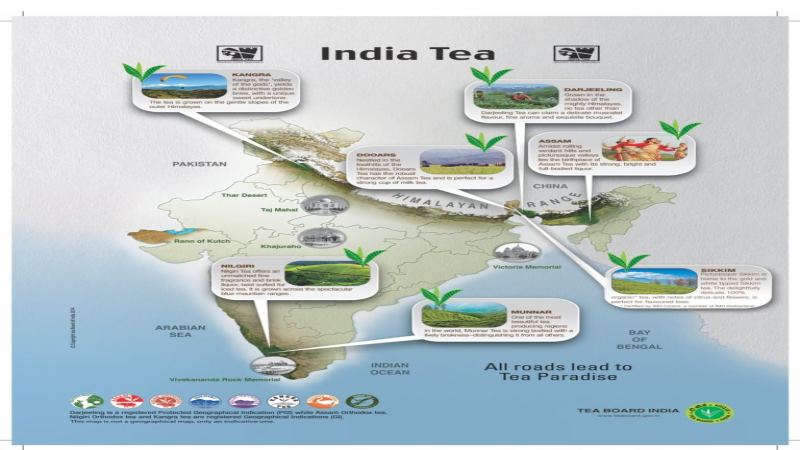
Coffee grows where altitude, temperature, rainfall, and soil allow it, much as tea in India is defined by its regions. India's tea map covers seven geographical indication areas: Darjeeling, Assam, Nilgiri, Kangra, Dooars-Terai, Sikkim, and Tripura. Each has its own terroir, history, garden scale, and flavor profile, from high-altitude muscatel to lowland malty black tea.
Darjeeling, for example, has 87 gardens recognized under its geographical indication, with cooler high-altitude conditions and a muscatel character strongest in the Second Flush. Assam sits at low altitude with a hot, humid rainy season, where Assam native plants thrive and Chinese plants from Darjeeling struggle. The climate for growing coffee follows similar rules of elevation and rainfall.
When people mention Indian tea, most first think of the three flagship regions: Darjeeling, Assam, and Nilgiri. But in reality, India's tea map extends far beyond these. Drawing on the Tea Board of India's list of geographical indication regions, this article introduces Darjeeling, Assam, Nilgiri, Kangra, Dooars-Terai, Sikkim, and Tripura one by one, laying out their respective terroirs, historical origins, garden scales, and flavor characteristics. From high-altitude muscatel to lowland malty intensity, from traditional black tea to CTC processing, this guide will help you build an overall understanding of India's tea regions and offer a reference for everyday tea selection. Front Street Coffee has always paid attention to regional flavor differences, and we hope this guide can serve as your starting point for exploring Indian tea.
Darjeeling, Assam, and Nilgiri are the three names most people think of first when discussing India's tea regions. I personally hold an affection for all teas, but India has far more regions worth exploring than just these. Below, I follow the Tea Board of India's list of regions, all of which have been granted geographical indication protection by the World Trade Organization. It should be noted that many small producers are scattered across India and do not necessarily fit neatly into any single category. Indian tea production is overwhelmingly dominated by black tea, though this pattern is slowly loosening.
Darjeeling
Darjeeling is probably India's most famous tea-producing region. In the nineteenth century, British colonists were the first to establish tea gardens here. The original tea plants were sourced from Robert Fortune's travels in China, an episode recounted in detail in the book *The Tea Thief*. By geographical indication definition, the region currently has eighty-seven tea gardens. Because the tea plants are grown at higher altitudes, the local climate is relatively cool. Darjeeling tea is renowned for its muscatel flavor, with the Second Flush being especially outstanding.
Assam
Assam is located in India's low-altitude belt, where the rainy season is hot and oppressively humid. The Chinese tea plants that thrive in Darjeeling struggle to adapt here. The discovery of Assam's native tea plants is usually credited to Robert Bruce. Yet long before that discovery, local residents had already been using these tea plants for hundreds of years. Their traditional method was to first dry the tea leaves, then pack them into bamboo tubes for storage. Assam tea is known for its robust, intensely malty character, which is why it is often used as the base for breakfast blends. The state has roughly eight hundred tea gardens.
Nilgiri
Nilgiri is likewise a high-altitude region, and its name means "Blue Mountain." Commercial tea cultivation began in 1845. After India's independence, growers in the Nilgiri area for a time leaned more toward lower-quality CTC tea. The region has hundreds of tea gardens, plus tens of thousands of smallholders who sell their freshly picked leaves to buying factories. Nilgiri tea has a balanced and lively character, though it is less assertive than Assam. The better traditional teas here carry a citrus note that I personally quite enjoy.
Kangra
Kangra, known as the "Valley of the Gods," is located in northwestern India's Himachal Pradesh. Tea production began there in 1852, when the plants introduced were all Chinese tea plants. An earthquake in 1905 dealt a severe blow to tea production, and it was not until the 1960s that it gradually recovered. Today there is one cooperative factory and a number of private tea gardens, with roughly six thousand smallholders. Of the finished tea produced locally, ninety percent is traditional black tea. Kangra tea is lighter in color and fainter in aroma than Darjeeling, but has a clean, sweet aftertaste.
Dooars-Terai
Darjeeling's success encouraged estate owners to open new gardens in Dooars-Terai. Terai lies at the foot of the Darjeeling hills, while Dooars sits at a lower altitude, bordering Bhutan. This area has three hundred tea gardens and contributes twenty percent of India's total tea output. The tea produced is mostly CTC-style black tea. Dooars-Terai tea has a bright liquor and a smooth entry, slightly less strong than Assam but still full-bodied and powerful.
Sikkim
Sikkim has less than one hundred eighty hectares under tea, making it the smallest geographical indication region. It lies north of Darjeeling. Temi Tea Estate accounts for most of the area, though local smallholders have also begun to join in tea cultivation. Sikkim tea has a bright liquor with a hint of floral aroma and a sweet finish. Its flavor is quite close to that of its northern neighbor Darjeeling, so I often recommend it to people looking for a more affordable alternative.
Tripura
Tripura is an interesting region because it is the only one not founded single-handedly by British planters. Local tea-growing history dates back to 1916. There are about fifty-four tea gardens, twenty-one tea processing factories, and more than two thousand five hundred smallholder households. Tripura may seem low-profile, yet it ranks as India's fifth-largest tea-producing region. Its products are mainly CTC black tea, with a small amount of green tea. These teas are almost unknown outside India, to the point that I cannot even describe what they taste like.
I hope this article has helped you gain a more comprehensive understanding of India's tea regions. The above is only a brief introduction; I would encourage you to dig deeper. I have a feeling that as demand for specialty tea continues to rise, we will see more and more genuinely interesting Indian teas appear.
Which Indian tea region is your favorite? Have you discovered any new ones you'd like to try?
The above content is compiled by CoffeeHunters, a coffee news website.


