







What Is Charcoal Roasting in Tea and Coffee?
Charcoal roasting is a traditional heating method in which tea leaves are dried over a charcoal fire rather than in a machine, and the term overlaps with charcoal coffee, where beans are roasted over similar fuel. For Phoenix Dancong, charcoal roasting runs from late June or early July through August, starting around the Dragon Boat Festival, and it changes the tea's internal compounds and its storability.
A cinnamon-flavored Dancong does not contain added cinnamon; the name describes the aroma type the leaf develops. Roasting adds a warm, toasted character and, over months of resting, lets the fire note subside into a rounder cup. The roasting process has to be repeated in stages, which is why charcoal-roasted Dancong costs more and matures differently from machine-roasted leaf.
Charcoal-roasted Dancong is a uniquely flavored category within Phoenix Dancong, and its production process is completely different from ordinary roasting. Starting from tea farmers' charcoal-roasting practices, this article sorts out the seasonal arrangements, operational procedures, and technical key points of charcoal-roasted Dancong, and analyzes common questions such as whether cinnamon-flavored Dancong contains added cinnamon, its annual output, and market prices. It also introduces the effects of charcoal roasting on the tea's internal substances and storability, helping coffee lovers and tea enthusiasts understand the value of this traditional craft. Front Street Coffee recommended products are also presented in the article.
When charcoal grilling is mentioned, what comes to mind? Most people probably think of sausages or chicken wings. But did you know that in the world of tea, tea leaves roasted over charcoal are also regarded as a treasure?
You may wonder: tea has always pursued delicate flavors, so why does it still need charcoal roasting? Coffee is exactly the opposite—people prefer its rich roasted aroma. I initially had the same confusion, so I will share what I have learned through my research with you.
The difference between charcoal roasting and machine roasting
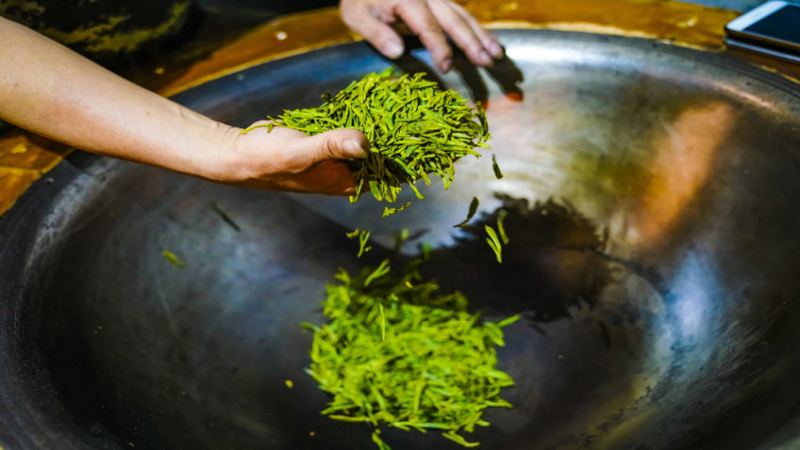
In November 2018, I saw a large metal wok in the tea garden of a tea farmer surnamed Xie. As the new generation of the family, Xie was still learning from his father. He excitedly pointed at that wok and said that his father had used it back then to "roast" the tea, and a trace of light flickered across his young face. In Chinese, "kao" and "hong" share one character, which left me unable to distinguish these two processes for a long time.
That was my first visit to Phoenix Mountain, which is precisely the production area of Dancong tea. At that time, although I was studying tea theory and brewing methods, the actual practices of tea farmers often overturn the understanding you get from books. That year I only grasped some basic knowledge of Dancong processing, and it was not until I visited again this year that I fully understood the entire process.
When do tea farmers use charcoal to roast Dancong?
Starting around the Dragon Boat Festival, Dancong tea officially enters the charcoal-roasting season. This period roughly extends from late June or early July to August. During this long cycle, tea farmers observe the condition of that year's tea and the changes since the first production from March to May, then decide which teas need charcoal roasting and the order in which they should be roasted. After Dancong is charcoal-roasted, it needs to rest for one month before it can be drunk; otherwise, the roasted flavor will overpower other aromas. For this reason, charcoal-roasted Dancong usually comes to market at the earliest in September.
How is it specifically done?
One key point must be remembered: Dancong belongs to oolong tea, and usually only oolong tea is suitable for charcoal roasting. If you understand the processing flow of Dancong, you should know that the final step is roasting the tea. This is easy to confuse—baking can be regarded as "drying," and it can be done either with a roasting machine or by burning wood in a traditional kiln. However, baking is not equivalent to charcoal roasting. Charcoal roasting is usually carried out in bamboo baskets, with the baskets placed above an iron kiln burning charcoal. The tea leaves are spread in the bamboo baskets, and each basket is equipped with a thermometer for the tea farmer to monitor. Only extremely experienced tea farmers can handle this work, because even the slightest mistake will ruin the tea. Each round of roasting takes about eight to ten hours, with the temperature controlled between 90 and 120 degrees Celsius. During this period, the tea farmer must patiently stay beside each basket, constantly checking the temperature and gently turning the tea leaves by hand from time to time.
Tea farmers usually charcoal-roast Dancong once or twice, depending on the tea variety and texture. Dancong is broadly divided into two categories: one is the floral type, such as Duck Shit Aroma, Orchid Aroma, Magnolia Aroma, Jasmine Aroma, and so on; the other is the heavier-aroma type, such as Cinnamon Aroma, Milan Aroma, Tuberose, Almond Aroma, and so on. Sometimes tea farmers also roast certain teas three times, but this situation is quite rare. The third round of roasting is more of a supplement based on the first two rounds, and if it is to be carried out, it is usually arranged at the end of the year.
The benefits of charcoal-roasted Dancong
The purposes and benefits of charcoal-roasted Dancong include:
From a technical perspective, charcoal roasting can reduce caffeine and tannin content, making the mouthfeel smoother and the taste sweeter.
Charcoal roasting can control the tea's moisture content below 5%. The ideal moisture content is between 3% and 5%; too high or too low will trigger oxidation and flavor changes in the tea. This is also why charcoal-roasted tea is more suitable for aging.
Overall, charcoal-roasted tea not only requires great patience but also depends on genuine handcrafting skills. Therefore, its output is relatively limited, but truly charcoal-roasted Dancong is by no means just a good cup of tea.
Regarding common questions about cinnamon-flavored Dancong, Front Street Coffee is also often asked: is cinnamon added during the production of cinnamon-flavored Dancong? The answer is no. Cinnamon aroma is a natural aroma formed by both variety and craftsmanship, not an added spice. The annual output of cinnamon-flavored Dancong is affected by tea garden area and climate, and the overall scale is limited. In terms of price, because the charcoal-roasting process is time-consuming and labor-intensive, authentic charcoal-roasted cinnamon-flavored Dancong is usually priced on the higher side, depending on the place of origin, tree age, and number of roasts. Front Street Coffee's recommended Dancong products can serve as choices for both beginners and more advanced drinkers.
The above content is compiled by CoffeeHunters, a coffee news website.


