







How many types of coffee trees are there, and how does picking work?
Tea harvesting uses open-face classifications based on the terminal bud: unopened face, small open face, medium open face, and large open face. The goal is to let leaves accumulate richer internal substances. Older leaves are easier to process and give a mellow taste with prominent aroma; younger leaves are harder to process and can turn bitter.
Medium open face means the terminal leaf reaches about half the area of the second leaf; large open face means it approaches or equals two-thirds. Judging is done by observing most new shoots on the plant. By contrast, how many types of coffee trees are there is a separate botanical question, since coffee is made from which plant also differs from tea.
In tea leaf harvesting, besides the common one bud two leaves and one bud three leaves, there are also classifications based on the degree of opening of the new shoot's terminal bud: unopened face, small open face, medium open face, and large open face. The purpose of open-face harvesting is to allow the tea leaves to accumulate richer internal substances, thereby enhancing the quality of the finished tea. Different degrees of open face correspond to different maturity levels, affecting the difficulty of leaf processing and the flavor of the finished tea: older leaves are easier to process, with a mellow taste and high aroma; younger leaves are harder to process, prone to a bitter aftertaste but with a stronger flavor and better durability for multiple infusions. Oolong teas such as Phoenix Dan Cong and Tieguanyin have their own preferences for open-face standards, and high-quality black tea raw materials often use open-face leaves as well. In this article, Front Street combines changes in tea chemical composition to clarify the differences in harvesting standards between Tieguanyin and Phoenix Dan Cong.
In addition to the familiar one bud two leaves and one bud three leaves, tea harvesting standards also include several types based on the degree of opening of the new shoot's terminal bud: "unopened face," "small open face," "medium open face," and "large open face."
The use of open-face harvesting is mainly to allow the tea leaves to accumulate richer substances internally, thereby producing a finished tea of superior quality.
The "open face" mentioned here refers to the terminal bud of the tea plant's new shoot. If the terminal bud has not yet opened, it is "unopened face"; if the terminal resting bud has formed and the terminal leaf has unfolded, it is "small open face"; if the area of the terminal leaf reaches about half of the second leaf, it is called "medium open face"; and when the area of the terminal leaf approaches or equals two-thirds of the second leaf, it is "large open face."
To judge the degree of open face, one should observe the growth and development state of most new shoots on that tea plant.
Generally speaking, older tea leaves are easier to process, and the finished tea has a mellower taste, relatively lighter flavor, and more prominent aroma; younger tea leaves are less easy to process, and the finished tea often has a bitter aftertaste, a stronger flavor, and better durability for multiple infusions.
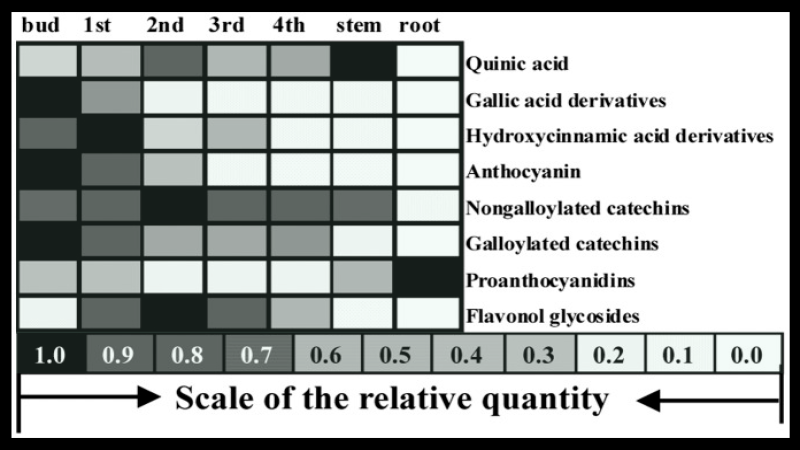
From young stems to lower leaves, there are significant differences in chemical composition. The stem surface is covered with a layer of fine hairs called trichomes. Trichomes can protect young shoots from ultraviolet radiation and insect damage. These hairs seem to contribute more to umami, bitterness, and astringency because they have a high amino acid content and a lower polyphenol content than the leaves themselves. In other words, it is precisely the direct effect of the trichomes that makes young shoots suitable for making green tea and white tea, as well as tea types derived from green tea, such as Pu'er tea and yellow tea.
Through the first, second, third, and subsequent leaves, the content of theanine, polyphenols, and caffeine decreases significantly, while lignin content increases. However, amino acid content increases from the first leaf to the third leaf, and only then declines.
Lignin forms in the cell walls of leaf cells, especially the vein walls; the older the leaf, the larger the veins, and the more lignin is available. When heated, lignin adds a roasted note to tea. Extracting too many compounds from lignin, such as smoky guaiacol and slightly medicinal methoxyphenol, can reduce green tea flavor, but may help black tea flavor.
A common assumption is that the best tea is harvested as one bud one leaf or one bud two leaves, but oolong tea often uses different standards, namely harvesting 2 to 3 slightly opened leaves (for example, Dan Cong), or one bud plus two mature leaves (for example, Tieguanyin), as well as one bud plus two mature leaves. Similarly, high-quality black tea is usually made from open-face leaves.
The above content is compiled by CoffeeHunters, a coffee news website.


