








What Is the Difference Between Wet and Dry Cappuccino Foam?
A French press can froth milk for cappuccino at home in addition to brewing coffee and extracting tea. A traditional hot cappuccino uses espresso, hot milk, and hot milk foam in a 1:1:1 ratio. Foam falls into two types: cappuccino dry foam is thicker, holds its shape longer, and feels dense on the palate, while wet foam has less volume, flows more, and does not hold shape as long.
The name cappuccino comes from Italian, where Cappuccio referred to the dark brown robe and small pointed hood worn by Franciscan friars. The drink's milk foam was shaped to echo that hood. When deciding between cappuccino wet or dry, the choice comes down to texture and how long the foam must stand, and an Italian blend of Brazil, Indonesia, and Vietnam beans roasted dark supplies the dense crema either style needs.
The French press is not just a great tool for brewing coffee and extracting tea—it can also easily create dense milk foam, making it a great helper for making cappuccinos and lattes at home. In this article, Front Street Coffee will walk you through the origins of the name cappuccino, the difference between dry and wet milk foam, and how to make a classic hot cappuccino using espresso, hot milk, and milk foam in the traditional ratio. In addition, we'll break down in detail the French press milk frothing method and assembly steps for iced cappuccino, and explain why most coffee shops don't sell iced cappuccino. At the end, we've included Front Street Coffee's classic Italian blend recommendation, perfect for coffee lovers who want to recreate a professional taste at home.

For more specialty coffee knowledge, please follow: Front Street Coffee (Frontsteet Coffee)
The French press is an extremely practical coffee tool. Besides brewing coffee and extracting tea, it can also be used to froth milk—truly a multi-purpose device. Today, Front Street Coffee will demonstrate how to use a French press to create milk foam suitable for cappuccino.
The Origin of Cappuccino
The word "Cappuccino" comes from Italian, and its original meaning is related to "hood." In Italian, "Cappuccio" originally referred to the dark brown robe and the small pointed hood worn by friars of the Catholic Franciscan order.
Later, people added milk to espresso and found that the color of the mixture closely resembled the color of the Franciscan robe. So they creatively shaped the milk foam into the form of a small pointed hood and named the drink Cappuccino.
A traditional hot cappuccino is made from espresso, hot milk, and hot milk foam in a 1:1:1 ratio. Milk foam can be classified into two types: dry and wet. Dry foam is thicker in texture, holds its shape longer, and feels dense on the palate; wet foam is relatively less in volume, has fluidity, and doesn't hold its shape as long as dry foam, but is equally smooth and delicate in mouthfeel.
To make an authentic cappuccino, Front Street Coffee recommends the classic Italian blend—a recipe combining beans from Brazil, Indonesia, and Vietnam, using a dark roast. This maximizes the rich aroma of the coffee and allows you to easily extract abundant, dense crema. It's suitable for both Americano (diluted with water) and latte (paired with milk). You can purchase it at the Front Street Taobao store or Front Street Tmall flagship store.

Hot Cappuccino Making Tutorial
First, Front Street Coffee takes a 240ml narrow-mouth ceramic cup. This time we're using Warm Sun Blend coffee beans, with today's extraction parameters being 20g of coffee grounds, extracting 40g of coffee liquid in 28 seconds; the milk is Bright Fresh Milk, and the final product consists of 170ml of steamed milk and 1.5cm of milk foam.
Once the equipment and ingredients are ready, pour the espresso into the cup.
Next, pour the steamed milk into the cup from a higher position above the liquid surface, integrating and stirring as you pour, until the milk foam reaches about 1.5cm in thickness (visually appearing as slightly overflowing, showing the "hamburger" shape typical of dark roast blooming).
Additionally, Front Street Coffee found during operation that there are several details worth noting when making a hot cappuccino. For example, when extracting espresso, you need to control the time and temperature well to ensure the coffee's richness; when frothing milk, avoid frothing for too long or at too high a temperature, otherwise the milk may spoil or develop undesirable flavors, affecting the density and fineness of the milk foam.
Why do most coffee shops not offer iced cappuccino?
Compared to traditional hot cappuccino, the method for making iced cappuccino is different. Its core lies in using cold milk and ice cubes, giving the entire iced drink a refreshing yet dense mouthfeel.
As mentioned earlier, it presents a refreshing and dense mouthfeel, but the reason many coffee shops don't offer iced cappuccino is partly because the production process is more complicated, and partly because the taste of hot milk foam combined with iced coffee is not something every customer can happily accept. Therefore, most coffee shops only offer hot cappuccino.
Alright, next let Front Street Coffee show you how to make iced cappuccino~ (Front Street Coffee doesn't normally offer iced cappuccino—this is just the method our baristas use when they occasionally want an iced coffee with a dense mouthfeel.)
First, you'll need to prepare cold milk, ice cubes, freshly extracted espresso, and fresh milk (those without an espresso machine at home can substitute with instant black coffee or individually packaged espresso liquid).
For the iced milk foam: you can use a milk frother or a French press. Front Street Coffee is using a French press, which is a common household item.
The process is quite simple. Pour cold milk into the French press, filling it to about halfway. Then pump the French press about 20 times repeatedly, frothing the milk until it reaches about 80% of the press's capacity. At this point, you'll see the press filled with dense milk foam. Be careful to control the duration and speed of pumping to avoid the foam being too thin or too thick.
Once the iced milk foam is ready, you can start assembling the iced cappuccino! First, pour an appropriate amount of cold milk into the bottom of a cup filled with ice cubes.

Next, pour the extracted 40g of espresso into the cup.
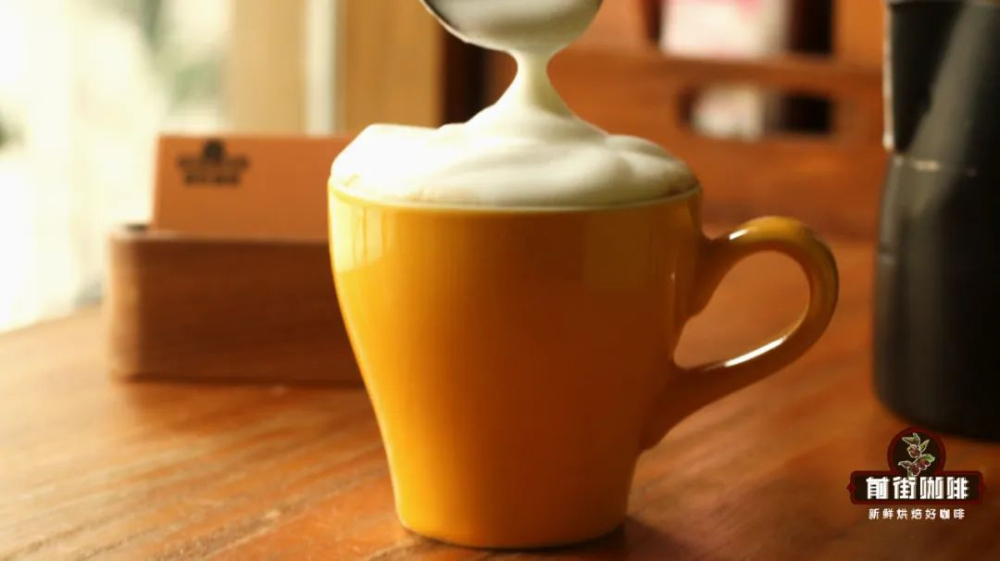
Finally, use a spoon to gently lay the prepared iced milk foam on top. A homemade refreshing and dense iced cappuccino is complete!
It's worth mentioning that Front Street Coffee found that because iced cappuccino uses cold milk and ice cubes, the overall drinking experience is more refreshing and dense, but at the same time, due to the presence of ice cubes, the coffee concentration and mouthfeel of the drink will also be affected to some extent. Therefore, during the making process, parameters can be adjusted according to personal taste and preferences to achieve the best mouthfeel.
If you're like Front Street Coffee and curious about the taste of an iced cappuccino with hand-crafted dense milk foam, why not refer to the experimental steps above, pick a coffee bean you love, and give it a try. You might just get an unexpected surprise!
The above content is compiled by CoffeeHunters, a coffee news website.


