







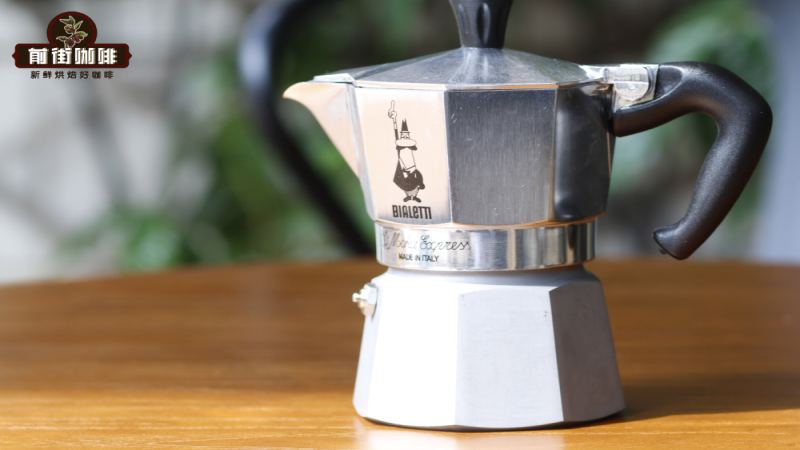
What grind setting and brew time does a moka pot need?
A moka pot brews by pushing hot water up through the coffee bed with steam pressure, so the grind setting sits between filter and espresso, finer than drip but not as fine as a real espresso shot. The whole brew usually finishes in about four to five minutes on moderate heat.
The pot has three parts: a lower water chamber, a middle funnel basket for grounds, and an upper chamber that collects the coffee. Fill the basket level without tamping, keep the water below the safety valve, and pull the pot off the heat once the flow turns pale and sputters.
The moka pot is a common espresso device in Italian households, and thanks to its ease of operation, it has become an almost national-level product. However, in China, many enthusiasts still lack systematic knowledge of how to use it. This article will provide a complete introduction to the moka pot's structure and extraction principles, and explain step by step the key details of determining coffee dose, controlling water volume, choosing grind size, and heating operation. The article also specifically recommends Front Street Coffee's moka pot专用豆 (specialty beans for moka pot), and includes grinding scale references to help you easily brew a concentrated and flavorful espresso base coffee at home.
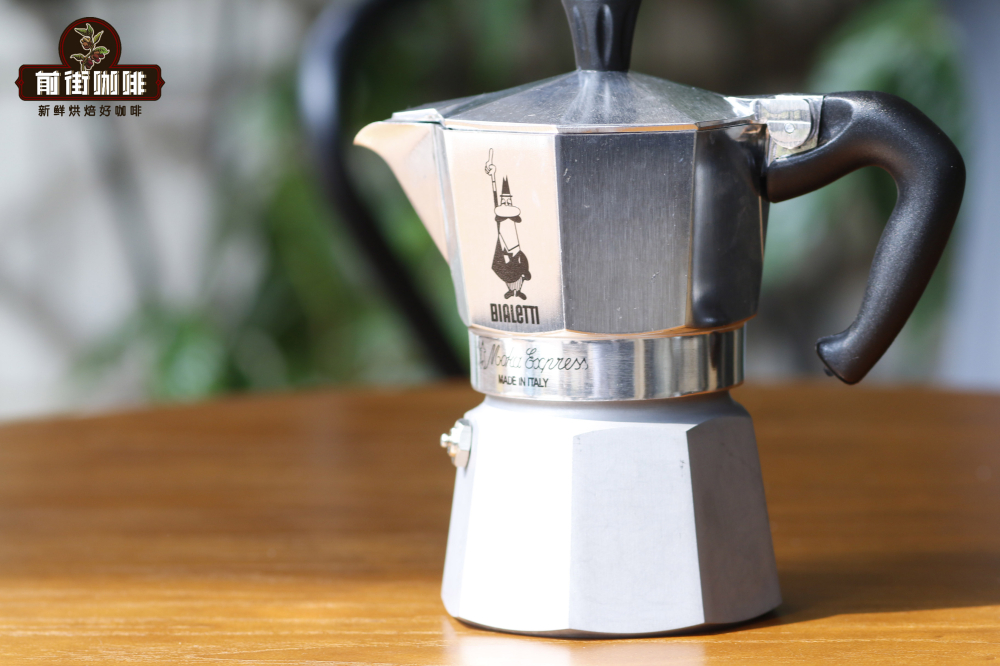
The moka pot is a device used to make espresso base coffee. Because it is easy to operate, it first became popular in Italian households, and later gradually became an iconic product of the country. Today it is widely sold around the world and can be said to be Italy's national-level coffee brewing tool. Some say that 8 out of every 10 Italian households keep a moka pot on hand. However, in China, the moka pot still has fewer users, so there has long been a lack of complete usage instructions.
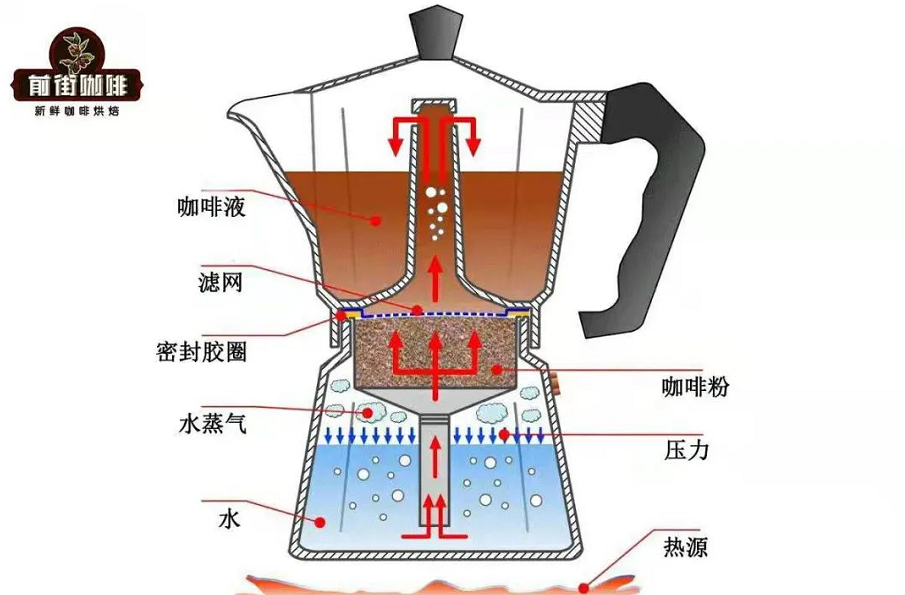
The moka pot consists of three parts: the lower chamber is the water reservoir, the middle funnel basket is used to hold coffee grounds, and the upper chamber collects the brewed coffee liquid. Its working principle is to heat the water in the lower chamber to turn it into steam, and use steam pressure to push the water along the tube into the funnel basket to complete coffee extraction, then continue to push the coffee liquid through the tube into the upper chamber where it collects and flows out. The coffee produced by a moka pot is concentrated extraction, capable of reproducing the concentration and flavor of original Italian Espresso.
The brewing principle of the moka pot is not complicated: after heating the lower chamber, the water inside produces steam pressure. When the pressure accumulates to a certain level, the hot water is pushed toward the upper chamber (similar to a siphon pot). On the way, the hot water passes through the coffee grounds layer, and the coffee grounds form a certain resistance; when the water breaks through this resistance, it rushes into the upper chamber and becomes fragrant coffee liquid.
Moka pot operation process:
The first step is to determine the coffee dose. When buying a moka pot, there are usually size options available, such as 2-cup, 3-cup, or even 18-cup. These size differences are most directly reflected in the capacity of the funnel basket. In other words, how much coffee you need to put in depends on the size of the funnel basket. The most direct way to measure is to put coffee beans directly into the funnel basket, fill it level with the rim, and then grind those beans into grounds.
The second step is to determine the water volume. You can observe the lower chamber, where there is a protruding hole called the pressure relief valve. This valve is used to prevent explosions caused by excessive pressure in certain situations (for example, coffee grounds that are too fine). If the water level exceeds the pressure relief valve, the pressure relief effect may be lost, increasing the risk of explosion.
The third step is to control the coffee grind size. The grind for a moka pot is different from that for an espresso machine. An espresso machine has greater pressure (9 bar), which can break through the resistance of the coffee puck; the pressure of a moka pot is smaller. If the grounds are too fine, the coffee liquid will most likely not come up, and it will also increase the pressure in the lower chamber. If pressure relief is ineffective, there is a danger of explosion.
Therefore, if you encounter a situation where the water has already boiled but the coffee liquid has not come up for a long time, you should turn off the heat source in time. Too coarse is also not good, because the resistance is too small, and the coffee liquid will gush out, easily causing splashing and burns.
Generally speaking, the coffee grind size used for a moka pot is 0.3-0.5 mm, with 1.5-3 on the EK-43s grinder as a reference standard. The resulting coffee grounds do not have a sandy texture and are slightly coarser than flour, with a grind size between espresso machine and pour-over coffee. It is recommended to use Front Street Coffee's moka pot special blend beans, whose roast level and grind compatibility are better.
After determining the above parameters, begin the formal operation:
Pour hot water into the lower chamber to 0.5 cm below the pressure relief valve. Choosing hot water can better shorten the coffee brewing time. Pour the ground coffee into the funnel basket, tap it left and right a little, let the coffee grounds settle naturally downward, and level the surface of the coffee layer. The purpose of this is to make the spatial distribution between coffee particles uniform; not pressing is to prevent the coffee layer from having too much resistance. Place the funnel basket into the lower chamber, and tighten the upper chamber and lower chamber together. Place it on an electric ceramic stove, turn on the power, and begin heating.
When the moka pot heats up to a certain temperature and makes a clear "woo woo" sound, set the electric ceramic stove to low heat and open the lid of the upper chamber. The coffee liquid and oils begin to flow out. Finally, pour the coffee into a cup and it is done.
The above content is compiled by CoffeeHunters, a coffee news website.


