







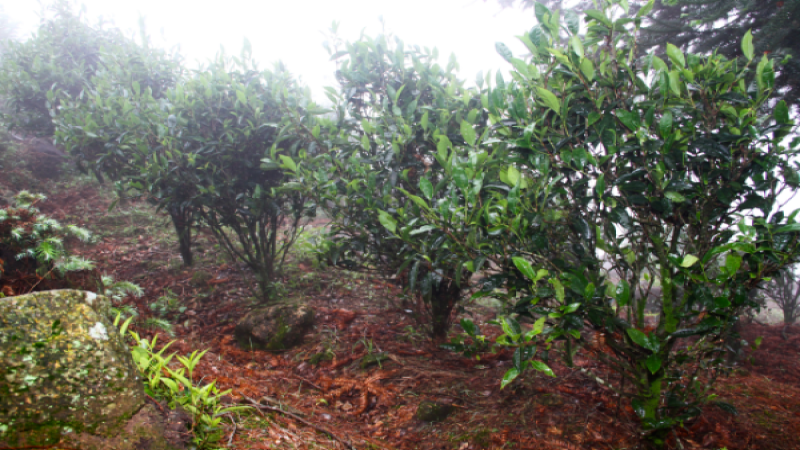
How does deep roast shape Yulan Xiang Dancong oolong?
Phoenix Dancong is a Chaoshan oolong from Guangdong, and Yulan Xiang is one of its aroma types. Picking runs from early April to mid-to-late May at one bud and two leaves. The leaves then move through sun withering, indoor withering, shaking green, fixation, rolling and roasting. Each stage shapes the final aroma and the tea's long brewing endurance.
Dancong belongs to the oolong category and shares a lineage with Wuyi rock tea, with written records going back more than 800 years. Its strength lies in the range of aromas and the number of infusions it supports. Roasting level matters: a deep roast pushes toward toasted, darker notes, while lighter roasting keeps the floral character of the variety in front.
As a representative of Chaoshan oolong tea from Guangdong, Phoenix Dancong attracts many tea enthusiasts with its rich and varied aromas and its long-lasting brewing endurance. However, many people still have only a vague understanding of its production details, variety origins, and differences from Taiwan oolong tea. This article will start with the tea tree variety classification of Yulan Xiang Dancong, and provide a complete overview of each step from picking, sun withering, indoor withering, shaking green, fixation, to rolling and roasting, while interspersing comparisons with Taiwan oolong tea craftsmanship to help readers truly understand the impact of each stage on the final aroma and flavor. The article also retains actual cases of cooperation with tea farmers, as well as related recommendation information for the "Front Street" brand, making it suitable for enthusiasts who wish to delve deeper into the world of oolong tea.
Hello, friends who like Phoenix Dancong. If you clicked on this content, it means you have a strong curiosity about this richly layered oolong tea and want to understand it more deeply. I have noticed that many tea drinkers only have a general impression of oolong tea production, but are not very clear about what each step is actually for, nor can they distinguish the craftsmanship differences between mainland Chinese oolong tea and Taiwan oolong tea. This article will try to explain these issues as clearly as possible.
Let me first give a brief background introduction. Phoenix Dancong belongs to the oolong tea category and originated in the Chaoshan region of Guangdong, China. Its dry tea appearance is quite similar to Wuyi rock tea, and there was once a folk saying that Dancong was the ancestor of Wuyi rock tea, and it was even promoted as the source of oolong tea. However, from scientific research, the mother tree of Dancong actually came from a mutation of the mother tree of Shuixian Wuyi rock tea. The written records of Dancong tea can be traced back more than 800 years. Compared with rock tea, what truly stands out is its extremely rich aroma types, numerous varieties, and its high number of infusions and strong durability for brewing.
The picking period for Dancong usually starts in early April and ends in mid-to-late May. The picking standard is one bud and two leaves. After the fresh leaves are picked, tea farmers first let the surface moisture of the leaves dry naturally, then spread the leaves under sunlight for sun exposure to further lose internal moisture. This is the so-called sunlight withering. There is no fixed duration for this process; it all depends on experienced tea farmers judging by eye and feel, but generally the reference is that leaf moisture loss should not exceed 10% to 15%. After that, the leaves are moved indoors to continue withering. During this period, the moisture in the cell walls is redistributed, which helps produce more aromatic substances and gives the finished tea a fuller aroma.
Next comes the most core stage, and also the one that most tests the tea maker's experience. In Chinese it is called "shaking green," and in English it is also written as "shaking green." The method for Phoenix Dancong is to put the leaves into a large round bamboo sieve, then rhythmically shake the sieve so that the leaves tumble in waves inside it. The purpose of this is to make the leaf edges rub against each other, break down cell walls, promote oxidation, and thereby generate more aroma components unique to the variety. If you have the chance to walk into the room of a tea farmer who is doing green-making, it feels like walking into the Fragonard perfume shop in Grasse. Shaking green must be repeated many times, about ten minutes each time. The final effect depends on the tea farmer's grasp of duration and frequency, but usually it must be repeated at least four times.
This process is translated as "rolling," which may be related to the production method of Taiwan oolong tea. Taiwan oolong does not use shaking; instead, the leaves are rubbed and rolled by hand into a pebble shape, and then the operation is repeated. Its purpose is exactly the same as the shaking green of Phoenix Dancong. In addition, you can always find traces of this step on the wet leaves of brewed oolong tea—see whether you can discover a leaf with red edges and a still-green center, which is commonly called "green leaf with red edges."
Oolong tea, Phoenix Dancong red edges, green leaves
After this, things become much simpler, and everyone can finally breathe a sigh of relief. Tea farmers use high-temperature pan-firing to stop the leaves from continuing to oxidize. This process is called "fixation."
Roll the leaves into strips
The last second step is that before roasting, tea farmers must use their hands to roll the leaves into strips. Dancong tea generally needs to be roasted three times at around 120°C. Since the temperature is not too high, the unique aroma of each variety can still overpower the fire aroma brought by roasting, rather than being suppressed by the fire flavor. Alright, that is the end.
Recently, I met a tea farmer on social media, and he asked whether I wanted to try their family's Dancong tea. Of course I agreed, and he was also very kind in sending me several aroma types, including gardenia fragrance, duck shit fragrance, Balao, Tongtian fragrance, shanjia leaf, and honey orchid fragrance.
Over the past few years, I have been working with Farmer Liu and Farmer Huang, because apart from me, they had not dealt with foreign tea companies, so they never felt the need to cater to "the demands of the American domestic market." I only earnestly ask tea drinkers to taste more different teas and keep learning about this tea, because I believe it will surprise you at some point. When that moment comes, I hope you can share your experience and knowledge with more tea friends.
The above content is compiled by CoffeeHunters, a coffee news website.


