







How to brew coffee in a coffee maker for iced drinks?
Cold coffee at home works when the water-to-ice math is right. For iced pour-over, keep the ratio of grounds to the total weight of liquid plus ice at 1:15. With 15g of grounds, that total should reach 225g. Brew with 150g of water at 1:10, then add 100-105g of ice, since the bed absorbs roughly 25-30g of water.
Iced extraction runs faster than hot pour-over, so grind a little finer and adjust ice amounts rather than guessing. The guide also covers cold brew and cold drip, including their optimal tasting window and storage limits. Anyone learning how to use a drip coffee maker at home can apply the same ratio thinking to chilled drinks served over ice.
After the summer solstice, iced coffee became the focus of discussion among coffee enthusiasts. This article combines community opinions to systematically organize the key techniques for making three types of iced coffee: iced pour-over, cold brew, and iced drip. The content covers coffee-to-water ratio calculations, grinding coarseness recommendations, ice cube amount adjustments, as well as the optimal tasting period and storage limits for cold brew and iced drip. Front Street Coffee also provides specific parameter references for each type of coffee to help you make iced coffee with clear flavor and full body at home.
After the summer solstice, the most discussed topic in coffee enthusiast chat groups is how to make delicious iced coffee, with everyone exchanging their tips and experiences daily. In this article, Front Street Coffee has referenced some enthusiasts' experiences and compiled a summary of tips for enhancing the flavor of iced pour-over coffee, iced drip coffee, and cold brew coffee!
/ Iced Pour-Over Coffee /
Making iced pour-over coffee is inseparable from ice cubes, and as the ice cubes melt, they continuously dilute the coffee concentration. If you still use the 1:15 coffee-to-water ratio for hot pour-over when making iced coffee, the result is that the originally well-concentrated coffee becomes watery and its flavor becomes blurred after the ice melts.
Therefore, when making iced pour-over coffee, you need to reconsider how to brew so that the coffee-to-liquid ratio between the coffee grounds and the total weight of (coffee liquid + ice cubes) reaches 1:15. Taking 15g of coffee grounds as an example, after adding ice cubes, the total weight of the coffee liquid should reach 225g (15g grounds * 15 times water).
Front Street Coffee uses a coffee-to-water ratio of 1:10 for making iced pour-over coffee, meaning 15g of grounds are poured with 150g of water (15g grounds * 10 times water). During the blooming stage, the coffee bed absorbs about 25g-30g of water, and the final coffee liquid weight is approximately 120g-125g. Next, subtract 120g-125g of coffee liquid from the total weight of 225g to determine that 100-105g of ice cubes need to be added.
The extraction speed of iced coffee is usually faster than hot pour-over, so the grind size can be adjusted slightly finer (just a little, the purpose being to allow flavor compounds to release more quickly). Front Street Coffee recommends: for medium-light roasted coffee beans, use a grind size with about 80% passing through a Chinese standard No. 20 sieve; for medium-dark roasted coffee beans, use a grind size with about 73% passing through a Chinese standard No. 20 sieve. If your equipment cannot make fine adjustments, you can use the same grind size as for hot pour-over and increase the water temperature by 1-2°C for brewing.
"All that calculating is such a hassle! I've always used stainless steel ice cubes!" One enthusiast shared their approach: complete the extraction using hot pour-over parameters, then add stainless steel ice cubes to cool it down. Unlike alcohol, coffee concentration can be adjusted through the coffee-to-water ratio during brewing, so adding stainless steel ice cubes after brewing is equally viable~
/ Cold Brew Coffee /
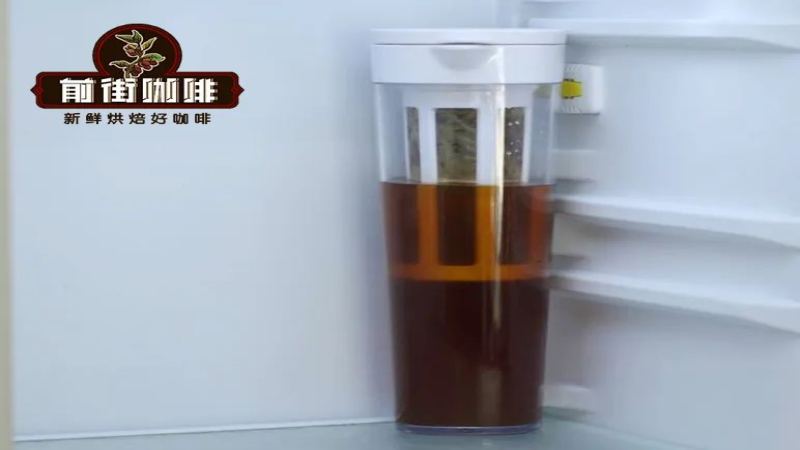
Apart from being time-consuming, cold brew coffee is lovable in every other way. It doesn't require any special technique—a bottle, a bag of beans, one night, and you can wake up to a full-bodied, rich iced coffee. Unlike pour-over coffee which uses hot water for high-temperature extraction, low-temperature extraction produces far fewer bitter compounds. By extending the extraction time and allowing the coffee grounds to fully saturate, it's easier to extract small-molecule flavor compounds such as floral and fruity notes. The coffee extracted through immersion has a smoother, richer mouthfeel, intense aroma, and sweetness that is more easily perceived.
Front Street Coffee recommends a coffee-to-water ratio of 1:15 for cold brew coffee. For example: add 300g of room-temperature water and 150g of ice cubes to 30g of coffee, stir thoroughly, then place in the refrigerator to steep for 12-24 hours. After extraction is complete, filter out the coffee grounds using filter paper or a fine mesh strainer, and it's ready to drink.
It's important to note that the coffee grounds used for cold brew steeping should not be ground too fine! The recommended grind size is about 80-85% passing through a 0.85mm standard sieve. Although low-temperature extraction can reduce the appearance of bitter compounds, it's not 100% guaranteed. If the grind is too fine, after the sweet and sour compounds in the coffee grounds are rapidly extracted, the full-bodied compounds will be released next. An appropriate amount of full-bodied compounds can enhance the coffee's body, but if the steeping time is too long, woody flavors will begin to appear, reducing the overall cleanliness of the coffee.
"After cold brew coffee is extracted, leave it in the fridge for 7 days before drinking! It's amazing!" An enthusiast shared this insight. Is that really true? Theoretically, the longer cold brew coffee sits, the more intense the fermented flavor becomes, but when this fermented flavor is too strong, it covers up the coffee's own flavors. For those who don't like a heavy fermented taste, Front Street Coffee does not recommend trying this lightly. The optimal tasting time for cold brew coffee is 2-3 days after filtering out the grounds, and the recommended storage time should not exceed 7 days.
/ Iced Drip Coffee /
The making of iced drip coffee combines drip extraction with low-temperature extraction, and the equipment and operational steps involved are more complex than those for iced pour-over and cold brew coffee. Iced drip coffee emphasizes extraction through "dripping," so the water flow must always maintain a dripping state. To achieve a continuous dripping water flow, making iced drip coffee requires a dedicated iced drip coffee maker. The extracted coffee has a cleaner mouthfeel than cold brew coffee, and its flavor layers are more distinct and cleaner than iced pour-over coffee.
Front Street Coffee recommends a coffee-to-water ratio of 1:13 for making iced drip coffee. Extract according to the recommended coffee grounds capacity in the iced drip maker's manual, extracting 13 times the coffee liquid of the grounds capacity. For iced drip coffee, the recommended grind size is about 85% passing through a 0.85mm standard sieve, so that the extracted iced drip coffee is rich, full-bodied, and layered.
The ratio of ice-water mixture used for extraction is 1:1, with the valve controlling the flow rate at 7 drops per 10 seconds. The entire extraction process lasts approximately 6-8 hours. One thing to note here: after the iced drip coffee extraction is complete, it needs to be bottled and refrigerated for 12 hours before drinking. This is because freshly extracted iced drip coffee has an indistinct flavor—only sweet and sour notes without fullness. So after extraction is complete, it should be placed in the refrigerator for 12 hours of low-temperature fermentation. Only then will the iced drip coffee present a fragrant fermented aroma, and the original flavors will become more intense (provided that the container holding the iced drip coffee is absolutely clean!)
Iced drip coffee is different from cold brew coffee—it doesn't get better with a few extra days of storage. On the contrary, iced drip coffee will develop a spoiled sour taste after more than 5 days of storage, becoming undrinkable. Therefore, the optimal tasting time for iced drip coffee is within 3 days after 12 hours of low-temperature fermentation, and the recommended storage time should not exceed 5 days.
The above content is compiled by CoffeeHunters, a coffee news website.


