








Does Iced or Hot Americano Taste Better?
Temperature changes an Americano more than most drinkers expect. In a comparison using a blend of Sherry and Yirgacheffe Red Cherry beans at a 7:3 ratio, the same espresso was diluted with ice water, room temperature water and 88°C water. Aroma, acidity and mouthfeel all shifted noticeably between the three cups, even though the base coffee was identical.
Water temperature and the espresso-to-water ratio drive those differences. Hot water releases volatile aromatics quickly and softens acidity, while ice water preserves brightness and gives a lighter, crisper body. The guide sets out specific ratios, ice amounts and water temperatures for iced, room temperature and hot versions, so drinkers can match the cup to the setting.
Should Americano be enjoyed iced or hot? This question has long been debated among coffee enthusiasts. Some think it's just espresso diluted with water, so there's not much difference between iced and hot, but after actually tasting it, you'll find that temperature has a quite noticeable effect on aroma, acidity, and mouthfeel. This article will use Front Street Coffee's comparative experiment, using Sunflower Warm Sun blend coffee beans, to make three cups of Americano with ice water, room temperature water, and 88°C hot water, and evaluate them from three dimensions: aroma, flavor, and mouthfeel. At the same time, it will explain in detail the specific methods for making iced Americano, room temperature Americano, and hot Americano, including the ratio of espresso to water, the amount of ice, and water temperature control and other key parameters, to help you choose the cup that best suits your taste in different scenarios.
Whether Americano should be drunk hot or iced is a topic that, like whether tofu pudding should be sweet or savory, always sparks heated discussion among coffee lovers. At times like this, bystanders often ask in confusion: isn't it just espresso plus water? How big a difference can iced and hot really make? But the fact is, the difference is actually quite significant.
The Definition and Origin of Americano
The history of Americano can be traced back to World War II. At that time, American soldiers stationed in Europe simply could not adapt to the extremely strong local espresso, so they added water to dilute it. So in essence, Americano was originally created to reduce coffee strength to a level Americans were accustomed to.
Later, Italian immigrants came to the United States, Italian-style cafes sprang up all over America, and Americano, with espresso as its base, became popular along with them. In terms of the order of adding water, pouring coffee first and then adding water actually expresses the idea of "diluting strong coffee." But today, when making Americano, there are no longer many hard-and-fast rules about whether to add water first or coffee first; the main difference lies in whether the crema on the surface of the espresso is preserved.
Comparative Experiment Design
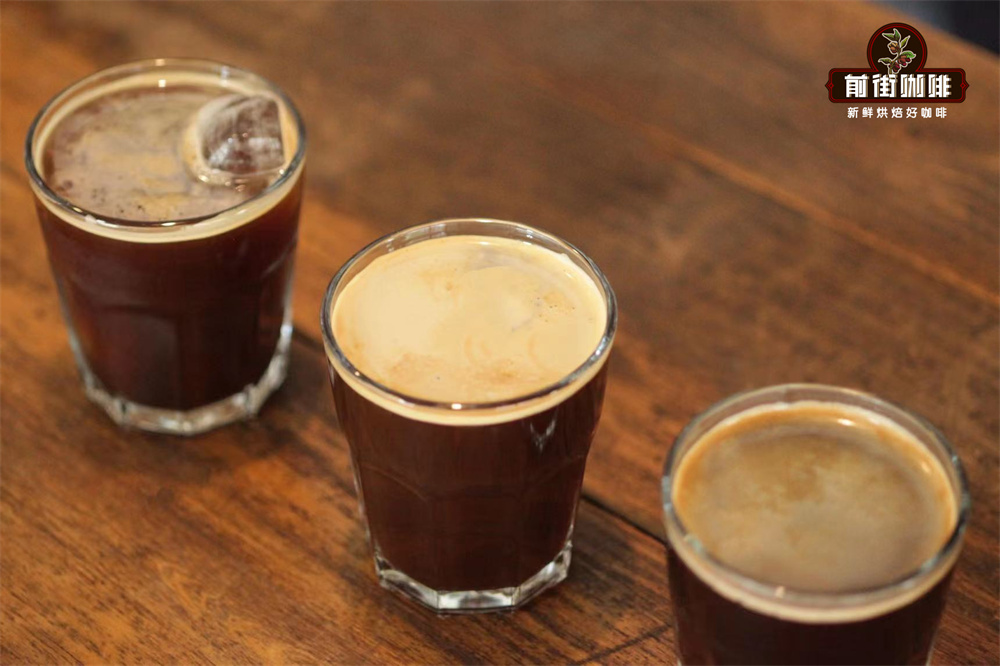
This time, Front Street selected Sunflower Warm Sun blend coffee beans (a blend of Sherry coffee beans and Yirgacheffe Red Cherry coffee beans in a 7:3 ratio), used the same extraction parameters to make three espressos, and then added ice water, room temperature water, and 88°C hot water respectively, comparing them from the three perspectives of aroma, flavor, and mouthfeel to see how Americanos at different temperatures perform.
The espresso extraction parameters used in the experiment are as follows: Feima E78 espresso machine, Feima 900N grinder, grind size 1.9, double-spout portafilter, 20g coffee grounds, extracting 35g of coffee liquid (double espresso), extraction time 27 seconds. The espresso extracted with these parameters presents whisky aroma, milk chocolate, and vanilla cream flavors, with soft acidity, a caramel-like finish, prominent aroma, and a rich mouthfeel. When Front Street makes Americano, the ratio of espresso to hot water is 1:6, that is, 1g of coffee liquid to 6g of water.
|How to Make Iced Americano
First prepare 110g of ice cubes and 100g of room temperature water, mix them into an ice-water mixture, then pour in the extracted 35g of espresso. Because the ice will continue to melt, it needs to be stirred evenly before drinking.
|How to Make Room Temperature Americano
First pour the extracted 35g of espresso into the cup, then add 210g of room temperature water.
|How to Make Hot Americano
Likewise, first pour 35g of espresso into the cup, then add 210g of hot water. The water temperature should be controlled at around 88°C; it should not be too high, because water that is too hot can easily give Americano a burnt flavor.
Flavor Comparison of Americanos at Three Temperatures
Hot Americano: The whisky aroma is very active, the acidity is not very prominent, and it shows more hazelnut and caramel flavors, with a relatively high body.
Room temperature Americano: The aroma is not as obvious as in hot Americano, the acidity is soft, and the mouthfeel is smooth. Because the crema of the espresso has not been broken up, the overall expression shows more vanilla-cream-like smoothness, as well as a nutty and caramel finish.
Iced Americano: Among the three, iced Americano has the weakest aroma, but the most prominent acidity. On the palate, you can feel whisky aroma, berry-like sweet acidity, and a hazelnut chocolate-like finish, with a refreshing and smooth mouthfeel.
Human senses perceive taste differently at different temperatures. The advantage of tasting hot coffee is that you can experience the layered changes in flavor as the coffee goes from hot to cool. When drinking iced coffee, the low temperature reduces the taste buds' sensitivity to bitterness and sweetness, thereby making sourness more prominent. So, when you're torn about what temperature of Americano to drink, just choose according to the mouthfeel you want at that moment.
The above content is compiled by CoffeeHunters, a coffee news website.


