







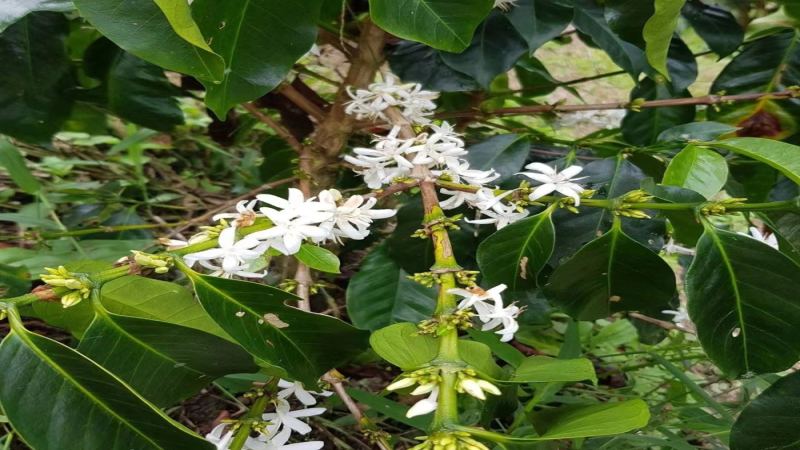
Why Is Huila Coffee Central to Pink Bourbon Production?
Pink Bourbon is a rare variety whose cherries often ripen in shades of pink and orange rather than the usual red. On many farms it is planted alongside Caturra and Castillo, which makes selective picking important. In Huila, smallholder plots spread across steep slopes, and the variety's lower yield per tree encourages growers to focus on careful hand sorting before the cherries ever reach the mill.
Huila sits in the southern section of Colombia's Central Cordillera, where coffee is generally grown above 1,500 meters. Cupping there often shows gentle fruit acidity up front, notable sweetness in the back end, and strong overall balance. The Isabella Pink Bourbon lot is grown at 1,760 meters and processed with a semi-washed method, then roasted and brewed to highlight that profile.
Pink Bourbon is a rare variety that has attracted much attention in the specialty coffee circle in recent years. Its ripe coffee cherries present a romantic pink color, and it was first discovered in Huila, Colombia. From the perspective of Front Street Coffee, this article sorts out Colombia's 2021 coffee production estimate, analyzes the genetic origin of Pink Bourbon—whether it is a natural cross between Yellow Bourbon and Red Bourbon, or a descendant of Colombia and Caturra—and explains the fundamental reason why its recessive traits lead to low yields. At the same time, it introduces in detail the terroir advantages of the Huila producing region, the process of the semi-washed method, and Front Street Coffee's roasting curve, cupping performance, and brewing parameters for this bean, providing a complete reference for coffee lovers.
Colombia 2021 Coffee Production Estimate
Thanks to good growing conditions and increased yield per unit area, Colombia's total coffee production in 2020/21 is expected to reach 14.1 million bags. Coffee exports are expected to increase by 600,000 bags to 12.4 million bags, mainly sold to the US and EU markets. At the same time, the country's domestic coffee consumption continues to rise, and ending stocks are expected to decline slightly.
Red Bourbon and Yellow Bourbon are no strangers to coffee lovers, so where did Pink Bourbon, this novel variety, come from? In this article, Front Street will talk about this mysterious little darling—Pink Bourbon coffee beans from Colombia.
FrontStreet Coffee: Isabella Pink Bourbon Coffee Beans
Region: Huila, Colombia
Altitude: 1760m
Variety: Pink Bourbon
Processing Method: Semi-washed
Huila Coffee Producing Region
Huilan
The Huila Department is located in the southern section of Colombia's Central Cordillera and is one of the country's most renowned specialty coffee producing regions. Surrounded by mountains, coffee is generally grown at altitudes above 1,500 meters. FrontStreet Coffee has cupped many coffee beans from the Huila region and found that coffees produced there often have gentle fruit acidity in the front end, notable sweetness in the back end, and a quite excellent overall balance, making one feel that Huila beans have strong potential. Therefore, Front Street believes that if coffee beans from this region are processed using different green bean methods, they can bring completely different surprises to the palate.
Pink Bourbon
Pink Bourbon
Pink Bourbon, as the name suggests, presents a romantic pink color after its coffee cherries ripen and belongs to a rare coffee variety. Pink Bourbon was first discovered in the town of Palestine in Huila, Colombia, and its main growing areas are currently concentrated in the Huila region of Colombia.
Genetics of Pink Bourbon
DNA
Pink Bourbon is the offspring of a natural cross between Yellow Bourbon and Red Bourbon. Both Yellow Bourbon and Red Bourbon are dominant traits expressed by dominant genes and have relatively strong reproductive stability; while Pink Bourbon, the new variety produced by crossing the two, belongs to a recessive trait expressed by recessive genes, and offspring from crossbreeding are highly prone to trait segregation.
There is another explanation for the genetic origin of Pink Bourbon. Some studies indicate that Pink Bourbon is the product of a natural cross between Colombia and Caturra. Caturra is a variant of Bourbon, while the Colombia variety, as a coffee tree variety heavily promoted for cultivation in the country, has obvious advantages because it carries some Robusta genes—high yield and resistance to leaf rust—but its drawback is mediocre flavor performance and a lack of delicate sweet-acid layers.
The main reason Pink Bourbon is called a rare variety is that maintaining this beautiful pink color is extremely difficult. Sometimes coffee farmers harvest some orange Bourbon, because the color of the coffee fruit is ultimately determined by recessive genes in the pollen grains. Among the pollen grains selected by farmers for crossing, there are both yellow genes tending toward Yellow Bourbon and red genes tending toward Red Bourbon, and these are all recessive genes, making them very likely to interfere with each other.
Pink Bourbon Yield
Plant Yield
Taking Pink Bourbon coffee from the 2020 harvest season in Colombia's Huila region as an example, about 1,800 coffee trees were planted in Huila in 2020. Over one harvest season, each tree produced about 1.8 kg of fresh cherries. After pulping and mucilage removal, about 0.36 kg of coffee beans could be obtained. In a normal harvest season, the yield of this batch of coffee was less than 650 kg.
At this point, some people may ask Front Street: with such a small amount, wouldn't it be gone right after drinking it? Actually, there is no need to worry. On the one hand, the natural crossing of Yellow Bourbon and Red Bourbon to produce Pink Bourbon will not stop; on the other hand, almost all Arabica coffee uses self-pollination, meaning the coffee flower to be pollinated and the pollen may come from the same plant, or even the same flower, which greatly improves the stability of recessive trait expression. Therefore, when growing Pink Bourbon, a relatively isolated growing environment is very necessary to avoid genetic contamination from other varieties.
Semi-washed Processing Method
Semi-Washed
The Pink Bourbon coffee beans obtained by Front Street use the semi-washed processing method. First, the harvested coffee cherries are poured into a pulper to remove the skin and pulp, and the parchment beans covered with mucilage are taken out. Then they are poured into a mucilage remover, where a small amount of water and mechanical force are used to scrape off the sticky mucilage layer, and smooth-surfaced parchment beans are obtained. Then the coffee cherries are dried or taken outdoors for sun exposure. Finally, when the moisture content of the coffee cherries drops to 10%-14%, a huller is used to remove the silver skin and other residues stuck to the coffee beans, and the semi-washed processing method is complete.
FrontStreet Coffee believes that coffee beans processed by the semi-washed method taste slightly lower in fruit acidity than washed beans, but a little higher in acidity than natural beans; their sweetness is slightly lower than semi-natural beans, but their cleanliness is a bit better than semi-natural beans, with a flavor between semi-natural and washed.
FrontStreet Coffee Roasting Record
Because Pink Bourbon displays such a unique flavor, in order to bring out better flavor performance from this bean, Front Street's roaster used a medium-light roast for this coffee. The beans were charged at 180°C, with the damper set to 3 and heat at 120; the turning point was 1'42", and at 140°C the heat remained unchanged while the damper was opened to 4; at this point the bean surface turned yellow, the grassy smell completely disappeared, and the dehydration stage began. At 176°C the heat was lowered to 100, and at 180°C the heat was lowered to 70, while the damper remained unchanged.
At 8'17", ugly wrinkles and dark streaks appeared on the bean surface, and the toast aroma clearly turned into coffee aroma, which can be defined as the prelude to first crack. At this time, it is necessary to listen clearly for the sound of first crack. First crack began at 9'30", and the damper was adjusted to 5 (adjusting the heat must be done very carefully, and it must not be so low that there is no cracking sound). After first crack, it was developed for 1'30" and dropped at 191.5°C.
FrontStreet Coffee Cupping Report
The rare Pink Bourbon also performed very distinctively in Front Street's cupping. Unlike the generally flatter flavor of ordinary Bourbon, this Pink Bourbon has a fresh floral aroma, juicy sweetness of blueberry and green grape, a cherry note in the middle, and a yellow sugar-like sweetness in the finish. In terms of acidity, it shows more of a complex citrus-berry expression.
FrontStreet Coffee Brewing Notes
Dripper: Hario V60
Water temperature: 90°C
Coffee dose: 15g
Coffee-to-water ratio: 1:15
Grind size: caster sugar (80% passing through China standard No. 20 sieve)
FrontStreet Coffee uses staged extraction: use 30g of water for a 30-second bloom, then pour in a small stream in circles until 125g for the first stage; when the water level drops and is about to expose the coffee bed, continue pouring until 225g and stop; when the water level drops and is about to expose the coffee bed, remove the dripper. (Timing starts from the beginning of the bloom.) The extraction time is 2'00".
Brewed flavor: citrus, berries, and cherry tomatoes on the entry; as the temperature changes, there is caramel sweetness and a light fermentation aroma; the aftertaste has floral and nutty creamy aromas, with a smooth and clean mouthfeel.
For more specialty coffee beans, please add the private WeChat of FrontStreet Coffee. WeChat ID: kaixinguoguo0925
The above content is compiled by CoffeeHunters, a coffee news website.


