







Is Wine Process Coffee Actually Soaked in Red Wine?
No. The wine process borrows the fermentation logic of winemaking rather than soaking beans in red wine, so the brewed cup contains no meaningful alcohol. The Hartmann Estate Catuai from the Volcan region of Panama ferments with the pulp still attached, producing a small amount of alcohol that dissipates during high-temperature roasting.
Hartmann Estate sits at 1,250 to 1,700 meters on fertile Baru volcanic soil in a dry, cool climate, and the family pioneered coffee cultivation in Volcan. The article covers estate background, Catuai variety origins, the controlled coffee process, plus roasting curves, cupping results and V60 segmented brewing parameters.
Is red wine process coffee actually soaked in red wine? Does it contain alcohol? These are common questions among many coffee enthusiasts. In fact, this processing method borrows the fermentation logic of winemaking, rather than directly soaking coffee beans in red wine. In this article, Front Street Coffee takes you deep into the red wine process Catuai coffee beans from Hartmann Estate in the Volcan region of Panama: from the estate's background and variety origins, to the specific controlled fermentation process and flavor performance. We also share Front Street's roasting curve, cupping results, and V60 segmented brewing parameters to help you understand what makes this bean unique.
Recently, a friend asked Front Street: Is the red wine process method simply soaking coffee beans directly in red wine? Will the brewed coffee contain alcohol? The answer is no. The so-called red wine process only borrows the approach of winemaking to complete the fermentation of coffee beans; it does not use red wine to soak the beans. When coffee cherries ferment with the pulp still attached, a small amount of alcohol is indeed produced, but after high-temperature roasting, the alcohol essentially dissipates completely, so there is no need to worry about residual alcohol in the finished beans. Below, Front Street will introduce this coffee bean from Hartmann Estate in Panama that uses the red wine process.
Front Street Coffee — Hartmann Estate Red Wine Process Coffee Beans
Region: Volcan, Panama
Estate: Hartmann Estate
Altitude: 1250-1700m
Processing method: Red wine process
Variety: Catuai
Hartmann Estate
Finca Hartmann
In recent years, coffee from Panama's Volcan region has attracted increasing attention in the specialty market. This region has a dry, cool climate and fertile Baru volcanic soil, with elevations mostly above 1,700 meters, providing superior growing conditions for coffee trees. In the early days, the Volcan area mainly grew fruits, vegetables, and other cash crops, and very few farmers planted coffee. The pioneer who first opened up coffee cultivation in the Volcan area was the well-known Hartmann family in Panama.
Hartmann Estate is currently managed by the third generation of the family. Mr. Ratibor Hartmann and his four siblings divide responsibilities and work together, living on the estate and making coffee cultivation their profession. From published books on bird-friendly, shade-grown cultivation to the estate's toucan logo, it is clear that Hartmann Estate places great importance on environmental protection; it also follows green principles in coffee cultivation, using fertilizer made from fermented coffee skins and pulp.
The Hartmann family also provides management and coffee processing services for many estates in Panama. For example, Finca La Mula, a frequent winner at Best of Panama, and 90+'s estates in Panama are all managed by the Hartmann family. This estate keeps a low profile and rarely appears at Best of Panama, but the coffee it produces is considered one of Panama's finest lots. The Hartmann family deserves much of the credit for Panama coffee's reputation today.
Catuai Variety
Catuai
Catuai was developed by the Instituto Agronomico de Campinas (IAC) in Sao Paulo, Brazil, through artificial hybridization of Mundo Novo and Yellow Caturra, originally under the code name "H-2077." It inherits Mundo Novo's high yield, strong disease resistance, and good cupping performance, as well as Caturra's short stature, high-quality acidity, and suitability for natural processing.
Red Wine Process
Processing coffee in a way similar to red wine fermentation can significantly enhance the coffee's sweetness and cleanliness, and bring layered, elegant acidity. This fermentation method greatly improves the coffee's quality and distinctiveness. The red wine process is also called controlled fermentation, or lactic/acetic fermentation.
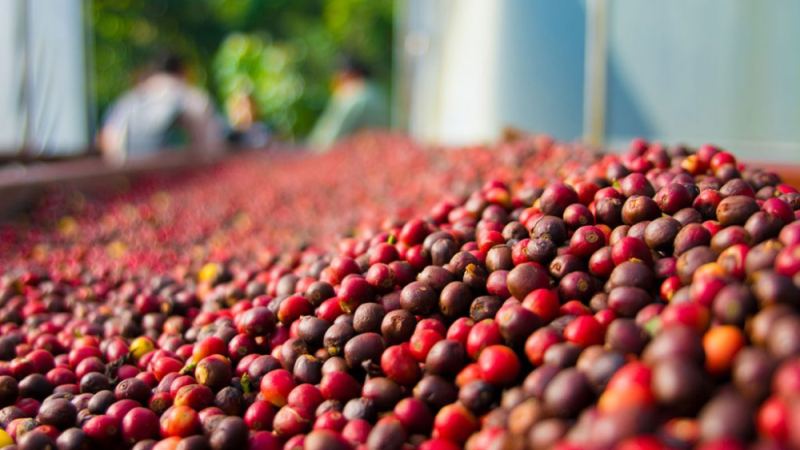
After harvesting the cherries, the estate carefully selects ripe red coffee cherries to ensure that among the fruit used for processing, the proportion of unripe cherries is below 2%, the proportion of defective beans is below 3%, and the proportion of floating beans is below 5%. The selected cherries are placed into a specific container, which should be equipped with a device similar to a wine fermentation lock or one-way exhaust valve.
In this way, carbon dioxide can be discharged through the device, thereby controlling the air concentration inside the container. At this point, the coffee cherries in the container undergo acetic fermentation, and the resulting beans have a brighter, cleaner flavor with citric acidity. Front Street believes that coffee beans using the red wine process present a fermented vinous aroma similar to red wine, with a full body and clean acidity.
Front Street Coffee Roasting Notes
Front Street's roaster uses a Yangjia 800N semi-direct-fire roaster with a 600g charge. When the drum temperature rises to 200°C, the beans are added, and the airflow is set to 3; after 30 seconds, the heat is adjusted to 170°C, and the airflow remains unchanged; the turning point appears at 1'39'', and the heat is maintained; at 4'57'', the bean surface turns yellow, the grassy smell completely disappears, and the dehydration stage begins, so the heat is reduced to 130°C and the airflow is maintained at 3.5;
At 8'00'', dehydration is complete, and the heat is reduced to 80°C; at 8'00'', unsightly wrinkles and dark streaks appear on the bean surface, and the toasty aroma clearly turns into coffee aroma, which can be regarded as the prelude to first crack. At this point, you need to listen carefully for the sound of first crack; at 8'43'', first crack begins, the heat is reduced to 60°C, and the airflow is fully opened to 5 (adjusting the heat requires extra care, and it must not be so low that the cracking sound cannot be heard); after first crack, develop for 1'43'' and drop the beans at 195.5°C.
Front Street Coffee Cupping Report
Front Street Coffee conducts cupping within 8-24 hours after roasting the sample beans. Front Street Coffee baristas usually use 200ml ceramic cupping bowls. The cupping water temperature is 94°C, and the grind size is controlled so that 70%-75% passes through a No. 20 standard sieve (0.85 mm). The ratio is 11.1 grams of coffee powder to 200 milliliters of hot water, or 1:18.18, so that the extracted concentration falls exactly within the golden cup range of 1.15%-1.35%, with a steeping time of 4 minutes.
Front Street Panama Hartmann Estate Red Wine Process Coffee Beans Cupping Results
Dry aroma: orange, jasmine
Wet aroma: red wine, honey
Flavor: tropical fruit, nuts, red wine, honey, sucrose
Front Street Coffee Brewing Notes
Dripper: V60#01
Water temperature: 90°C
Coffee-to-water ratio: 1:15
Grind size: medium-coarse grind / EK43s setting 10 (80% passing through China standard No. 20 sieve)
Front Street uses segmented extraction: first pour 30 grams of water and bloom for 30 seconds; second pour 95 grams of water (scale reads 125 grams), finishing in about 1 minute 05 seconds; third pour 100 grams of water (scale reads 225 grams), finishing in about 1 minute 40 seconds; total extraction time is 2 minutes 05 seconds, and brewing is complete once the dripper is removed.
[Front Street Panama Hartmann Estate Red Wine Process]
Brewed flavor: smooth on entry, lively and bright acidity, soft acidity, rich layers, with an obvious red wine finish, honey, and sucrose notes, and a brown sugar flavor after fully cooling.
The above content is compiled by CoffeeHunters, a coffee news website.


