







Why Are Mocha Coffee Beans, Mocha Drinks and the Moka Pot All Named Mocha?
Mocha coffee beans, espresso mocha and the moka pot share a name but were born one to two centuries apart, and there is no direct production link between them. The single thread that ties them together is the port of Mocha in Yemen, which long ago stopped exporting coffee. Mocha coffee beans took their name from that port.
From the 15th century, the port of Mocha was a major Red Sea trading hub for more than three hundred years, though it did not grow coffee itself. Beans from Yemen's central highlands shipped out through it, and Europeans, knowing only the port, called them mocha. Espresso mocha later used chocolate to imitate that flavor, and the moka pot borrowed the name. Choose fresh medium-dark roasted beans for the moka pot.
The word mocha appears repeatedly in the coffee world—mocha coffee beans, espresso mocha, and the moka pot. The three seem to share the same origin, but in reality, they were born across a span of one to two centuries, and there is no direct production connection between them. The only thread that truly links them points to the port of Mocha in Yemen, which long ago stopped exporting coffee. Starting from history, this article sorts out the origins of each of the three mochas one by one: how mocha coffee beans got their name from the port, why espresso mocha uses chocolate to imitate the flavor of days past, and why the moka pot borrowed the name mocha. At the same time, for friends who want to make good coffee with a moka pot, it also offers suggestions for choosing fresh medium-dark roasted beans.
Friends who have just stepped into the coffee world are often confused when faced with a string of terms containing the word mocha. People who start with espresso and people who start with single-origin coffee often understand mocha coffee in completely different ways. Below, let us sort out what exactly the connection is among mocha coffee beans, mocha coffee, and the moka pot.
Mocha
Judging only by the words themselves, all three carry the name mocha, which easily leads people to think: use mocha coffee beans as the ingredient, use a moka pot as the equipment, and you can make a cup of mocha coffee. But this reasoning is obviously wrong—the times when they appeared differ by as much as one or two centuries. The only remaining clue points to Mocha in Yemen. Next, let us look at why they are all named mocha.
Mocha Coffee Beans
The port of Mocha in Yemen, for more than three hundred years starting in the 15th century, was a port of great importance on the Red Sea outlet, comparable in status to today's Port of Shanghai, and most of the world's maritime trade had to pass through it. Mocha itself did not produce coffee; the coffee nearby mostly came from the high-altitude areas of central Yemen's mountains and was then shipped out from the port of Mocha. After these coffees reached various European countries, they were widely praised, and at the time people only knew that they came from the port of Mocha, so they called them mocha coffee (beans). After that, any coffee exported from the port of Mocha would be sold under the label mocha coffee.
To this day, Yemeni Mocha is still a rare and precious coffee in the world. In recent years, the situation in Yemen has continued to be turbulent, and coffee cultivation has suffered severe damage, with only a very small amount of Yemeni coffee able to make its way out through the sound of gunfire each year. A few years ago, Front Street Coffee was fortunate to obtain a bag of Mokha Mattari coffee, produced in the Bani Matar region of Yemen, named after its place of origin. Yemeni coffee packaging is also different from the usual coarse burlap sacks, using a fine-pored woven cloth similar to flour sacks.
Yemeni Mocha is divided into different schools depending on the growing region. For example, Mattari has chocolate notes and acidity, while Sanani mocha is known for its ruggedness and fragrance. But their common main characteristic is a rich chocolate profile.
Mocha Coffee
What we now call mocha coffee (Coffea Mocha) usually refers to a drink in espresso coffee, made up of espresso, milk, and chocolate sauce (or chocolate powder). Some coffee shops use chocolate chunks instead of sauce or powder. Melt the chocolate into the espresso, then pour in steamed milk, and the coffee and cocoa blend in the cup, sweet and mellow.
This seems to have nothing to do with the port of Mocha. Espresso mocha can be traced back to 18th-century Italy. Although there is currently no more authoritative historical material to confirm the origin of its name, we might as well make a bold guess. By the 18th century, the global coffee landscape had already changed: the Dutch had brought coffee to Southeast Asia, and the French had brought coffee to South America. Mocha had long lost its monopoly on coffee, and with the rule of the Ottoman Empire in the middle and late periods, mocha coffee's market share also gradually shrank.
From this it is not hard to see that less and less mocha coffee was flowing into Europe. In order to recreate the chocolate charm in mocha coffee beans, Italians added chocolate sauce to espresso and then used milk to blend a flavor close to that of mocha coffee beans, which is not hard to understand. Therefore, the birth of espresso mocha was very likely an attempt to imitate the then-scarce mocha coffee beans. In addition, mocha coffee beans held a place in people's minds like today's Geisha, so giving a drink with a similar flavor the name mocha coffee also made it seem more stylish.
As espresso coffee culture swept the world, espresso mocha (chocolate milk coffee) also became an indispensable member of the espresso family.
Moka Pot
This actually has little to do with the port of Mocha. The inventor of the moka pot was Alfonso Bialetti, and among the three mochas it was born the latest (1933). It is a traditional Italian household brewing device and did not come from Mocha in Yemen, but its influence cannot be underestimated, and it is said that every Italian household must have one.
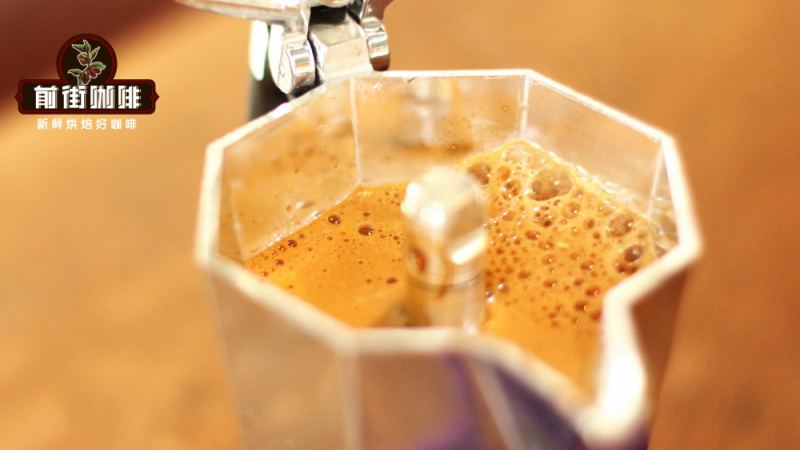
The moka pot consists of three parts: the upper pot, the filter basket, and the base. The lower pot holds water, the filter basket holds more finely ground coffee, and the upper pot is used to receive the extracted coffee liquid. The extraction principle of the moka pot is not complicated: it uses the steam pressure generated in the lower pot. When the pressure is great enough to penetrate the layer of coffee grounds, the hot water is pushed up into the upper pot, brewing a rich and aromatic coffee. Although its pressure (1.5-2bar) is insignificant compared with an espresso machine (9bar), it can still extract coffee oils, and the mouthfeel is quite rich.
Precisely because the moka pot uses pressure extraction, with high temperature and fast speed, if you want to make coffee with moderate oils and a rich aroma, it is best to give priority to fresh medium-dark roasted coffee beans. You can buy Front Street Classic Espresso Blend coffee beans (traditional Mamba recipe, delicate and full-bodied oils, suitable for home use and commercial use in coffee shops), Front Street Commercial Blend coffee beans (the same ingredients used by coffee shops, rich oils), and Front Street Specialty Blend coffee beans (pronounced caramel aroma and obvious sweet aftertaste).
To help everyone enjoy good coffee freely, Front Street promises that every bag of coffee beans is roasted within 5 days, so that all customers receive them in the freshest condition and can easily make delicious moka pot coffee.
So why is the moka pot called a "moka pot"? In English it is spelled Moka pot. The most common explanation is: since the first batch of coffee entered Venice in the 17th century, the words mocha and coffee have already been linked with each other, and it can be said that in northern Italy, mocha was equivalent to coffee. Therefore, the moka pot is actually also called a coffee pot, meaning a brewing device with which you can get a cup of rich coffee at home.
The above content is compiled by CoffeeHunters, a coffee news website.


