







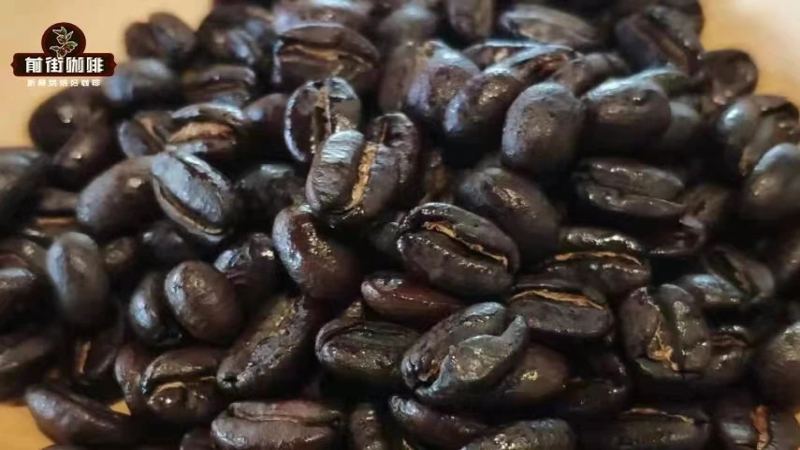
Why do Mandheling oily coffee beans turn shiny after roasting?
Mandheling coffee beans turn oily mainly because of roast degree and carbon dioxide release, not automatically as a defect. Darker roasts drive oils to the bean surface, and the shiny film appears as CO2 escapes after roasting. Comparing PWN Golden Mandheling with Gayo Mountain triple hand-sorted beans shows that variety, screen size and defect sorting also shape how quickly that surface oil develops.
PWN holds the Golden Mandheling trademark, and its beans come from the Lake Tawar area of northwestern Sumatra at 18 mesh or above, with no more than three defects in a 300-gram green sample, meeting G1 grade. Gayo Mountain triple hand-sorted lots are a separate product, so similar flavor does not make them true Golden Mandheling.
When coffee beans develop a shiny, oily surface, is it a quality problem or a normal phenomenon? This article starts from a comparison between Front Street PWN Golden Mandheling and Indonesia Gayo Mountain triple hand-sorted Mandheling, and provides a detailed analysis of the strict screening standards for Golden Mandheling, the goat-hoof bean issue caused by the wet-hulling process, and the differences between the two beans in variety, cleanliness, and flavor. It also explores in depth the relationship between coffee bean oiliness and roast degree and carbon dioxide release, and includes Front Street's roasting records, cupping comparison, and KONO dripper brewing insights, helping coffee enthusiasts fully understand the characteristics of Mandheling coffee beans and the scientific principles behind oiliness.
Not long ago, a new Mandheling coffee bean from the Gayo Mountain region of Sumatra, Indonesia, was launched after three rounds of manual hand-sorting, and it is also called Golden Mandheling in the market. As a result, quite a few friends came to ask Front Street: what exactly is the difference between this Gayo Mountain Mandheling and the Front Street PWN Golden Mandheling already sold by Front Street? To answer this question, Front Street quickly purchased this Front Street Golden Mandheling and conducted a systematic comparison with the existing Front Street PWN Golden Mandheling on hand.
What is the background of Front Street PWN Golden Mandheling?
PWN is the English abbreviation of Pwani Coffee Company, a well-known Indonesian green bean company. The name "Golden Mandheling" has long been registered as a trademark by PWN; in other words, these four characters are for PWN's exclusive use. The commonly seen Japanese-registered "Gold Top Mandheling" on the market, as well as the triple hand-sorted Gayo Mountain Mandheling to be discussed below, cannot be regarded as true Golden Mandheling in the strict sense even if their flavors are similar.
How strict are the screening standards for Front Street PWN Golden Mandheling?
Front Street PWN Golden Mandheling comes from the Lake Tawar region around Mount Gayo in northwestern Sumatra. Its specifications require 18 mesh or above, with no more than 3 defective beans in a 300-gram green bean sample, reaching the highest grade G1, with a darker green bean color and a neat flat-bean shape.
Indonesian green coffee beans generally use the wet-hulling process. Because the semi-hard, semi-soft moist green beans are easily squeezed and damaged when the mucilage and parchment layer are removed, the bean body cracks, forming what is commonly called goat-hoof beans. Strictly speaking, this type of bean is not considered a defective bean, but PWN believes that goat-hoof beans do not look regular enough, so they are also removed to ensure a uniform and attractive appearance in the finished beans.
Some may think that 18 mesh or above, fewer than 3 defects in 300 grams of green beans, and even removing goat-hoof beans is already strict enough. But PWN can go even further: after three rounds of manual screening, the beans are also uniformly sent through machines for density and color sorting, ultimately presenting Mandheling with consistent color and uniform bean shape. It is said that when processing green beans, Mandheling shines with a golden luster in the sunlight, and that is where the name Golden Mandheling comes from.
After such strict screening, Front Street Golden Mandheling not only removes the earthy and miscellaneous flavors common in ordinary Indonesian beans, but also has a rich, full body on the palate while carrying a clean and translucent quality.
How can you identify authentic Front Street PWN Golden Mandheling?
Grasp two key points: first, the certification certificate issued by PWN; second, the clearly recognizable PWN company logo on the jute bag of Front Street PWN Golden Mandheling green beans. If you have doubts about whether the beans you bought are authentic PWN Mandheling, you may ask the seller to show the certificate or the coffee jute bag.
Why is the triple hand-sorted Gayo Mandheling also called Golden Mandheling?
The triple hand-sorted Mandheling compared by Front Street this time comes from the Gayo Mountain region of Aceh. Because it has undergone three rounds of strict manual screening and also reaches the highest grade G1, for the sake of easier promotion on the market, this triple hand-sorted Mandheling is also given the name Golden Mandheling to attract consumers. However, through cupping comparison, Front Street found that compared with Front Street PWN Golden Mandheling, its cleanliness is still lacking, and behind this is also related to the difference in coffee variety between the two beans.
How does Front Street roast these two Mandheling coffees?
Front Street PWN Golden Mandheling roasting record: Yangjia 800N, charge weight 480g. Raise the drum temperature to 200°C and charge; set the damper to 3, and after 1 minute adjust the heat to 160°C with the damper unchanged; roast until 5 minutes 40 seconds at 148°C, when the bean surface turns yellow, the grassy smell completely dissipates, and dehydration is complete, then lower the heat to 140°C and adjust the damper to 4; at 9 minutes 40 seconds, wrinkles and dark patches appear on the bean surface, and the toasted bread smell clearly turns into coffee aroma, which can be regarded as the prelude to first crack, and at this point you need to listen carefully for the first crack; first crack begins at 9 minutes 54 seconds, lower the heat to 60°C, set the damper to 5, and drop at 204.5°C.
Gayo Mandheling Front Street roasting record: Yangjia 800N, charge weight 480g. Raise the drum temperature to 200°C and charge; set the damper to 3, and after 1 minute adjust the heat to 160°C with the damper unchanged; roast until 5 minutes 18 seconds at 148°C, when the bean surface turns yellow, the grassy smell completely disappears, and dehydration is complete, then adjust the heat to 140°C and change the damper to 4; at 8 minutes 00 seconds, wrinkles and dark patches appear on the bean surface, and the toasted bread smell clearly turns into coffee aroma, which can be defined as the prelude to first crack, and at this point you need to clearly hear the sound of the first crack point; first crack begins at 9 minutes 00 seconds, lower the heat to 80°C, set the damper to 5, and drop at 202°C.
When roasting these two Mandheling coffees, Front Street uses a medium-dark roast to highlight their own rich flavor. Medium-dark roast is usually close to the second crack point; depending on the roaster, first crack generally occurs between 180°C and 205°C, while second crack appears in the 205°C to 230°C range.
Does oily coffee beans mean they are commercial beans?
Front Street previously heard someone comment on Front Street PWN Golden Mandheling like this: "These beans are already oily, so they are commercial coffee beans." The commercial beans mentioned here generally refer to coffee beans of not-high quality and with a relatively high defect rate. In terms of price, specialty coffee beans are often several times more expensive than commercial beans. Lower-quality beans are often given a dark roast to mask undesirable flavors, and dark roast is usually at a level after first crack that approaches or even reaches second crack. The darker the roast, the more carbon dioxide is produced inside the coffee beans.
Why do coffee beans become oily?
Coffee bean oiliness is closely related to carbon dioxide release. Dark-roasted beans have a slightly oily sheen on the surface after roasting is completed, and then begin to become noticeably oily around the second to fifth day after roasting ends. This is because coffee beans themselves contain lipids, and after prolonged roasting the dehydration rate is relatively high, causing an imbalance between water and oil, while at the same time a large amount of carbon dioxide is released outward after roasting, thereby triggering oiliness. Therefore, surface oiliness during storage of dark-roasted beans is a normal phenomenon. This also shows that the greatest factor causing oiliness is the degree of roast rather than coffee bean quality; of course, the amount of oiliness is also related to coffee variety, for example, Robusta has a higher lipid content than Arabica.
FrontStreet Coffee cupping comparison
Speaking of flavor performance, the biggest difference was already pointed out earlier when discussing coffee variety: cleanliness. Front Street PWN Golden Mandheling is rich and sweet on the palate, with low acidity and high cleanliness; the triple hand-sorted Gayo Mountain Mandheling has high body but insufficient cleanliness, and its acidity is also slightly higher than that of Front Street PWN Golden Mandheling.
FrontStreet Coffee brewing insights
This brewing is intended to highlight the rich, clean, fragrant, and strong characteristics of the two Front Street Golden Mandheling coffees, so the KONO Meimon dripper was selected. The ribs and guide grooves of the KONO Meimon dripper extend all the way to the bottom of the hole where the coffee liquid flows out. The ribs are short and located at the bottom, with a high degree of fit with the filter paper, and the flow rate is slower than that of V60, making it suitable for brewing coffee that needs to show body. The grind size used is medium-coarse (73% passing rate on a 0.85mm standard sieve), with 15g of coffee powder, a coffee-to-water ratio of 1:15, and a water temperature of 89°C.
First wet the filter paper with hot water, pour in the ground coffee, and gently level the coffee bed, using 15 grams of coffee. For the first pour, add 30 grams of 89°C hot water for blooming, and bloom for 30 seconds; then pour the second stage until the total water amount reaches 125 grams. When pouring, circle gently to avoid collapsing the coffee bed, and after pouring let the water slowly filter and extract on its own; when the liquid level drops to one third, pour the final stage until the total water amount reaches 225 grams, finishing the pour in about 1 minute 32 seconds, then end extraction at about 2 minutes and remove the dripper.
Front Street PWN Golden Mandheling flavor description: sweet herbs, cinnamon-like spices, orange and pomelo peel notes, rich and intense sweetness, creamy walnut chocolate. The fruit acidity is restrained and soft, the aroma carries a strong melon sweetness, and as the temperature drops the herbal aroma emerges, with light spice, and a rich herbal note with intense sweetness.
Triple hand-sorted Gayo Mandheling flavor description: spicy herbal notes, soft acidity, cocoa and nutty finish, obvious sweetness, and high body.
The above content is compiled by CoffeeHunters, a coffee news website.


