







What altitude does Ethiopian coffee grow at in Sidama, Guji and West Arsi?
Sidama, Guji and West Arsi each deliver a different cup. Sidama, in southern Ethiopia, grows coffee between 1,400 and 2,000 meters, with varied soils and native varieties producing widely diverse flavors. Guji gained attention through the Huakui bean, and West Arsi has a long coffee-drinking history.
To the south, what is yirgacheffe was once part of Sidama and was separated out for its standout flavor. Comparing Huakui 4.0 with Arsi beans across green beans, roasting, cupping and brewing shows the split clearly: citrus-like bright acidity on one side, a richer fruity aroma and juicy body on the other.
In Ethiopia's coffee landscape, the three producing regions of Sidamo, Guji, and West Arsi each have their own characteristics. Sidamo is known for its diverse flavors, Guji rose to fame with the Huakui bean, and West Arsi has a long history of coffee drinking. Front Street Coffee will take you through an in-depth look at the terroir, processing methods, and flavor performance of these three regions, and through a comparison of the green beans, roasting, cupping, and brewing of Huakui 4.0 and Arsi coffee beans, present their similarities and differences. Whether you prefer bright acidity or a rich juicy feel, this article can help you find the cup of Ethiopian coffee you love.
Professional coffee knowledge exchange. For more coffee bean information, please follow Front Street Coffee (FrontStreet Coffee).
Previous articles by Front Street have mentioned that Yirgacheffe originally belonged to the Sidamo producing region, and only later was it separated out because its flavor performance was especially outstanding. This time Front Street continues to introduce another important coffee origin in Ethiopia—Sidamo. Whenever we recommend Ethiopian coffee beans to Front Street's guests, we often ask: "Would you like an Ethiopian coffee with brighter acidity, or one with a richer juicy feel?" When guests cannot decide, Front Street's baristas use the citrus-like bright acidity that is Yirgacheffe's signature, as well as Sidamo's rich fruity aroma and juicy feel, to help guests quickly identify the flavor direction they prefer.
Sidamo
Sidamo
The Sidamo producing region is located in southern Ethiopia, extending east to the Arsi and Bale administrative zones, and bordering the Gamogofa administrative zone to the west. Coffee is grown at altitudes between 1,400 and 2,000 meters. The region's economy is mainly agricultural, and coffee farms are primarily distributed around the East African Rift Valley. In recent years Sidamo has developed strongly and has become an important coffee export hub. The coffee produced here has extremely diverse flavors. Different soil types, microclimatic conditions, and countless native varieties make the coffee of each town show distinct differences and unique character.
Within Sidamo, the most famous coffee-growing areas are Guji (GUji) and West Arsi (West Arsi). Most of the Sidamo region uses the natural method to process green coffee beans. Front Street believes it is precisely the natural process that gives the coffee of this region its rich fruity aroma and smooth mouthfeel.
Guji
guji
The Guji producing region once belonged to Sidamo and was officially designated as an independent producing region by the Ethiopian Commodity Exchange (ECX) in 2010. It is located southeast of Yirgacheffe, with complex terrain featuring interlaced high mountains, deep valleys, and plains. The soil in this area is fertile black soil (Vertisol), with a soil layer nearly two meters thick, and the average altitude exceeds 1,800 meters. The unique geographical conditions bring significant day-night temperature differences, providing an ideal terroir foundation for producing high-quality specialty coffee. And to explain what made the Guji producing region widely known, Front Street must mention the bean Huakui.
Huakui comes from Hambella, which is located within Guji, Ethiopia's largest coffee producing region, and administratively belongs to Oromia Regional State. To the west, Hambella faces Yirgacheffe's Kochere across the mountains, with a highland about 30 kilometers wide at an altitude of 3,200 meters lying between them; to the southeast, east, and north it borders Guji's Shakiso, Uraga, and Kercha sub-regions respectively. It is the highest-altitude coffee sub-region in Ethiopia.
At present, the Hambella producing region has nearly 20 processing plants of various scales. In 2017, a natural bean from DW Company's "Buku Abel" processing plant won the Ethiopia National Taste of Harvest Competition championship. Chinese green bean importers named this bean Huakui, and at the time it displayed rich strawberry and cream aromas. After that, DW Company added processing plants in Dimtu, the core production area of Hambella, including Buku Abel, Buku Saysay, Haro Soresa, and Tirtiro Goye, with an annual coffee output of about 1,100 tons. Strictly speaking, among all these estates and processing plants, only the natural coffee beans from the "Buku Abel" processing plant can be called "Huakui coffee beans."
Front Street Coffee (FrontStreet Coffee) once cupped Huakui, Huakui 2.0, and Huakui 3.0, and found that although the flavors of Huakui 2.0 and 3.0 were very close to the 2017 Huakui, their body and aftertaste were not as good as the original. Interestingly, Front Street can sometimes still identify beans exactly the same as the original Huakui batch from the green beans of these two batches. As for Huakui 3.1, Front Street found that its flavor was far from Huakui, and even somewhat close to Geisha, a change that was also confirmed by the green bean merchant. 2020 was the fourth year for this bean Huakui; the producing area had expanded to several times its original size, and with more scientific cultivation and management, the flavor of Huakui 4.0 was even more outstanding and received high praise from many coffee lovers. Front Street also acquired and listed a Huakui 4.0 coffee bean.
West Arsi
West Arsi
West Arsi is located between the well-known Yirgacheffe producing region and Harerge, at an altitude of 1,900 to 2,200 meters, in western Sidamo. Its name comes from the Oromo branch that has long settled there.
West Arsi is composed of three woredas (third-level administrative divisions in Ethiopia): Arsi, Bale, and East Shewa. About 88.52% of the population in this area is Oromo, which is of great significance in coffee history because they were the earliest tribe in human history to drink coffee, and half of the coffee produced in Ethiopia comes from this region.
Coffee cultivation in West Arsi is mainly based on smallholder farming, with an average farm size of about 2 to 3 hectares per household. Even so, this is still slightly larger than the 1.5 to 2 hectares common in most parts of Ethiopia. Although coffee-growing technology is still in the development stage, technological progress in this producing region is very rapid. Coffee farmers do not need to hire temporary or full-time workers, but rely on family members to help select coffee, which allows them to better control quality. Processing stations usually also pay extra for fully ripe red cherries, greatly motivating coffee farmers.
Natural Process
Natural
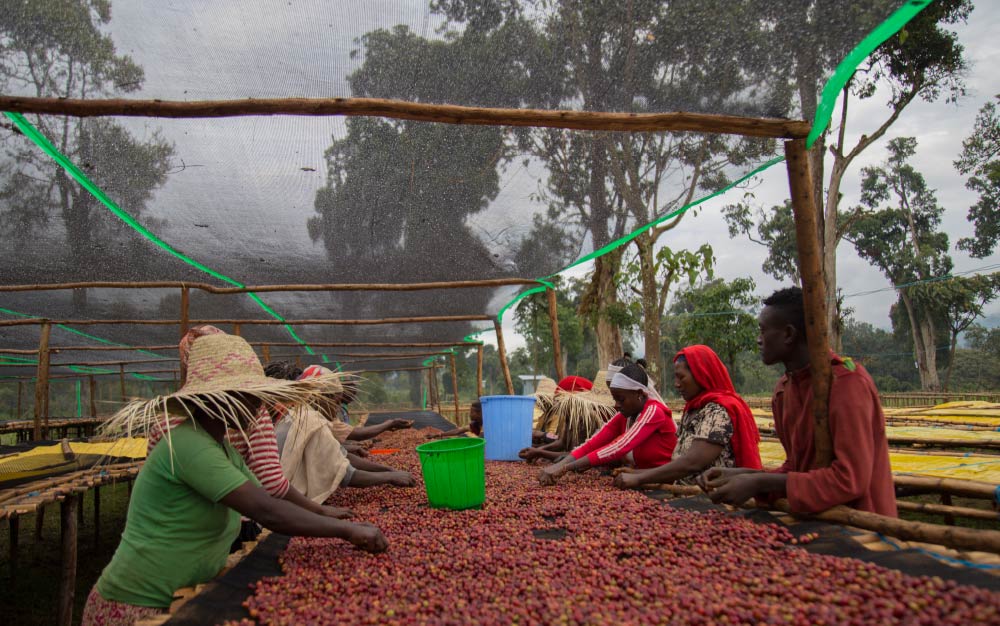
During the harvest season, coffee farmers in the Sidamo region pick only ripe red cherries, placing them one by one into baskets. After picking, the cherries are uniform in size, consistent in ripeness, and free of impurities. During processing, defective beans as well as unripe or overripe cherries are first removed by hand. The red cherries are then spread flat on raised wooden racks or entire drying beds for sun drying, thereby preventing the beans from touching the ground and absorbing off-flavors.
During sun exposure, they must be turned constantly to ensure the coffee beans lose moisture evenly; every three to five days, the coffee farmers manually remove moldy and defective beans. After the fruit skin dries and hardens, a huller is used to remove the dry hard skin. After obtaining the green beans, in pursuit of the ideal taste, the coffee farmers also perform a final sorting.
Next, Front Street will use Huakui 4.0 from the Guji producing region and Arsi coffee beans from West Arsi to conduct a series of comparisons from green beans, roasting, and cupping to brewing, to see how the beans from the two producing regions differ.
Front Street Coffee (FrontStreet Coffee) Green Bean Comparison
Both coffee beans use the natural process, and the green beans are green with a yellow tint. Huakui 4.0 contains some small beans mixed in among its varieties and looks uneven in size, while the Arsi beans are relatively uniform in size.
Front Street Coffee (FrontStreet Coffee) Roasting Recommendations
For these two new-crop beans, during roasting we extend the drying time so that the surface and core of the beans are heated evenly. To showcase their acidity and floral-fruity aroma, a light roast level is used.
Huakui 4.0: Yangjia 800N, bean charge 480g: raise the drum temperature to 175°C and charge, set the air damper to 3, and the gas to 120. When it rises to 140°C, set the air damper to 4. Roast to 6'00'', at 151.7°C, the bean surface turns yellow, the grassy smell completely disappears, and drying is complete. When wrinkles and dark spot patterns appear on the bean surface and the toasted bread smell clearly turns into coffee aroma, this can be regarded as the prelude to first crack. At this point you need to listen clearly for the sound of first crack. First crack begins at 9'50'', open the air damper fully, reduce the gas to 80 at 188°C, first crack development time 1'40'', drop at 196°C.
Arsi: Yangjia 800N, bean charge 480g: raise the drum temperature to 160°C and charge, set the air damper to 3, and the gas to 120. Adjust the gas once at 115°C, set the air damper to 4. Roast to 6'00'', at 154.9°C, the bean surface turns yellow, the grassy smell completely disappears, and drying is complete. At the 8th minute, wrinkles and dark spot patterns appear on the bean surface and the toasted bread smell clearly turns into coffee aroma, which can be regarded as the prelude to first crack. At this point you need to listen clearly for the sound of first crack. First crack begins at 9'08'', open the air damper fully, first crack development time 1'20'', drop at 193.5°C.
Front Street Coffee (FrontStreet Coffee) Cupping Report
Huakui 4.0
Dry aroma: citrus, berries
Wet aroma: blackcurrant, rose
On the palate: almond, strawberry, blackcurrant, fermented note, lasting sweetness
Arsi
Dry aroma: berries
Wet aroma: jam
On the palate: plum, berries, cranberry jam, nectarine, mango, honey
Front Street Coffee (FrontStreet Coffee) Brewing Recommendations
Dripper: V60 #01
Water temperature: 90-91°C
Coffee dose: 15g
Coffee-to-water ratio: 1:15
Grind size: BG6m / fine granulated sugar size (sift powder to 80% with a No. 20 sieve bowl)
Front Street brewing method: In the first stage, pour 30 grams of water for a 30-second bloom, then pour 95 grams (the electronic scale shows about 125 grams), finishing the pour in about 1 minute. When the water level drops to 2/3 of the coffee bed, pour the remaining 100 grams (the electronic scale shows about 225 grams), finishing the pour in about 1 minute 40-1'45''. Dripping is completed at 2'00''-2'10''. Remove the dripper and extraction is complete.
Huakui 4.0 brewed flavor: at high temperature there is an almond aroma; after gradually cooling, the sweet-tartness of berries, a blackcurrant juice feel, a honey aftertaste, and lasting sweetness.
Arsi brewed flavor: at high temperature, a berry juice-like mouthfeel; after gradually cooling, an aftertaste of plum, nectarine, mango, and honey.
The above content is compiled by CoffeeHunters, a coffee news website.


