







What makes Yirgacheffe Gotiti coffee distinctive?
The Gotiti Cooperative sits at the southeastern edge of Yirgacheffe in Ethiopia's Gedeo Zone, at roughly 2000 to 2100 meters, with about 300 farmer members. Its washed heirloom coffee carries citrus and floral-fruity notes with a green tea finish. The cooperative split from the Worka Cooperative, and the site is treated as one of the last pure expressions of this terroir.
Yirgacheffe is among the highest-altitude coffee regions in the world, with cool, foggy conditions that suit slow cherry ripening. The washed process and a light roast profile support the bright cup, which suits pour-over extraction. What does G1 grade mean in Ethiopian coffee is worth knowing here, since the grade reflects sorting and preparation standards.
Ethiopia is the birthplace of coffee, nurturing countless native varieties. Among the many specialty regions, Yirgacheffe stands out with its signature citrus and floral-fruity notes. And the Gotiti Cooperative, located at the southeastern edge of Yirgacheffe, is regarded as the last pure land of this terroir. Front Street Coffee's selected washed Yirgacheffe Gotiti comes precisely from this cooperative with about 300 farmer members. This article will walk you through the historical journey of Gotiti's independence from the Worka Cooperative, the traditional washed processing method, and the light roast profile and pour-over extraction plan custom-tailored by Front Street's roaster, so you can recreate a cup of specialty pour-over interwoven with citrus and berry notes and a finish of green tea freshness right at home.
Ethiopia is the cradle of the global coffee species, and humanity's first encounter with coffee took place on this very land. Thousands upon thousands of native coffee varieties grow here; walking through Ethiopia's wilderness or dense forests, any coffee tree could be a unique variety found nowhere else. Precisely for this reason, Ethiopia can be called the world's coffee gene bank. If one were to pick a single representative from among the many Ethiopian coffees, Front Street would unhesitatingly recommend the Gotiti Cooperative, renowned as a "fruit bomb."
Ethiopia Yirgacheffe Banko Gotiti Coop
Front Street · Yirgacheffe Gotiti Cooperative
Country: Ethiopia
Region: Yirgacheffe, Gedeo Zone
Altitude: 2000-2100m
Variety: Heirloom
Processing Method: Washed
Grade: G1
The Yirgacheffe region is known for its citrus fruit flavors and is deeply favored by coffee lovers. While exploring the Yirgacheffe region, Front Street discovered an exceptionally flavorful bean—the Front Street Washed Yirgacheffe produced by the Gotiti Cooperative.
|About Yirgacheffe
Yirgacheffe was originally a small town in Ethiopia, located within the administrative region of Sidamo Province. This town was historically a wetland—in the ancient language, "Yirga" means "to settle down," while "Cheffe" refers to "wetland." Yirgacheffe is one of the highest-altitude coffee regions in the world and a gold-standard hallmark of Ethiopian specialty coffee. The highlands at 1700-2100 meters, combined with the year-round cool, foggy, spring-like climate, and its unique geographical environment and cultivation system, create exceptional conditions for growing specialty coffee.
Strictly speaking, Yirgacheffe is a sub-region of Sidamo. This small town is situated to the northwest of Sidamo, nestled against mountains and beside a lake, and is one of the highest-average-altitude coffee regions in Ethiopia. Because of its unique flavor, it later separated from Sidamo to form its own system, becoming Africa's most renowned coffee region.
What people commonly call the "Yirgacheffe flavor" refers to intense jasmine floral aromas, lemon or lime-like acidity, and the sweetness of peach and almond along with tea-like notes. Front Street's Yirgacheffe coffee is layered and rich, with a delicate body and captivating flavors and a long-lasting sweetness. "Coffee enters the mouth, a hundred flowers bloom" is the most fitting description—as if flowers blossom across the taste buds and nasal passages. Beyond the floral notes, the delicate body is like silk gently caressing the mouth, a sensation beyond words.
|Introduction to the Yirgacheffe Region
Gedeb is a township located below Kochere town, 60 kilometers from Yirgacheffe town, and is a well-known specialty coffee region in Ethiopia. Its altitude ranges between 1900 and 2200 meters, considerably higher than the average Yirgacheffe region. The advantage of high altitude makes Gedeb a natural treasure for coffee cultivation, an emerging micro-region. Although the ECX auction market classifies this town under the Kochere region, it is at the same administrative level as Kochere town.
In the specialty coffee world, Gedeb can be viewed independently of Kochere as a Yirgacheffe sub-region at the same level as Kochere. This town encompasses coffee-producing villages such as Worka Sakaro, Halo Bariti, Banko Gotiti, and Banko Dahato.
|Gotiti Cooperative
The Gotiti Cooperative is located in the Worka region at the southeastern edge of Yirgacheffe, and was originally part of the Worka Cooperative under the Yirgacheffe Coffee Farmers Cooperative Union (YCFCU). As the specialty coffee industry places increasing emphasis on green bean traceability, independent "single-origin" lots have been successively discovered by coffee hunters worldwide. In 2012, Gotiti, with about 300 farmer members, formally separated from Worka and became the independent "Gotiti Cooperative."
Gotiti village was the earliest village area to be independently established; many smallholder farmers were originally members of the Worka Cooperative, so their coffee cultivation skills are naturally beyond question. The Gotiti Cooperative is hailed as the last pure land of Yirgacheffe, and therefore its green bean processing methods also follow the traditional path (washed and natural processing).
|Processing Method
After harvesting, the coffee cherries are quickly sent to the processing station within 6 to 12 hours. First, they are weighed, then poured into water to soak, with the purpose of screening out the cherries that float due to poor quality.
Next, the coffee cherries enter the pulper to remove the skin and pulp. The coffee cherries with pulp and skin removed are sent into fermentation tanks or barrels and left to ferment for 18 to 36 hours, during which enzymes break down the mucilage and pectin in the fruit. After demucilaging, the coffee cherries are washed in the tank with an appropriate amount of water, and by stirring, the residual pectin breakdown on the bean surface is removed; after washing, only the parchment layer, silver skin, and green beans remain.
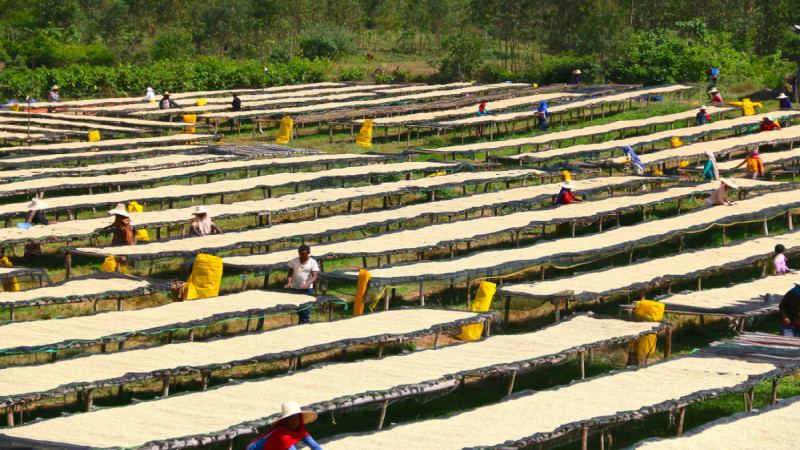
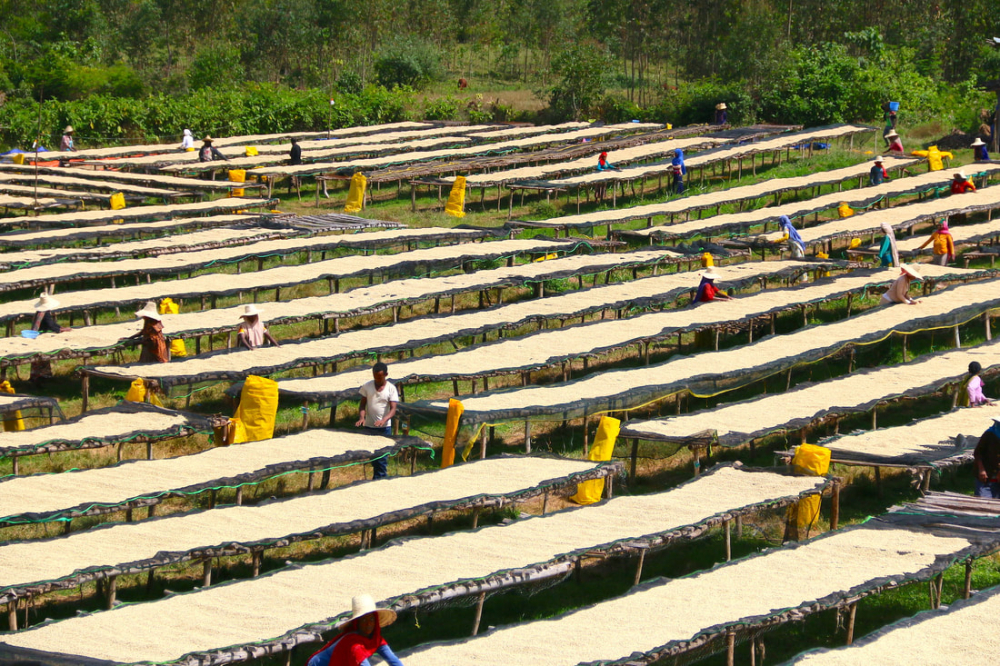
After washing, the coffee beans undergo sorting to remove defective beans. They are then sent to drying areas (tarps, concrete patios, or raised beds, etc.) for drying. The drying duration depends on environmental climate and other factors, typically ranging from 5 to 14 days. During this stage, the moisture content of the coffee beans drops from 55% to 11%.
|Front Street Coffee's Roasting Reference
For Yirgacheffe beans, Front Street's roaster typically uses a light roast to showcase their floral and fruity notes. For this Front Street Yirgacheffe Gotiti, we still use low heat to extend the bean's dehydration time.
When the drum temperature rises to 175°C, charge the beans, set the damper to 3, and the heat to 120; the turning point appears at 1 minute 32 seconds; when the drum temperature reaches 140°C, keep the heat unchanged and open the damper to 4; at this point the bean surface turns yellow, the grassy smell completely dissipates, and the dehydration phase begins. At 166°C, reduce the heat to 100, then at 176°C reduce it again to 80, keeping the damper unchanged.
At 8 minutes 28 seconds, wrinkles and dark streaks appear on the bean surface, and the toast aroma distinctly turns into coffee aroma, which can be regarded as the prelude to first crack; at this point, carefully distinguish the sound of the first crack. First crack begins at 9 minutes 38 seconds; adjust the damper to 5 (be sure to adjust the heat cautiously, never so low that you cannot hear the cracking sound), develop for 1 minute 30 seconds after first crack, and drop the beans at 193.5°C.
|Front Street Coffee's Brewing Reference
Considering that Front Street · Gotiti is renowned for its highly distinctive fruit flavors, brewing should prioritize highlighting this characteristic.
As a pour-over single-origin, Front Street · Gotiti Cooperative is a medium-light roast with a shorter heat exposure time than dark roasts, a harder texture, and slower extraction efficiency, so it requires a fine grind and high-temperature water to unlock its delicate flavors. To make Front Street · Gotiti coffee pleasantly balanced between acidity and sweetness, the water temperature is recommended to be controlled at 91~93°C.
Regarding grind size, Front Street determines it through the sieving method. Based on the Specialty Coffee Association (SCA)'s grind recommendations for pour-over coffee, combined with Front Street's practical verification, pour-over Front Street · Gotiti uses an 80% sieving rate, corresponding to 10 on the EK43s grinder. If you don't have a sieve at home, Front Street suggests observing the flow rate to judge: brew 15g of coffee grounds at 1:15, and if the time is around 2 minutes, the grind is appropriate; less than 1 minute 50 seconds means the grind is too coarse, and more than 2 minutes 10 seconds means it's too fine.
Recommended brewing method: Pour-over
Dripper: Hario V60
Water temperature: 92°C
Coffee dose: 15g
Coffee-to-water ratio: 1:15
Grind size: Medium-fine (80% passing rate on China standard No. 20 sieve)
Brewing technique: Staged extraction. Bloom with 30g of water for 30 seconds, then pour in a slow circular stream until reaching 120g for the first stage; when the water level drops and is about to expose the coffee bed, continue pouring until 225g and stop; when the water level drops and is about to expose the coffee bed, remove the dripper. (Timing starts from the beginning of the bloom) The extraction time is 1 minute 50 seconds.
Flavor: The overall mouthfeel is clear, with prominent citrus and orange flavors; as the temperature changes, berry and honey notes emerge, and the finish lingers between the teeth and lips with a relatively persistent green tea freshness.
The above content is compiled by CoffeeHunters, a coffee news website.


