







Which Arabica Coffee Varieties Define Guatemalan Flavor?
Guatemala grows only Arabica, and its volcanic terrain and high plateaus yield Central American Strictly Hard Bean coffee with full, layered acidity and a balanced Latin American undertone. The three main varieties are Bourbon, Caturra and Catuai, and the country's producing regions include Antigua, Huehuetenango, Atitlan, Coban, Fraijanes, San Marcos and Acatenango.
Arabica coffee sits between 0.8% and 1.5% caffeine and is the base of most specialty coffee, which is why it dominates Guatemalan plantings. The article compares two beans, Huehuetenango and Antigua La Flor del Café, to show how terroir changes brewing performance, and explains how the flavor personalities of Bourbon, Caturra and Catuai differ across regions.
Guatemala is a major coffee-producing country in Latin America, and thanks to its volcanic terrain and high-altitude advantages, it produces high-quality Central American Strictly Hard Bean coffee. Local coffee has rich acidity without losing the balanced undertone of Latin American coffee, which is closely related to the Arabica varieties grown there. In this article, Front Street Coffee will guide you through the distribution of Guatemala's main producing regions, introduce the flavor personalities of the three major varieties Bourbon, Caturra, and Catuai, and compare the brewing performance of two beans, Huehuetenango and Antigua La Flor del Café, so you can experience the countless changes that terroir brings to coffee.
Professional coffee knowledge exchange. For more coffee bean information, please follow Coffee Workshop (WeChat public account: cafe_style).
Guatemala occupies an important position in the Central American coffee landscape, and the coffee it produces has always been of excellent quality. Friends who have tried Guatemalan beans mostly have this impression: its acidity is quite full and layered, while at the same time it continues the inherent flavor profile of Latin American producing regions, and all of this is closely related to the local coffee varieties. Next, Front Street Coffee (FrontStreet Coffee) will introduce Guatemala coffee bean varieties and their flavor and mouthfeel characteristics.
Guatemala Coffee Producing Region Characteristics
Front Street Coffee (FrontStreet Coffee) points out that Guatemala is located in the Central American isthmus, where volcanic activity has shaped many high mountains and plateaus, providing the conditions for producing high-quality Central American Strictly Hard Bean coffee. The country's main coffee-producing regions include Antigua, Huehuetenango, Atitlan, Coban, Fraijanes, San Marcos, Acatenango, and others, and all the coffee beans produced are Arabica varieties.
So what are Arabica variety coffee beans ?
Currently, coffee beans worldwide are mainly divided into three major varieties: Arabica, Robusta, and Liberica. Among them, Arabica has the most outstanding flavor performance, making it the preferred raw material for specialty coffee, with a caffeine content of only between 0.8% and 1.5%. It is also the most widely planted coffee variety in the world, with Arabica found in Central and South American countries, Africa, Asia, and other regions.
And according to Front Street's understanding, because Arabica coffee beans have the best flavor performance, their total production accounts for 75% of the world's coffee, Robusta accounts for about 20% of total world coffee production, and Liberica accounts for only 2% of the total.
As Front Street Coffee (FrontStreet Coffee) mentioned above, Arabica may seem to have many advantages, but in fact it is very delicate. It is only suitable for growing in high-altitude areas, can tolerate low temperatures but cannot withstand frost, has weak drought resistance, and is also prone to pests and diseases. For example, coffee tree "rust disease" once gave countless coffee farmers headaches, which is also one of the reasons why hybrids of Arabica and Robusta were later developed. In addition, Arabica is only a general term. The common coffee varieties in Front Street Coffee (FrontStreet Coffee) stores are actually subspecies derived from Arabica, such as Typica, Bourbon, Caturra, and others, all of which belong to pure Arabica lineage.
Taking Guatemala as an example, the main locally grown varieties are Bourbon, Caturra, Catuai, Typica, and others derived from Arabica. The varieties are quite diverse, but the largest planted area is still the first three. Next, Front Street Coffee (FrontStreet Coffee) will introduce the flavor characteristics of these three varieties one by one.
Flavor Characteristics of Guatemala Antigua La Flor del Café Coffee Bean Varieties
Bourbon
Bourbon coffee first took root on Reunion Island, which was called Bourbon Island before 1789. It originated from a natural mutation of the Typica variety derived from Arabica and is one of the oldest coffee varieties still in existence.
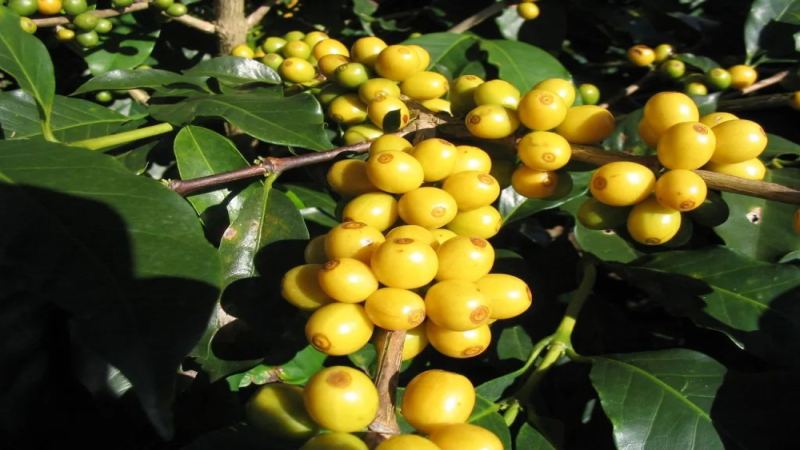
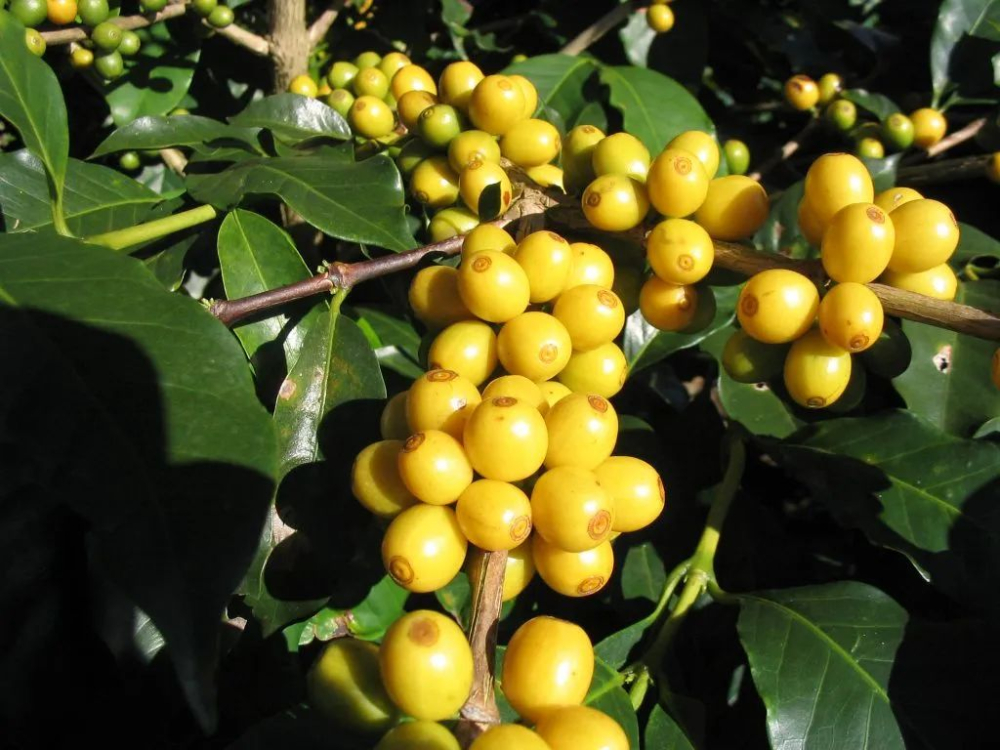
The common Bourbon coffee fruit turns from green to a ripe bright red, which is what everyone knows as "Red Bourbon." The fruit is relatively short and round, also called round-bodied Bourbon, with high density in the pulp and seed, excellent sweetness, and bright acidity. In addition to Red Bourbon, there is also Yellow Bourbon, as well as the rare Orange Bourbon and the precious Pink Bourbon. Red Bourbon.
Caturra
Caturra is a single-gene mutation of Bourbon, discovered in Brazil in 1937. Its productivity and disease resistance are both better than Bourbon, and the tree is shorter, making picking convenient. Unfortunately, like Bourbon, it has the periodic problem of fluctuating production every two years. In flavor, it is comparable to or slightly inferior to Bourbon beans, but what stands out more is its extremely strong adaptability. It does not need shade trees and can thrive directly under the blazing sun, commonly known as sun-exposed coffee. It is suitable for high-density planting, but requires more fertilizer, which increases costs, so early coffee farmers did not accept it very well.
Catuai
Catuai is a mixed Arabica variety, developed by crossing Mundo Novo (New World) and Caturra. It has good resistance to natural disasters, especially wind and rain. It inherits the advantage of Caturra's short tree height and eliminates the shortcomings of Mundo Novo; another advantage is that the fruit holds firmly and is not easy to fall off even when strong winds blow, making up for Arabica fruit's fragile shortcoming. However, the overall flavor is more monotonous than Caturra, and also more monotonous than Mundo Novo and lacking in body. This is the biggest regret. In addition, its fruit growth and harvest lifespan is only about ten years, and its relatively short lifespan is also one of its weaknesses.
The above is Front Street Coffee's (FrontStreet Coffee) summary of the characteristics of Guatemala coffee Arabica variety coffee beans. At present, Front Street Coffee (FrontStreet Coffee) stores have also separately introduced coffee beans from Guatemala's two most famous producing regions. Next, Front Street Coffee (FrontStreet Coffee) will introduce these two coffees from the Huehuetenango highlands and Antigua producing regions.
Front Street Coffee (FrontStreet Coffee) Guatemala Huehuetenango Coffee Beans
Country: Guatemala
Region: Huehuetenango
Altitude: 1500-2000 meters
Varieties: Bourbon, Caturra, Catuai
Processing Method: Washed
Flavor: Nuts, lemon peel, berries, citrus
Front Street Coffee (FrontStreet Coffee) Guatemala Antigua La Flor del Café Coffee Beans
Country: Guatemala
Region: Antigua (La Minita Estate)
Altitude: 1200-1600m
Varieties: Bourbon, Caturra, Catuai
Processing Method: Washed
Flavor: Citrus acidity, bright fruit acidity, caramel aroma, slight smoky note.
From the above, it can be seen that these two coffee beans have the same varieties and processing method, but due to differences in altitude and producing region, the flavors presented by the coffee beans are also different. After all, coffee beans are agricultural products, and their flavor changes with the geographical location, soil, and microclimate of the producing region. This is also one of the charms of coffee beans. Next, Front Street Coffee (FrontStreet Coffee) will share how to brew the parameters for these two Guatemalan coffee beans .
Since both coffee beans are medium-roasted coffee beans, Front Street Coffee (FrontStreet Coffee) uses the same brewing parameters to compare the flavors extracted from these two coffee beans.
Front Street Coffee (FrontStreet Coffee) Brewing Data Sharing
Dripper: V60 #01
Water temperature: 90-91°C
Dose: 15g
Coffee-to-water ratio: 1:15
Grind size: BG6m / medium-fine grind (80% passing through a No. 20 sieve)
Brewing method: Three-stage extraction
In the first stage, pour 30g of water for a 30-second bloom, then pour 95g (electronic scale shows about 125g), finishing in about 1 minute. When the water level drops to 2/3 of the coffee bed, pour the remaining 100g (electronic scale shows about 225g), finishing in about 1 minute 35 seconds. Drip filtration is completed at 2'00"-2'10", remove the dripper, and extraction is complete.
Guatemala Huehuetenango Coffee Flavor Description: Citrus and berry acidity, lemon peel, nutty aroma in the middle, tea-like finish.
Guatemala La Flor del Café Coffee Flavor Description: Citrus acidity is quite prominent, juicy acidity, rich floral aroma, pleasant sweetness, medium body, with a slight caramel note and smoky flavor in the finish. Overall pure, gentle, smooth in texture, balanced flavor with lively and varied layers.
For more specialty coffee beans, please add the private WeChat of Front Street Coffee (FrontStreet Coffee), WeChat ID: kaixinguoguo0925.
The above content is compiled by CoffeeHunters, a coffee news website.


