







What Defines Coffee Producing Regions Across Asia?
Coffee producing regions in Asia share a heavy, low-acid profile: firm bean texture, full body, and rounded sweetness, with aroma and acidity kept in the background. Indonesia, India, Vietnam, Papua New Guinea, Yemen, and China all grow specialty coffee, and most lots are washed or semi-washed.
Yunnan coffee dates to 1892, when a French missionary planted trees in a valley in Binchuan County; Zhukula Township still holds old trees around 90 years old that fruit normally. Growing areas now spread across Dehong, Xishuangbanna, Simao, Yuxi, and Baoshan, mostly using the washed method.
Asian coffee has always stood out in the global landscape with its rich, steady style, from Indonesian Mandheling to Indian Monsooned Malabar, and to Chinese Yunnan Typica—each region has its own unique flavor expression. This article will systematically review the characteristics of major Asian coffee origins, with a focus on Yunnan coffee's historical roots, cultivation distribution, and quality performance, and recommend Front Street 2013 Yunnan Typica, a natural-process bean suitable for introductory tasting. It will also guide you through the flavor differences and processing methods of Indonesian Sumatra, Java, and Indian coffee, helping you gain a more comprehensive understanding of the charm of Asian beans.
Front Street Asian Coffee Origin Introduction
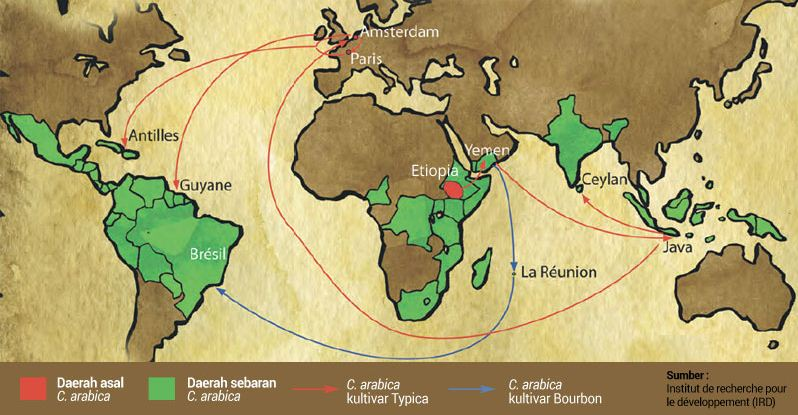
After coffee was introduced to Asia, it took on a rich and understated character. Coffee beans from Asian origins typically have a firm texture and full body, with prominent and rounded sweetness, while aroma and acidity tend to be more restrained in comparison. However, flamboyance was never the direction Asian beans pursued; what they emphasize is a solid, broad mouthfeel like the base of a pyramid—even before the coffee enters your mouth, that weighty aroma already rushes toward you.
Because Asian beans mostly use washed or semi-washed processing, the green beans tend to be relatively uniform in size. Semi-washed green beans usually appear darker in color than those processed by other methods. In fact, high-quality Asian beans can display satisfactory aroma and gentle, non-irritating fruit acidity even under light roast conditions. Overall, countries in Asia such as Indonesia, Yemen, India, Vietnam, and Papua New Guinea all produce specialty coffee.
Yunnan Region (China Yunnan):
In mainland China, Yunnan is the most famous for coffee cultivation, and its products have already been exported overseas. Yunnan's coffee history can be traced back to 1892, when a French missionary began planting coffee in a valley in Binchuan County. Even today, Zhukula Township in Binchuan County still retains dozens of old coffee trees, the oldest reaching 90 years of age and still flowering and fruiting normally.
Currently, Yunnan coffee generally uses the washed processing method, and the planting areas continue to expand. Coffee is grown in Dehong, Xishuangbanna, Simao, Yuxi, and Baoshan, with production increasing noticeably and gradually attracting attention from the international market. Among these, the Simao region mainly grows the Catimor variety, with most of the product sold back to Nestlé; Baoshan's Lujiangba is dominated by Typica and Bourbon varieties, with a fragrant, mellow flavor and the potential for specialty coffee.
If you want to experience the pure terroir of Yunnan small-bean coffee, you can try Front Street 2013 Yunnan Typica. This bean uses natural processing and medium roasting, with a balanced mouthfeel and flavor notes of nuts, chocolate, and black tea, making it very friendly for beginners just getting into coffee tasting.
Indonesia:
Well-known representative coffees: Java, Sumatra Mandheling
Indonesia's coffee-producing regions are mainly concentrated on the three islands of Java, Sumatra, and Sulawesi, all of which are volcanic landscapes. It is generally believed that Indonesian coffee beans have a rich aroma, low acidity, and carry notes reminiscent of Chinese medicinal herbs and earth. Front Street Mandheling from the Sumatra highlands is renowned worldwide for its particularly rich texture. Top-grade Front Street Mandheling is extremely clean at light roast, with full layers of sweetness and acidity; at dark roast, it presents a deep texture and intense mouthfeel.
India
Well-known representative coffee: Monsooned Malabar
Indian coffee has a very mild flavor, with fairly low body and acidity, along with a hint of spice, and the earthy note common to Asian beans is naturally present as well. Indian beans are often used in Espresso blends. In fact, Indian beans taste similar to Sulawesi or Sumatra beans, just with slightly less body. Indian coffee does not have a particularly wide market internationally, with its main consumer market concentrated within India itself. Sun-dried Indian beans are called Cherry, washed Arabica beans are called Plantation Arabica, and washed Robusta is called Parchment Robusta. In addition, Monsooned beans and aged beans can enhance coffee's syrupy mouthfeel, and aged beans in particular bring a dark chocolate-like flavor.
The above content is compiled by CoffeeHunters, a coffee news website.


