







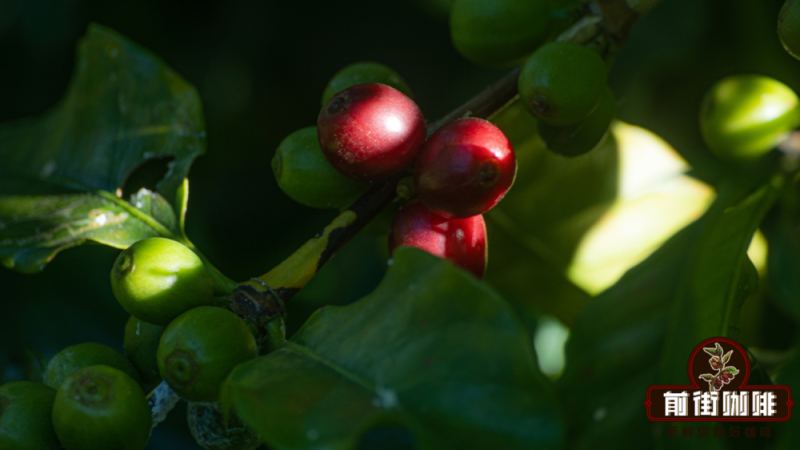
Where is Yunnan coffee grown and how does it taste?
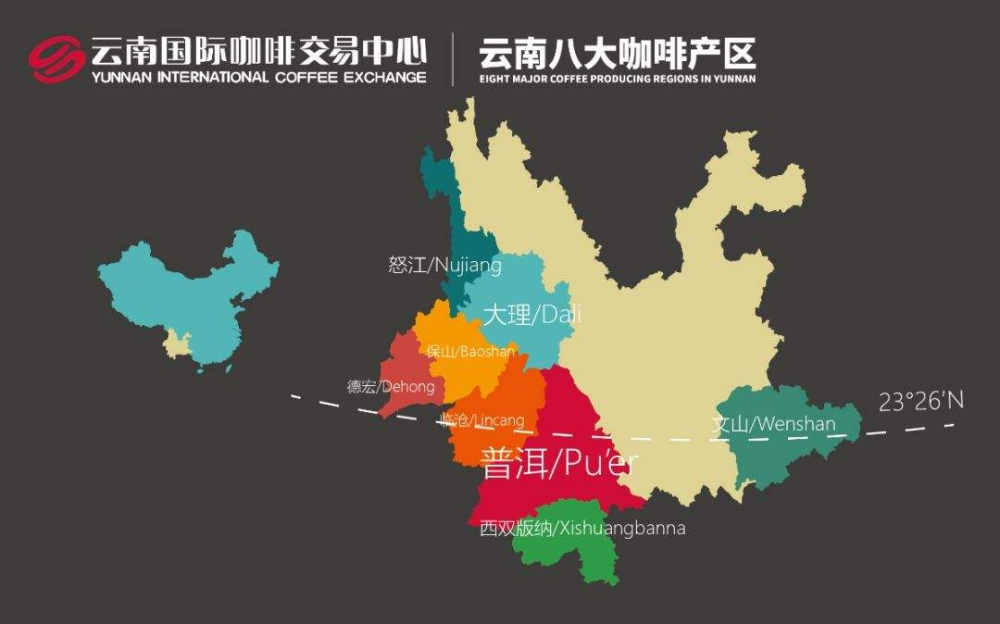
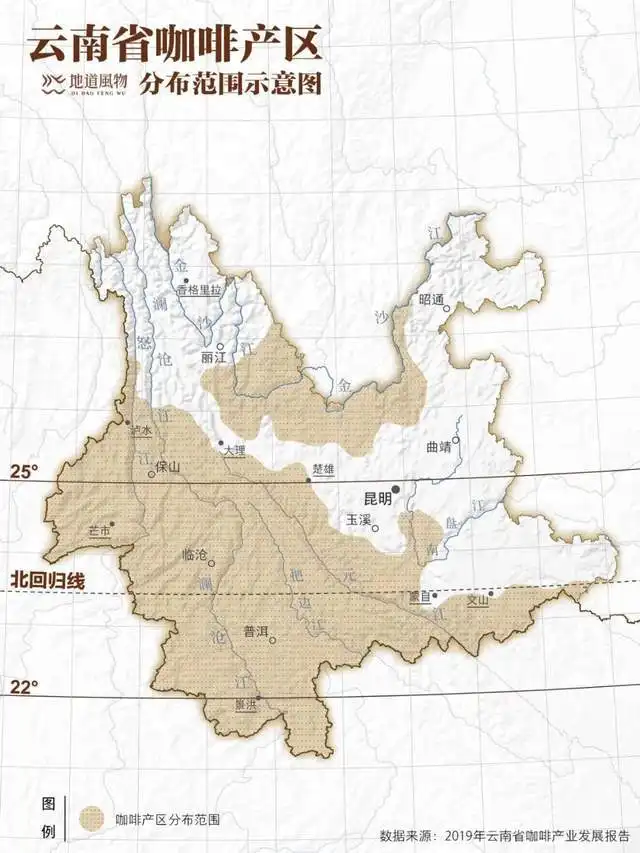
Yunnan coffee grows in four core areas: Lincang, Baoshan, Pu'er, and Dehong, all in the southwestern part of the province inside the coffee belt between the Tropic of Cancer and the Tropic of Capricorn. Cultivation began in 1904, when a French missionary planted the first trees in Zhukula Village. Altitude runs about 1,000 to 2,000 meters.
Tropical mountain terrain, abundant rain and sun, and large day-night temperature differences create favorable growing conditions, and farmers plant on hillsides. Typica and Catimor are the main arabica variety types, and the differences between them shape cup character, as does washed processing. Larger brands including Nestlé, Starbucks, and COSTA have entered the region as the specialty market has expanded.
Yunnan is China's most important coffee-producing region, with a cultivation history dating back to 1904, when a French missionary planted the first coffee tree in Zhukula Village. After more than a century of development, Yunnan coffee has formed four core production areas: Lincang, Baoshan, Pu'er, and Dehong. Thanks to the tropical mountain terroir of high altitude and large temperature differences, it has produced excellent-quality small-bean coffee. This article will systematically review the geographical conditions and cultivation characteristics of each production area, analyze the variety differences between Typica and Catimor, and introduce in detail washed processing and brewing key points. Front Street Coffee has its own estate in Lincang; its 2013 Typica and Baoshan washed everyday beans are excellent choices for experiencing the flavor of Yunnan coffee.
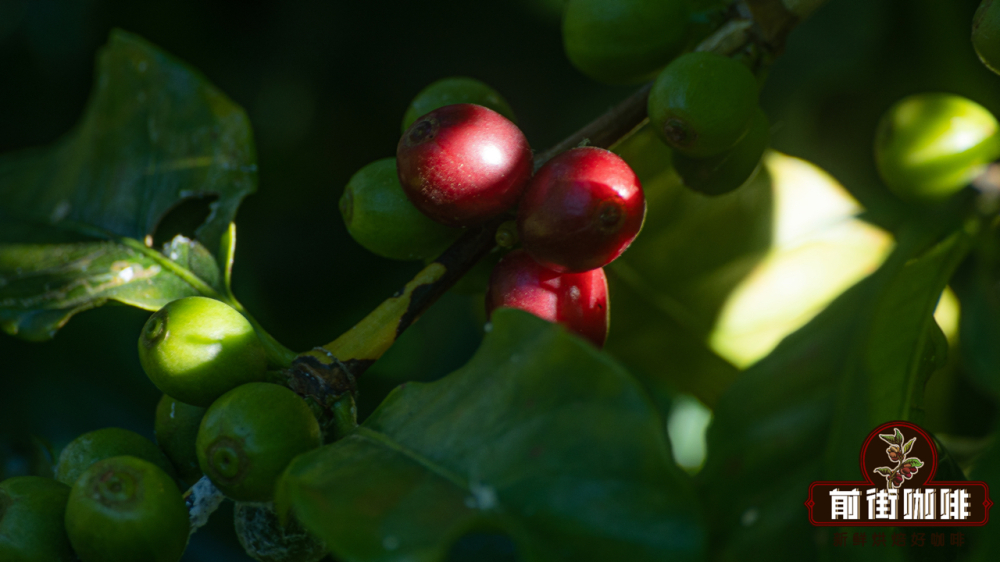
In 1904, when the French missionary Tian Deneng came from Vietnam to Dali, Yunnan, to preach, he planted the first batch of coffee trees in the local Zhukula Village. This is the starting point and symbol of coffee cultivation in Yunnan.
With reform and opening up, the industry accelerated its development, and the coffee planting area in Yunnan expanded year by year. To this day, many large brands have also begun to join the Yunnan coffee industry, such as Nestlé, Starbucks, and COSTA.
Yunnan Coffee Production Areas
With the expansion of the specialty coffee market, Yunnan, as an important coffee-producing region in China, has broad development prospects.
The areas where coffee is grown in Yunnan are located in the southwestern part of the province, right within the coffee golden belt, that is, between the Tropic of Cancer and the Tropic of Capricorn. The altitude is about 1,000-2,000 meters, with mostly mountainous terrain, steep slopes, and fertile soil. Farmers generally plant coffee trees on hillsides. Yunnan's abundant rainfall and sunlight, together with the significant day-night temperature difference formed at high altitude, combine to create exceptionally favorable terroir conditions for growing coffee trees.
The main coffee bean production areas in Yunnan are Lincang, Baoshan, Pu'er, and Dehong.
Lincang
Lincang, named because it borders the Lancang River, is located in southwestern Yunnan and borders Myanmar to the west. The terrain here is complex, with an altitude above 1,000 meters and an average annual temperature of 17.3°C. There are no distinct four seasons of spring, summer, autumn, and winter; instead, it is divided into a dry season and a rainy season. The rainy season begins every June and lasts 3-4 months. Abundant rainfall and sunshine, plus a large day-night temperature difference, make it very suitable for growing coffee, a high-altitude tropical plant. Under the advantages of the geographical environment, coffee cherries absorb more nutrients, and the flavor and mouthfeel are richer.
In order to truly explore coffee cultivation, Front Street Coffee also has its own coffee plantation estate in the Lincang area, established in 2013. Front Street planted the elegant Typica variety here and studied and managed it in meticulous detail, finally producing its first batch of coffee cherries in the seventh year, namely Front Street 2013 Coffee.
Front Street Coffee: Front Street 2013 Coffee Beans
Production Area: Lincang, Yunnan
Estate: Front Street Coffee Estate
Altitude: 1,300 meters
Variety: Typica
Processing Method: Natural Process
Baoshan
Coffee cultivation in Baoshan began in the mid-1950s, and the first coffee seedling was introduced from Southeast Asia by the late patriotic overseas Chinese Mr. Liang Jinshan. The quality of Baoshan small-bean coffee has been recognized by the state and was designated a National Geographical Indication Product by China's General Administration of Quality Supervision, Inspection and Quarantine in 2010.
Baoshan's average temperature is about 21.3°C, with a maximum of 40.4°C, and there is basically no frost throughout the year, making it recognized as the best place to grow small-bean coffee. With the expansion of international trade, the small-bean coffee of Baoshan's Lujiangba has been recognized by coffee experts at home and abroad. It was once evaluated as follows: "Strong but not bitter, fragrant but not harsh, with a mellow aroma; rich in oil, with a full-bodied fruit acidity and a lasting sweet aftertaste; this is a premium coffee."
For the Yunnan everyday beans launched by Front Street, we chose washed small-bean coffee from Baoshan. I believe some friends have already noticed that most of Front Street's everyday beans use washed processing. Front Street believes that washed processing can better present coffee's basic flavors. Like this washed Yunnan small-bean, the washed processing shows Yunnan coffee's mellow nutty character and soft acidity. The original intention of Front Street in launching everyday beans is to let coffee beginners taste the representative flavors of different production areas at the most affordable price, which helps them get started quickly.
Pu'er
When most people mention Pu'er, they think of tea. In fact, Pu'er City is Yunnan's largest coffee planting base. In the 1990s, Nestlé launched an agricultural technical assistance service project in Yunnan and opened demonstration farms. Nestlé established a coffee agronomy service department in Yunnan, cultivated coffee seeds suitable for local soil conditions and climate, and provided technical advice to local coffee farmers to improve the yield and quality of Yunnan coffee beans. Today, the high-quality coffee beans produced in Pu'er are also exported to European and American countries.
Dehong
As the "Hometown of Chinese Coffee," Dehong first introduced coffee seeds from the China-Myanmar border in 1951, beginning large-scale coffee tree cultivation from then on. Dehong has China's largest coffee seed gene bank—the Ruili Coffee Germplasm Repository of the Ministry of Agriculture—one of the first nine tropical crop germplasm repositories authorized by the Ministry of Agriculture.
Yunnan Small-Bean Coffee
What we often hear as Yunnan small-bean coffee is actually the Arabica variety. The variety originally grown in Yunnan was Typica, an ancient Arabica variety. The coffee beans it grows are much smaller than Robusta, hence the name "small-bean." Typica has a pure and elegant flavor; however, due to weak disease resistance, it is prone to leaf rust and has low yields, unable to meet farmers' income needs. With local promotion in Yunnan, the new variety Catimor began to be planted on a large scale, replacing the originally low-yielding Typica variety.
Catimor inherits the Robusta genes of Timor, giving it strong resistance to coffee berry disease and coffee leaf rust. It only needs partial shade for the coffee trees to thrive. The coffee cherries ripen quickly and yields are high, so farmers are more inclined to plant the Catimor variety.
Washed Processing
Due to the influence of the year-round rainy season, high air humidity, and unstable sunshine, most Yunnan coffee beans choose washed processing.
The harvested coffee cherries are put into a machine to remove the skin and pulp, then placed in a clean water tank to soak, allowing the acidic substances produced during fermentation to break down the pectin layer attached to the green beans. Finally, after being scrubbed clean, they are taken for sun drying. Coffee processed this way can avoid the negative fermented acidity that appears in natural processing, and is also cleaner.
Brewing Suggestions
Front Street believes that washed Yunnan small-bean has a softer and cleaner acidity, so a faster-flow V60 dripper is chosen. The dripper body has multiple ribs of varying lengths, which help with venting during extraction and speed up the flow, making the coffee's flavor layers more distinct.
Dripper: V60
Water Temperature: 91°C
Grind Size: 80% passing through a No. 20 standard sieve
Coffee-to-Water Ratio: 1:15
Dose: 15 grams
For brewing, Front Street uses staged extraction. After the coffee is ground and poured onto the filter paper, start pouring 30g of water from the center and bloom for 30 seconds. Be careful to keep a steady circular pour with a small stream from the inside outward throughout. For the second stage, pour 95g of water. When the coffee liquid has almost finished draining, begin pouring the third stage of 100g, and once all the coffee has filtered through, remove the dripper. The time is about 2 minutes, with an error of about 10 seconds either way.
After brewing this Yunnan small-bean everyday coffee, the entry is a sweetness of nuts and brown sugar. As the temperature drops, you can taste the acidity of plum, and the finish is a black tea aftertaste. Overall, it is soft.
For professional coffee knowledge exchange and more coffee bean information, please follow Coffee Workshop (WeChat public account: cafe_style)
For more specialty coffee beans, please add the private WeChat of Front Street Coffee: qjcoffeex
The above content is compiled by CoffeeHunters, a coffee news website.


