






Where did geisha coffee originate before Panama?
Geisha coffee was collected around 1931 in the Kaffa forest of southern Ethiopia and named after nearby Geisha Mountain. The seed was sent for trial planting in Kenya, Uganda and Tanzania, then reached CATIE in Costa Rica in 1953 and was registered as T2722. It took more than seventy years to become widely known.
Early plantings drew little interest because the trees had slender, fragile branches, were prone to disease and yielded poorly. The turning point came when the Peterson family of Hacienda La Esmeralda in Panama cultivated it. The farm's microclimates and divided plots, plus natural processing for lots such as the Red Label, brought out the floral and fruit notes now associated with the variety.
Geisha coffee is now a dazzling star in the specialty coffee world, and its signature floral aroma and complex fruit flavors fascinate countless coffee lovers. But few people know that this variety went through more than seventy long years from its discovery to truly making a name for itself. In this article, Front Street Coffee traces the origins of Geisha, from its collection in Ethiopia's Kaffa forest in 1931, to trial plantings in Kenya, Costa Rica, and elsewhere, and then to its discovery and cultivation by the Peterson family of Hacienda La Esmeralda in Panama, carefully sorting out the rise to fame of this legendary variety. The article also provides an in-depth introduction to the microclimate characteristics and plot division system of Hacienda La Esmeralda's three major areas, and includes the complete pour-over parameters and three-stage extraction steps for the Emerald Red Label Natural Geisha served at Front Street stores, for coffee lovers to reference and practice.
Nowadays, whether you are a veteran who cannot go a day without coffee or a light enthusiast who only drinks a cup once in a while, the name "Geisha" is probably not unfamiliar to you. Even if you have not yet tasted Geisha coffee yourself, most people have more or less heard of its reputation as a high-end, rare, and expensive coffee variety. Today, Front Street Coffee will take everyone back to trace where this world-renowned coffee variety actually came from.
Where is the original producing area of the Geisha variety?
To figure out the origins of Geisha, Front Street needs to turn the clock back to the 1930s. Around 1931, in order to find new varieties with disease resistance, people collected Geisha in the primitive forests of Kaffa in southern Ethiopia, and it was named after the nearby Geisha Mountain. After that, this variety was successively sent to agricultural research institutions in Kenya, Uganda, Tanzania, and other countries for trial planting. In 1953, the Geisha variety was introduced to CATIE, the Tropical Agricultural Research and Higher Education Center in Costa Rica, and registered under the number T2722.
During that period, multiple farms in Central America had records of planting Geisha, but this coffee tree had slender and fragile branches, was susceptible to disease, and also had low yields, so most farmers did not think highly of it, let alone promote it on a large scale. It was not until 2003 that the Peterson family of Hacienda La Esmeralda noticed its potential, and in 2004 they won the Best of Panama (BOP) competition with Geisha, thus opening the curtain on the era of Panamanian Geisha. Front Street Coffee therefore believes that Hacienda La Esmeralda was both the talent scout that discovered Geisha and a pivotal promoter in Geisha's rise to fame, and Front Street believes that Geisha coffee's ability to enjoy its lofty status today is largely owed to Panama's Hacienda La Esmeralda.
How did Hacienda La Esmeralda discover Geisha?
In the 1960s, Rudolph A. Peterson traveled to Panama to buy Hacienda La Esmeralda in Boquete in order to plan for retirement, initially focusing on dairy products. In 1973, Peterson's son also returned to Boquete to help his father run the farm, gradually shifting the focus to coffee cultivation, expanding the estate's planted area, and at the same time introducing many new varieties, among which was Geisha.
In 1997, the third-generation estate owner Daniel began to participate in estate management. At that time, the specialty coffee wave was rising. Daniel studied professional knowledge such as coffee cupping, and in 2003 he cupped the first harvested batch of Geisha beans, classifying the Geisha coffee trees according to different altitudes. When the next harvest came the following year, Daniel's family sent the Geisha beans that showed floral and fruity acidity in cupping to that year's Best of Panama competition, and ultimately took first place with an outstanding score.
In 2005, Hacienda La Esmeralda brought Geisha to the Specialty Coffee Association of America (SCAA) competition, defeated many famous competing varieties, and won the honor of world-class specialty coffee. After that, it also won the world championship in 2006 and 2007 consecutively, once again attracting the attention of coffee professionals around the world. Since then, coffee-producing regions around the world have begun to introduce Geisha one after another, including Yunnan in our country, which also joined the ranks of cultivating this popular variety. Although Geisha is now grown all over the world, Front Street believes that as the discoverer of Geisha's flavor, Hacienda La Esmeralda not only strictly controls the quality of the coffee it produces, but its natural processing method also best showcases the classic "Geisha flavor."
Geisha of Hacienda La Esmeralda
After Geisha coffee won the championship, the Peterson siblings implemented more systematic management of the Geisha coffee trees on the estate. From the perspective of major divisions, Geisha's planting areas are divided into three major plots: Cañas Verdes, Jaramillo, and El Velo. In order to ensure that every coffee lot can be traced back to its source, the Peterson family further subdivided each major plot into several smaller plots, so buyers purchasing Geisha coffee can find the specific planting plot through the lot information.
The Geisha variety was first discovered in the Jaramillo plot, and the move by Daniel and his sister to raise the altitude of Geisha cultivation was also first implemented here. As the place where Geisha was discovered and cultivated, Jaramillo became the most famous plot of Hacienda La Esmeralda. Jaramillo's average altitude exceeds 1,650 meters, and the humid, cold air on the high mountain allows the Geisha coffee here to fully absorb the essence of nature, with a rich and moving aroma.
Jaramillo's name comes from the Jaramillo mountain range east of Boquete. Annual rainfall can reach 4,000 milliliters, the average daytime temperature is between 19 and 25 degrees Celsius, and the average nighttime temperature is between 11 and 15 degrees Celsius. The entire area is humid and cold. Jaramillo is subdivided into 6 Red Label plots, namely: Mario, Noria, Reina, Bosque, Buenos Aires, and Caballeriza, which was added last year.
Canas Verdes estate is usually transliterated in China as 坎纳斯维迪斯, while in Spanish it means "green reeds," "green fields," and the like. Half of the Canas Verdes plots were purchased together with Jaramillo in 1967. After Geisha became famous overnight in 2004, the Peterson family began gradually acquiring surrounding small planting plots. Because the entire planting area sits on the eastern slope of Barú Volcano, the altitude span is quite large, extending from 1,500 meters all the way to 2,050 meters. Canas Verdes has annual rainfall of about 3,500 milliliters, an average daytime temperature of 16 to 23 degrees Celsius, and an average nighttime temperature of 10 to 15 degrees Celsius. The highly complex terrain, volcanic soil, and significant temperature difference between day and night together endow Geisha with its fragrant character.
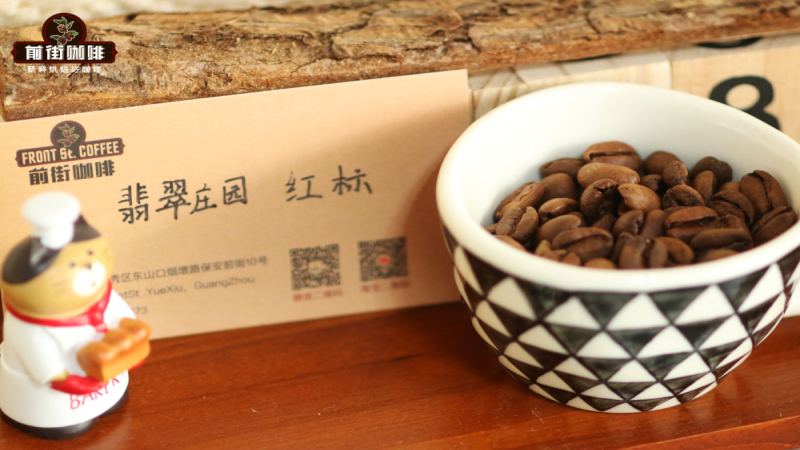
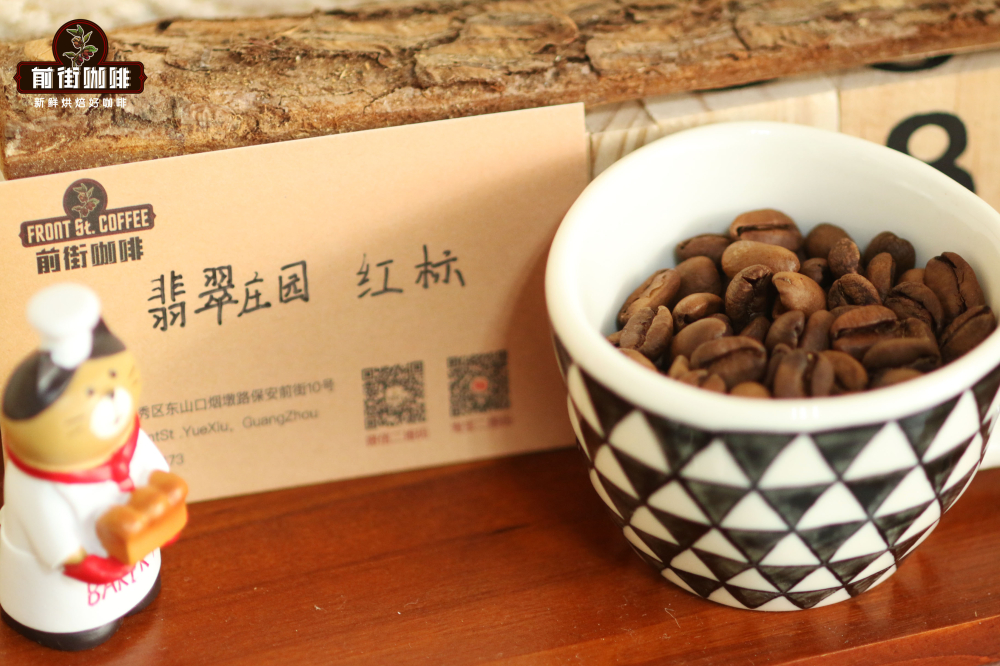
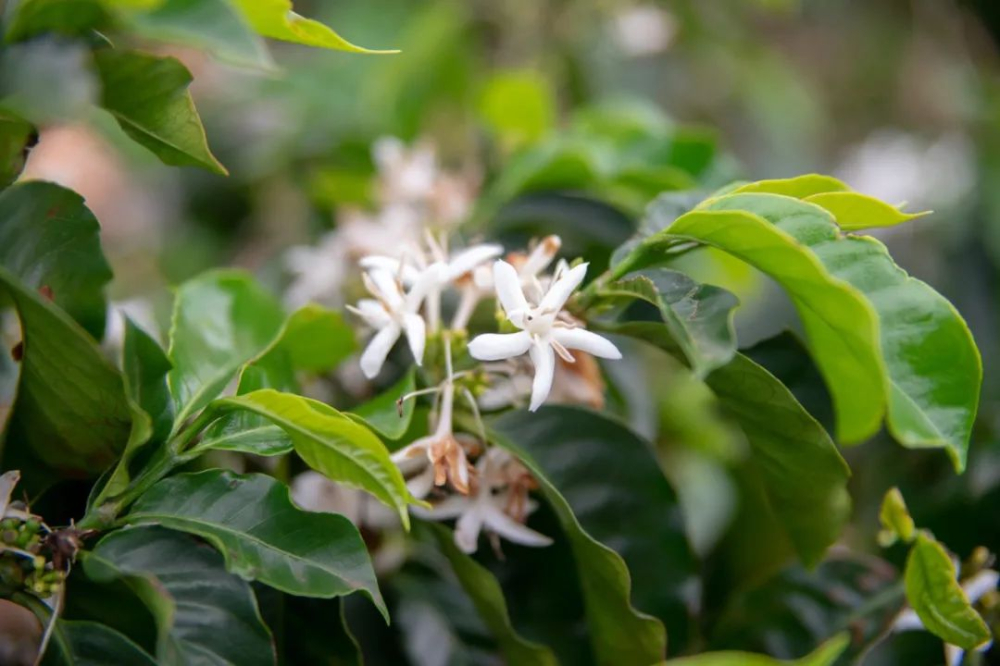
At present, the area where Canas Verdes grows Geisha covers a total of 11 small plots: Lino, Coronado, Fundador, León, Montaña, Trapiche, Jacinta, Cabaña, Tumaco, as well as Nido and Colga. The Red Label lot currently purchased by Front Street comes precisely from the Trapiche plot, which has an extremely outstanding sweetness expression. The green beans are processed by the natural method, bringing the coffee a rich aroma reminiscent of jasmine, cranberry, passion fruit, citrus, and cinnamon.
How should specialty Geisha coffee be brewed so it is not wasted?
Geisha coffee is world-famous for its rich floral aroma and complex fruit-toned character. Front Street's roasters hope to preserve Geisha's finer acidity as much as possible, so they choose a medium-light roast (slight adjustments are made for different lots). This roast level does not greatly change the high hardness of high-altitude beans, so brewing requires increasing the extraction rate somewhat in order to present fuller flavor layers. Here, a higher water temperature and a finer grind size are used to stimulate more aromatic substances. In addition, in order to make Geisha coffee's flavor expression clearer, Front Street appropriately widens the coffee-to-water ratio, using 1:16.
In order to increase the extraction rate of Geisha coffee while avoiding over-extraction and highlighting the sweet-and-sour flavor layers, Front Street Coffee's baristas choose the V60 dripper. The V60 dripper's cone has ribs connecting the top and bottom as well as a large central hole, which can speed up the flow of water, while the spiral-shaped vent groove design extends the water flow path and increases the contact time between coffee grounds and hot water. Each stream of water gathers along the grooves toward the center point of the dripper, concentrating the pressure on the coffee grounds and producing a coffee with richer layering.
Below, Front Street demonstrates the brewing steps for the Emerald Red Label Natural Geisha served in stores. You can refer to it and compare it with your own brewing approach. The pour-over parameters for Red Label Geisha coffee are: dripper: V60, water temperature: 91-92 degrees Celsius, coffee dose: 15g, coffee-to-water ratio: 1:16, grind size: fine granulated sugar size (20-mesh sieve, 80% passing)
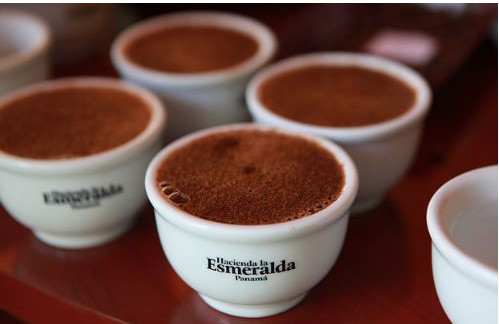
Three-stage extraction: First pour 15 grams of coffee grounds into the dripper and tare the weight. For the first stage, pour in 30g of water for a 30-second bloom, and start timing at the same time. Throughout, pour with a small stream from the center point and begin spiraling outward, making sure to wet the entire coffee bed.
For the second stage, begin pouring with a slightly larger stream and add 120g of water. The purpose is to lift the entire coffee bed. The water column needs to be poured vertically and evenly. At this point the scale shows 150g, and the pour is finished in about 55 seconds.
When the liquid level drops to the halfway point, begin using a small stream to pour the third stage of 90 grams in a small spiral. Try to control the stream so it does not spiral too widely, as that can easily disturb the coffee bed and cause under-extraction. The final total poured water is 240 grams, and the drip completion time is about 2 minutes 10 seconds. After removing the dripper, swirl the coffee liquid in the server to even it out, and it is ready to taste.
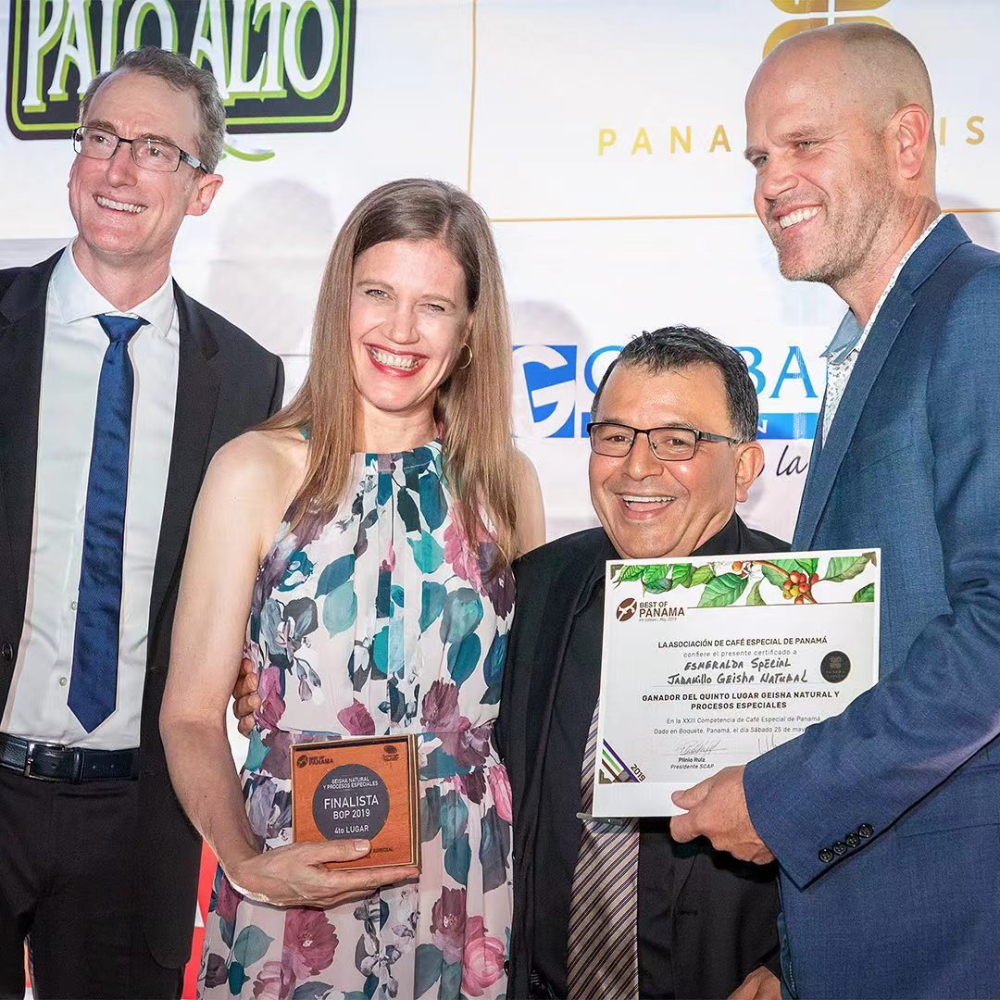
The pour-over Emerald Red Label Geisha coffee tastes clean with jasmine, citrus, and tropical fruit acidity. The flavor layers vary with temperature, the overall mouthfeel is smooth, and the tea-like finish is pleasant.
For professional coffee knowledge exchange and more coffee bean information, please follow Coffee Workshop (WeChat public account: cafe_style).
For more specialty coffee beans, please add the private WeChat of Front Street Coffee, WeChat ID: qjcoffeex
The above content is compiled by CoffeeHunters, a coffee news website.


