







How Catimor's Robusta Lineage Shapes Yunnan Coffee
Catimor does belong to the Arabica species, but it carries Robusta genes in its lineage through the Timor hybrid. Arabica normally has about 0.9% to 1.2% caffeine, while Robusta holds 2% to 4%, so Catimor sits between the two in character. That breeding history explains why it is disease-resistant and high-yielding yet often less refined in the cup.
Yunnan coffee growers adopted Catimor widely because it tolerates disease and produces reliable harvests. The trade-off shows in flavor: less of the soft aroma and balanced sweet-and-sour profile that pure Arabica varieties are prized for. Front Street's Yunnan small-bean coffee offers one example, with V60 three-pour brewing parameters used to bring out what the variety does well.
In the world of coffee, Arabica beans are highly prized for their elegant aroma and pleasant acidity, but is the Catimor variety that has appeared so frequently in recent years actually Arabica? What lineage flows through it? Why is it planted on a large scale in Yunnan? From the perspective of Front Street, this article sorts out the basic characteristics of Arabica, traces the breeding history of Catimor, analyzes why it is disease-resistant and high-yielding yet compromised in flavor, and focuses on the industrial changes and specialty-coffee exploration of Yunnan Catimor. The article also includes Front Street's Yunnan small-bean coffee origin information, flavor description, and V60 three-pour brewing parameters, giving you a comprehensive understanding of this special variety carrying Robusta genes.
Arabica coffee has always been known for its outstanding aroma and acidity, and precisely for this reason, many coffee bean merchants specifically indicate that their products use Arabica beans. So, does the Catimor variety that has appeared so frequently in recent years actually count as a member of the Arabica family? Front Street is here to talk about the origins of Catimor.
Arabica Arabica
Among the world's three major coffee varieties, Arabica belongs to the small-bean coffee category, and its cultivation accounts for more than 70% of total world production. In terms of caffeine content, Arabica is the lowest of the three brothers, at about 0.9% to 1.2%, only about half that of Robusta (Robusta beans can contain 2% to 4% caffeine). Because Arabica is relatively rich in fats and sugars, it produces a soft aroma and a pleasantly balanced sweet-and-sour flavor, thus capturing the hearts of more coffee lovers.
Arabica prefers to grow on high-altitude sloping land, usually thriving best between 600 and 1,800 meters. It is quite particular about microclimatic conditions, requiring an annual average temperature of around 20 degrees Celsius, and is mainly distributed in the belt between the tropics on both sides of the equator. Arabica coffee trees have relatively weak insect and disease resistance, so their yields are relatively limited, and the higher the altitude, the better the flavor, which means growing Arabica requires more investment than other varieties, and its price is naturally higher.
The Arabica varieties we commonly see include Ethiopian heirloom varieties, the ancient heirloom variety Typica, Bourbon, Caturra, Pacas, Catuai, Mundo Novo, Maragogype, and so on.
Catimor Catimor
In 1959, the Portuguese crossed Caturra from Brazil with Timor to breed Catimor, which has outstanding disease resistance. Caturra is a natural mutation of the Arabica variety Bourbon, discovered by Brazilians in 1937. It inherited Bourbon's lineage, so its disease resistance is not strong, but its yield is higher than Bourbon's, and in high-altitude environments it can show bright acidity and pure aroma. Timor is a natural interspecific hybrid of Arabica and Robusta, found in Timor, Indonesia, in the 1940s. It has strong tolerance to leaf rust and considerable yield. For this reason, their offspring Catimor also inherited super-strong disease resistance and high productivity.
From 1970 to 1990, leaf rust swept through coffee-producing countries around the world. With assistance from international organizations, countries vigorously promoted Catimor to resist leaf rust and increase yields. This highly disease-resistant plant can withstand coffee leaf rust and was widely planted in Central and South American countries in the 1980s. However, because Timor is the product of a natural cross between Arabica and Robusta, although the latter gave it disease resistance, Arabica's delicate mouthfeel disappeared along with it. Although Catimor inherited Robusta's strong disease resistance, it also inherited the genes for poor flavor. In addition, although early Catimor had huge productivity, it needed shade trees or it tended to wither.
Yunnan Catimor
In the 1970s and 1980s, because of the impact of leaf rust on global coffee cultivation, international organizations vigorously promoted the planting of the Catimor variety in various countries.
In 1988, Nestlé established a joint venture in Yunnan, China, with the aim of launching a coffee planting project and beginning experimental coffee planting in Pu'er, Yunnan. Starting in 1992, Nestlé set up a coffee agriculture department specifically to study the cultivation and improvement of Yunnan coffee, guide local farmers in planting, and introduce the highly disease-resistant Catimor. In addition, Nestlé promised to purchase the produced coffee at the U.S. spot market price, which also strongly promoted the development of Yunnan's coffee industry.
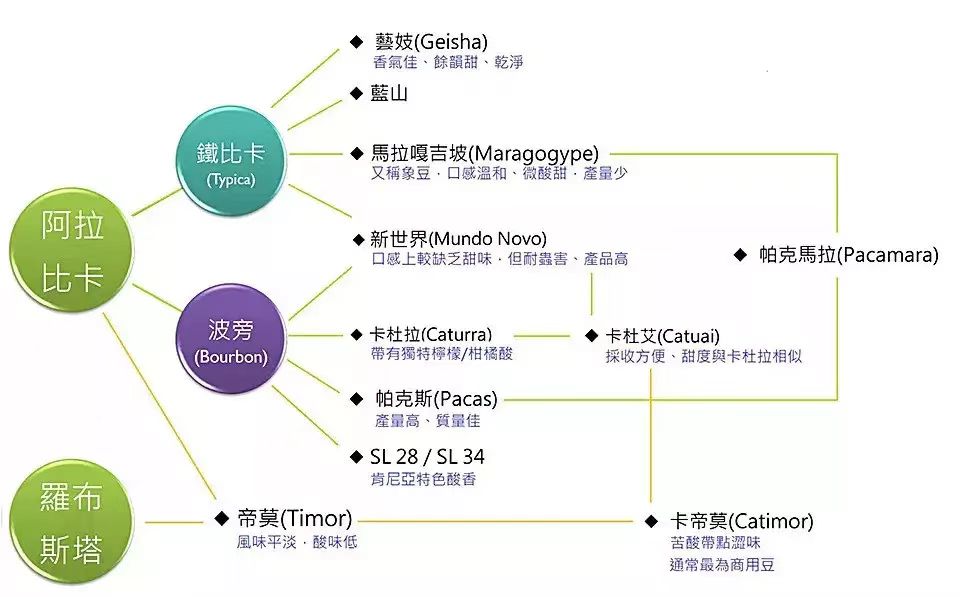
As mentioned earlier, Catimor is not of pure Arabica lineage; it carries 25% Robusta genes, which also affects its flavor performance—insufficient aroma, obvious bitterness, and a tendency to produce unpleasant astringency and harsh musty notes. When grown at low altitude, Catimor's cupping performance shows no obvious advantage or disadvantage compared with other commercial varieties; when grown above 1,200 meters, because Catimor's harvest time is shorter than that of traditional Arabica varieties and it accumulates fewer nutrients, its cup flavor is clearly inferior to Bourbon, Caturra, and Catuai.
In order to improve the negative flavor problems of Catimor coffee, Yunnan has continued to improve and optimize cultivation management and green bean processing techniques. In recent years, specialty batches of Catimor produced in Yunnan have also performed well in the international coffee market. Aromas of nuts and black tea, along with plum-like sweet acidity, have won the favor of some coffee people. As Yunnan is a representative coffee-producing region in our country, Front Street has also included Yunnan Catimor among its 7 regional daily-drink beans, allowing everyone to taste Catimor's flavor at a low price.
Front Street Coffee (FrontStreet Coffee): Yunnan small-bean coffee
Origin: Baoshan, China
Altitude: 1,200 meters
Processing method: washed
Variety: Catimor
Flavor: nuts, melon and fruit aromas, brown sugar, plum acidity
Brewing flavor
In terms of brewing, Front Street uses freshly roasted Yunnan small-bean coffee . After roasting, coffee beans go through a 4-to-7-day resting period and then enter their optimal tasting period. Once this stage passes, the aroma dissipates more quickly, and the flavor and mouthfeel decline noticeably. Front Street deeply understands the importance of coffee freshness, so all coffee beans shipped are freshly roasted within 5 days. When customers receive them, they are just at their best flavor state and can be brewed and enjoyed directly.
Front Street believes that the flavor of Yunnan small-bean coffee should lean toward a balanced mouthfeel, that is, avoiding excessively high acidity and heavy bitterness. Therefore, a V60 dripper is chosen, paired with a medium-fine grind size and a not-too-high water temperature for brewing.
Dripper: V60
Water temperature: 90 degrees Celsius
Grind size: 80% passing rate with a No. 20 standard sieve
Coffee-to-water ratio: 1:15
Coffee dose: 15 grams
Using a three-pour extraction, pour the ground coffee into the filter paper, start from the center and pour 30 g of water to bloom for 30 seconds, paying attention to using a small steady stream throughout and circling smoothly from the inside out; for the second pour, add 95 g of water, and when the coffee liquid is almost finished draining, begin the third pour of 100 g, then once all the coffee has filtered through, remove the dripper. The total time is about 2 minutes, with a margin of about 10 seconds either way.
The small-bean Catimor coffee has a dry aroma of nuts and berries. You can taste the sweetness of nuts, herbs, chocolate, and brown sugar, as well as a balanced plum-like acidity, with a faint fruity acidity in the finish.
For professional coffee knowledge exchange and more coffee bean information, please follow Coffee Workshop (WeChat public account cafe_style)
For more specialty coffee beans, please add the private WeChat of Front Street Coffee (FrontStreet Coffee), WeChat ID: qjcoffeex
The above content is compiled by CoffeeHunters, a coffee news website.


