







Where Are Brazilian Coffee Beans Grown?
Brazil is the largest coffee producer, supplying close to 45% of the world's green coffee beans, and most of its coffee beans grown are sun-dried rather than washed. Seventeen of Brazil's 21 states produce coffee, and seven states account for about 98% of national output, led by Minas Gerais, São Paulo, Bahia, Espírito Santo, Paraná, Rondônia and Rio de Janeiro.
Brazil's dry season length can influence international coffee prices, and rising domestic consumption has made the country the second-largest coffee consumer market after the United States. The crop arrived through a single famous episode: in 1727 an officer named Palheta carried seedlings out of French Guiana. A coffee farm in Brazil today is typically graded by state and shipping port.
Brazil is the country with the largest coffee planting scale and production in the world, supplying nearly 45% of the world's green coffee beans. This article comprehensively reviews the industrial landscape of this South American coffee powerhouse, from the distribution of coffee-producing regions in Brazil, its legendary planting history, the characteristics of major varieties, to flavor and taste. It also introduces the Brazilian Cerrado Red Bourbon and Queen Estate Yellow Bourbon selected by Front Street Coffee, and includes detailed pour-over parameters and brewing flavor descriptions, suitable for enthusiasts who want to gain a deeper understanding of Brazilian coffee.
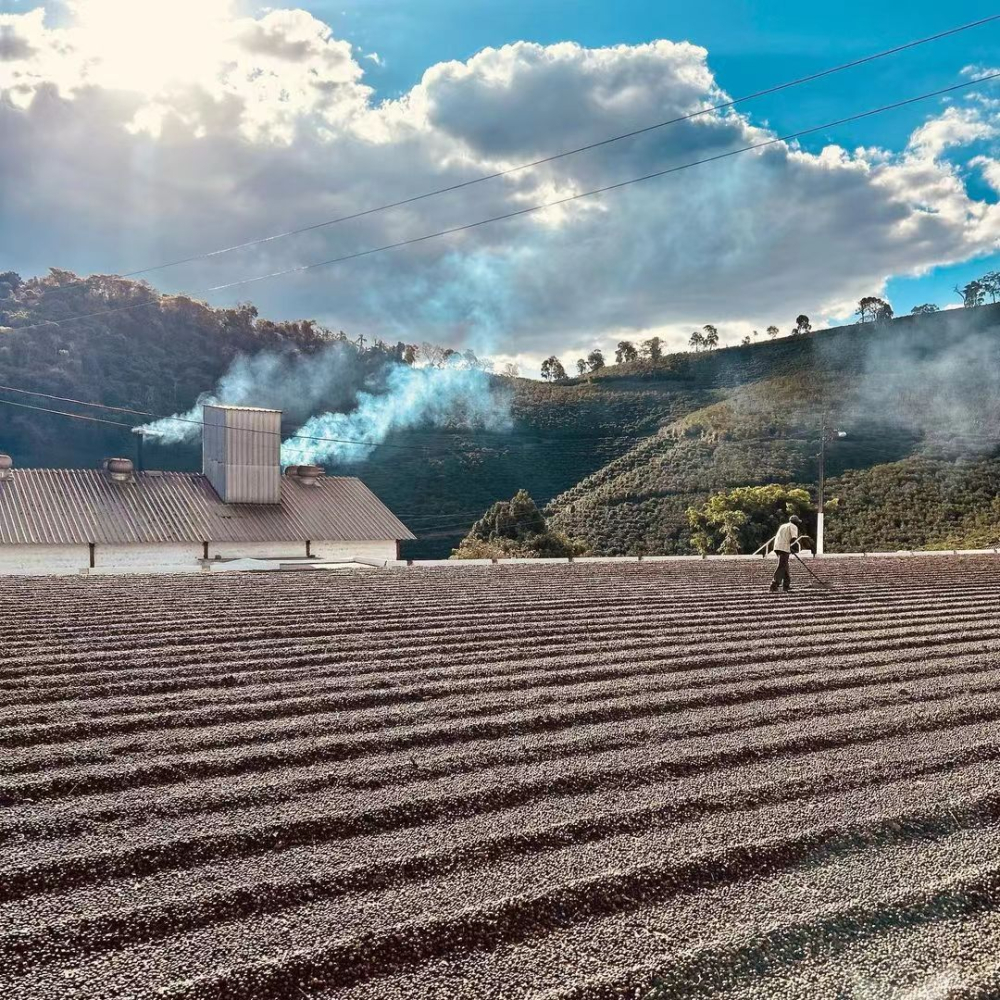
When it comes to major coffee-producing countries, Brazil in South America is undoubtedly at the top; it has the world's largest coffee planting area and production. In recent years, Brazil's domestic coffee consumption has also continued to rise, and it now ranks after the United States as the world's second-largest coffee consumer market. Brazilian coffee varieties are rich and diverse, and the vast majority are not washed, but instead sun-dried, and classified according to the producing state and shipping port.
As the world's largest coffee producer, Brazil supplies nearly 45% of the world's green coffee beans. The length of the country's dry season can even influence the trend of international coffee prices.
Brazil has 21 states in total, 17 of which produce coffee. Among Brazil's coffee bean-producing regions, 7 states have the most prominent output, together accounting for 98% of the national total.
São Paulo State (Mogiana, Centro-Oeste)
Paraná State (Norte Pionerio do Paraná)
Bahia State (Planaltoda Bahia, Cerrado da Bahia, Atlantico Baiano)
Espírito Santo State (Montanhas do Espírito Santo, Conilon Capixaba)
Minas Gerais State (Sul de Minas, Cerrado Mineiro, Chapada de Minas, Matas de Minas)
Rondônia State (Rond?nia)
Rio de Janeiro State (Rio de Janeiro)
A Legendary Episode
Brazil's coffee-growing industry is quite legendary. Three hundred years ago, Brazil did not have a single coffee tree, but an illicit love affair created Brazil's leading position in coffee. In 1727, a handsome army officer, Palheta, was ordered to go to French Guiana to mediate a territorial dispute between France and the Netherlands. The governor's wife of French Guiana unexpectedly fell in love with Palheta and gave him a bag of Bourbon coffee seeds (there is also a claim that he was given coffee seedlings). After Palheta returned to Brazil, he resigned from his official post and went to Pará Province near the equator in the northwest to grow coffee, which unexpectedly sparked a coffee-planting boom in Brazil.
For more than two hundred years, coffee fields gradually moved to the more populous southeast in São Paulo, Espírito Santo (translated into English as Holy Spirit, meaning "Holy Spirit"), and Paraná in the south. This area is located between 20 and 30 degrees south latitude, at a slightly higher latitude, and frost in winter causes cold damage, leaving farmers unable to bear the losses. After the 1970s to 1980s, Brazilian coffee farmers tried to develop the warmer Minas Gerais and Bahia provinces in northern São Paulo, located between 10 and 20 degrees south latitude, where winters are warmer and frost damage is unlikely. Today, Minas Gerais Province (hereinafter referred to as Minas) has become the new hope of Brazilian specialty coffee.
Planted Varieties
Brazil grows a wide variety of coffee varieties. At present, Red Bourbon, Yellow Bourbon, Mundo Novo, and Catuai are the main varieties. Caturra, Acaiá, Obatã, Aramosa, and Maragogipe are also planted and studied. The Campinas Institute of Agronomy in São Paulo is Brazil's famous coffee variety improvement arsenal, and the world's most widely planted Catimor is the masterpiece of Portuguese and Brazilian scientists.
Mundo Novo
Mundo Novo (also known as Mundo Novo) is a hybrid of Bourbon and Typica. It first appeared in the 1940s and is still widely popular in Latin American coffee-producing countries. Its disease resistance and yield are both better than Bourbon and Typica, but the price is insufficient flavor complexity.
Catuai
Brazil developed Catuai in the 1950s. It is a hybrid of Caturra and Mundo Novo, with strong disease resistance and high yield. Similar to Caturra, Catuai's ripe fruit is also naturally divided into red and yellow (I personally prefer the former). Catuai is known for its rich acidity and is a common variety in most Central American countries.
Caturra
In the 1930s, people discovered a certain genetic mutation of Bourbon near the city of Caturra in Brazil, and named it Caturra. Caturra has a very high yield, and its compact plant is also convenient for picking, but if planted in a lower-altitude environment, this characteristic instead becomes its own greatest enemy—the coffee becomes quite light here, so the weight of the fruit itself can crush the plant to death. If planted in a high-altitude environment (above 1,200 meters), Caturra's coffee quality and yield can both be better guaranteed. Caturra is a common variety in the Central American coffee belt.
Bourbon
When it comes to the Bourbon variety, many people have heard about its color distinctions, such as Red Bourbon, Yellow Bourbon, and Pink Bourbon. Bourbon is a secondary species produced by a mutation of Typica, and together with Typica it belongs to the oldest existing coffee varieties. When the green fruit matures, it turns bright red. Bourbon planted at high altitude usually has better aroma and bright acidity. Red Bourbon is perhaps the most common type, because under normal circumstances, coffee fruit gradually matures from unripe green, then to slightly yellow, then to orange, and at the best picking time the coffee fruit appears red, and finally becomes overripe dark purple.
Red Bourbon is so named because the fruit appears red. The same principle applies to Yellow Bourbon and Pink Bourbon. Yellow Bourbon is generally considered to be a hybrid of Red Bourbon and other varieties. When ripe, Yellow Bourbon fruit appears yellow. It was first discovered in Brazil, and Brazil is currently also the main country growing Yellow Bourbon. Besides the yellow fruit, Yellow Bourbon also has relatively lower yield and is not resistant to wind and rain, so it has not been widely planted. Pink Bourbon is even rarer. Pink Bourbon is obtained by crossing Red Bourbon and Yellow Bourbon, and the reason it is rare is that the pink form of the fruit is determined by a recessive gene and is very easily disturbed, so it is difficult to maintain the pink fruit appearance.
Brazil's coffee-growing areas are mainly based on two landforms: one is the Brazilian Plateau above 500 meters above sea level, and the other is the Brazilian Plain below 200 meters. The main varieties planted and well known to everyone are Bourbon (including Yellow Bourbon, Red Bourbon, and flat-bean Santos). The taste performance of Brazilian coffee is mainly low acidity, nutty flavors, balance, and moderate body. In the world of specialty coffee, Brazilian coffee is not outstanding, but in espresso, Brazilian coffee beans are often used as a blending variety. Because of its high balance, it is often used by merchants as Blue Mountain-flavored beans.
Coffee Bean Characteristics
Brazilian coffee beans refer to all coffee beans grown in Brazil. Apart from Santos, most Brazilian beans are "cheap and good" coffees. They can be used in mass-produced blended coffees, most of which are dark roasted. Front Street Coffee's two blended beans also choose Brazilian coffee beans: the espresso moka pot coffee beans recommended by many baristas—Front Street Black Cocoa Blend and Front Street Specialty Blend. The main raw material of instant coffee is also Brazilian coffee beans.
Brazilian coffee beans are large, fragrant, and rich, with moderate bitterness and high-quality acidity. The overall taste is soft, with low acidity, and endlessly memorable when tasted carefully. The taste of Brazilian coffee has relatively low acidity, combined with the coffee's bittersweet flavor, making it extremely smooth on the palate, and it also carries a faint grassy fragrance. It is lightly fragrant with a slight bitterness, smooth and pleasant, and the aftertaste is refreshing and exhilarating. So without good Brazil, there is no good espresso.
Front Street Brazilian Pour-Over Coffee
Front Street's coffee bean list includes two Brazilian coffees, namely Red Bourbon from the Cerrado region and Yellow Bourbon from Queen Estate. Now let's brew Brazilian Cerrado coffee beans and learn the method for brewing Brazilian coffee. Cerrado belongs to Minas Province and is a high-quality coffee-producing region in Brazil. This area is the essence of the Cerrado savanna, with high altitude and fertile soil, which is why it can produce specialty coffee beans that are sweet, full-bodied, and clean. Front Street has also tasted coffees from all major Brazilian producing regions, and as a large producing region, Cerrado has the most stable and distinctive flavor. This bean is used by Front Street in its espresso blend recipe and as a single-origin everyday coffee representing the flavor of the Brazilian producing region.
Brewing Parameters: Use a Kono dripper
Water temperature: 88°C
Coffee dose: 15 grams
Coffee-to-water ratio: 1:15
Grind size: medium-fine grind (70-75% passing through China standard No. 20 sieve)
Front Street Coffee (FrontStreet Coffee) uses staged extraction, also called three-stage brewing: use 30 grams of water for 30 seconds of blooming, pour in a small stream in a circular motion until 125 grams for the stage, and when the water level drops and is about to expose the coffee bed, continue pouring until 225 grams and stop pouring. When the water level drops and is about to expose the coffee bed, remove the dripper. (Start timing from the beginning of blooming.) The extraction time is 2'05"-2'15".
Brazilian Red Bourbon brewing flavor: obvious sweetness on the palate, accompanied by a faint caramel aroma, containing rich nutty flavors, with a clear dark chocolate note in the finish, and an overall relatively rounded impression.
The above content is compiled by CoffeeHunters, a coffee news website.


