







How Does Coffee Water Temperature Change Espresso Flavor?
Espresso water temperature is usually set between 85 and 95 degrees Celsius, and many machines ship with a default closer to 92 to 96 degrees Celsius. Too high a temperature pulls out burnt, bitter, woody notes, while too low leaves the shot sour, astringent, and thin on crema. Because modern machines now let users set temperature freely, it counts as an adjustable variable rather than a fixed constant.
Water temperature also affects flow rate, and the boiler reading is not the same as the temperature at the puck during extraction. Older machines often had factory-fixed boilers, which is why temperature was long treated as a constant. With freely adjustable models, the setting can be matched to the dose and ratio, so a 92 degree espresso setting can be tuned up or down to steer flavor.
When extracting espresso, parameters like grind size, dose, ratio, time, and pressure are often discussed repeatedly, but water temperature is frequently overlooked. In fact, water temperature has a decisive influence on the flavor direction of espresso—too high brings burnt bitterness and woody notes, while too low makes the coffee sour and astringent with thin crema. Based on Front Street's practice, this article systematically sorts out the reasonable range for coffee machine water temperature, how water temperature affects flow rate, the difference between boiler temperature and actual extraction temperature, and how to set water temperature under different dose ratios, helping you find that delicious temperature point in your daily shots.
For more specialty coffee knowledge, please follow: Front Street Coffee ( Frontsteet Coffee )
In the past, when Front Street explained the key points of espresso extraction, the focus was usually placed on variables such as grind size, dose, liquid weight ratio, extraction time, and pressure value, and quite a bit of space was also spent breaking down the techniques of receiving grounds, distributing grounds, and tamping. In comparison, the step of extraction water temperature was hardly ever expanded on.
The reason Front Street mentioned water temperature less is not that it is irrelevant to espresso, but that the boiler temperature of those early old machines was often fixed at the factory, making adjustment quite difficult. Therefore, in actual operation everyone was used to treating water temperature as an immutable constant and instead matching it through other parameters.
Today's newly designed models, as well as the mid-to-high-end equipment launched in the past decade, basically all support freely setting water temperature. This has also turned water temperature from a fixed condition into an important variable that can be flexibly adjusted during extraction.
What water temperature setting is generally appropriate for a coffee machine?
Generally speaking, a coffee machine water temperature between 85 and 95 degrees Celsius is a reasonable range. The default setting of some machines is on the higher side, around 92 to 96 degrees Celsius. Looking back at the knowledge of pour-over coffee water temperature, it is clear that the higher the temperature, the stronger the extraction efficiency, and the more coffee substances can be dissolved; conversely, when the temperature is lower, extraction efficiency decreases, and naturally fewer substances are dissolved.
The logic of water temperature in espresso is the same as in pour-over. If the temperature is set too high, the coffee easily develops burnt bitterness and woody aromas; however, high temperature also helps press out a thicker crema. In the early years, espresso tended to be bitter, partly because the coffee beans were roasted very dark, and partly because the machine boiler temperature was set relatively high, which precisely catered to the demand for rich crema. There will also be differences in extraction rhythm, with time generally compressed to between 20 and 25 seconds, because dragging it out will likewise produce burnt and sawdust-like flavors.
When the water temperature is low, the extracted espresso has a prominent acidity, and the crema also appears thin. For this reason, in the past the water temperature setting of mainstream espresso machines was rarely below 92 degrees Celsius.
Water temperature affects the flow rate of coffee extraction
When the water temperature is higher, the flow rate of the coffee liquid tends to be slower; when the water temperature is lower, the flow rate is somewhat faster. High temperature allows the puck to expand faster and simultaneously release gases. These gases block the water flow channels until they are pressed into crema and discharged, after which the flow rate gradually recovers. The higher the temperature, the more bubbles are produced, and the stronger the obstruction to water flow.
At low temperatures, the coffee flow rate speeds up noticeably. A relatively extreme example is: when the machine is just turned on and the boiler begins heating, at this time the brew head can still dispense water for extraction, but the water temperature is very low, only around 60 degrees Celsius. If the same parameters are used to extract espresso, the extraction time will be greatly shortened, and the coffee liquid will flow very quickly.
Similarly, when using a small-boiler coffee machine for continuous high-intensity shots, you will also find that espresso extraction gradually becomes unstable and the flow rate gets faster and faster. Part of the reason is that after the boiler refills with water, the temperature has not yet risen in time.
Boiler temperature is not equal to extraction temperature
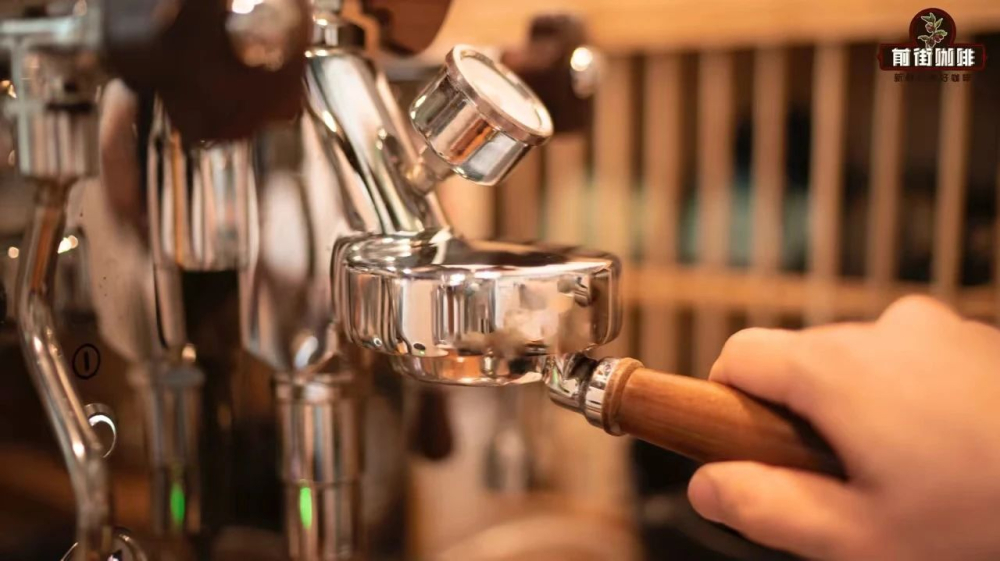
It should be made clear that what we can set is the water temperature inside the boiler, and as water flows from the boiler to the extraction point, it still has to pass through the dispersion screen and the portafilter basket. If more than 10 minutes have passed since the last extraction, the temperature of the brew head (dispersion screen) will be on the high side. If you lock in the portafilter and extract directly at this time, the water in the boiler will be heated when passing through the dispersion screen, causing the initial water temperature to be higher than the boiler setting.
To avoid this situation, before locking in the portafilter, the brew switch is usually turned on first to release water and cool down, letting the temperature fall back to close to the set value.
The temperature of the portafilter itself also affects the initial water temperature of extraction. If the portafilter is at room temperature, it will absorb part of the heat at the very beginning of extraction, so the actual water temperature will be lower than preset. Therefore, before receiving grounds, hot water should be released to preheat the portafilter, which is the same principle as warming the dripper in pour-over coffee. Of course, some people choose to keep the portafilter locked on the brew head to maintain heat when not extracting, but Front Street does not recommend this. For the specific reason, click here to view.
During the extraction process, the actual temperature also cannot remain consistent with the boiler water temperature from beginning
What is the appropriate temperature setting for everyday espresso extraction?
Here, Rao's hypothetical experiment in The Extraction Science of Espresso is cited: Italian baristas habitually extract espresso at 85 to 91 degrees Celsius, while American baristas prefer 92 to 96 degrees Celsius. The reason for this difference lies in the different brew ratios used in the two places. The Italian standard is to extract 1 ounce of espresso from 7 grams of coffee grounds, while the American standard is to extract 1 ounce from 18 to 21 grams.
Suppose 30 grams of 88 degrees Celsius water is mixed with 7 grams of 27 degrees Celsius coffee grounds, and then 38 grams of 95.3 degrees Celsius water is mixed with 21 grams of 26.7 degrees Celsius coffee grounds; the temperature after both mixes is exactly 82.8 degrees Celsius. Of course, this is only a hypothetical experiment. But it illustrates a key point: coffee grounds absorb heat, and the larger the dose, the more heat they take away. To reach the ideal extraction temperature, the preset water temperature must be raised accordingly.
Book cover of The Extraction Science of Espresso
The brew ratio we use today is similar to the American baristas' approach, both extracting a single espresso with a large dose, so in terms of temperature selection, it needs to be set at 92 to 96 degrees Celsius.
For more specialty coffee knowledge, please follow: Front Street Coffee ( Frontsteet Coffee )
The above content is compiled by CoffeeHunters, a coffee news website.


